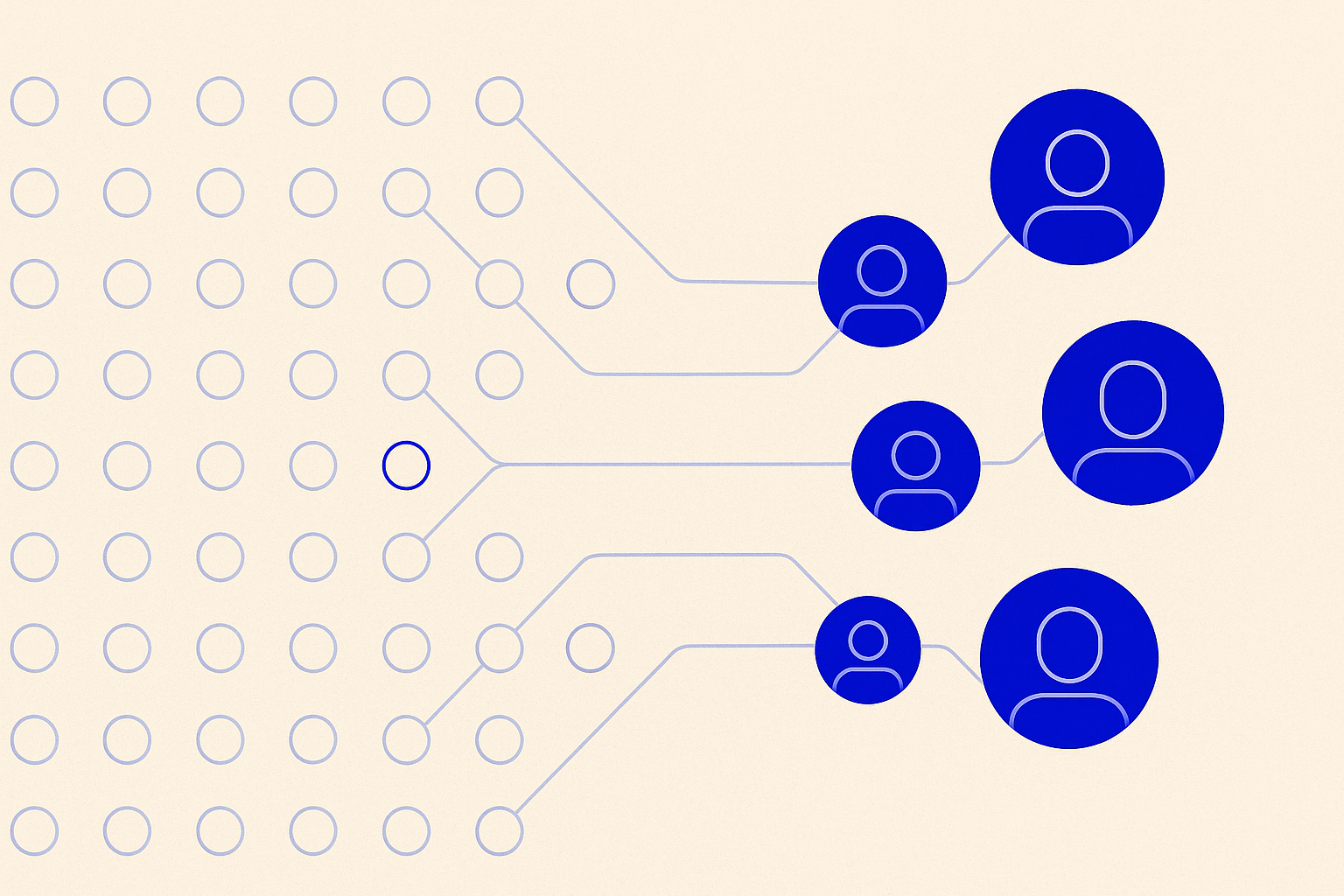

If you look at your analytics today, most of your revenue comes from people who didn’t convert on their first visit.
They arrive anonymously, view specific products, leave, come back through search or social, and only later sign up or purchase. The problem is that your systems treat each of those visits as separate events. By the time you know who the shopper is, you’ve already lost the context that explains why they’re buying.
An identity resolution solution fixes this by preserving intent across visits.
It tracks how the same person interacts with your site over time and links those interactions into one customer profile once an identifier appears. That means the products someone viewed anonymously, the categories they returned to, and the carts they abandoned don’t disappear when they finally share an email.
In this guide, we’ll walk through how identity resolution works at the visitor level, where most teams get it wrong, and how to implement it in a way that improves targeting, personalization, and conversion.
What is customer identity resolution?
Identity resolution is the process of connecting every interaction a shopper has with your brand into a single, continuous customer profile.
A visitor may land on your site anonymously, browse products, leave, return on another device, and only later share an email or phone number. Customer identity resolution links those actions together so you understand the full customer journey instead of viewing isolated events.
Why identity resolution is important
Customer identity resolution matters because buying intent builds over time. When you can connect anonymous activity to known customer records, you can act on real customer behavior.
Unifying customer data
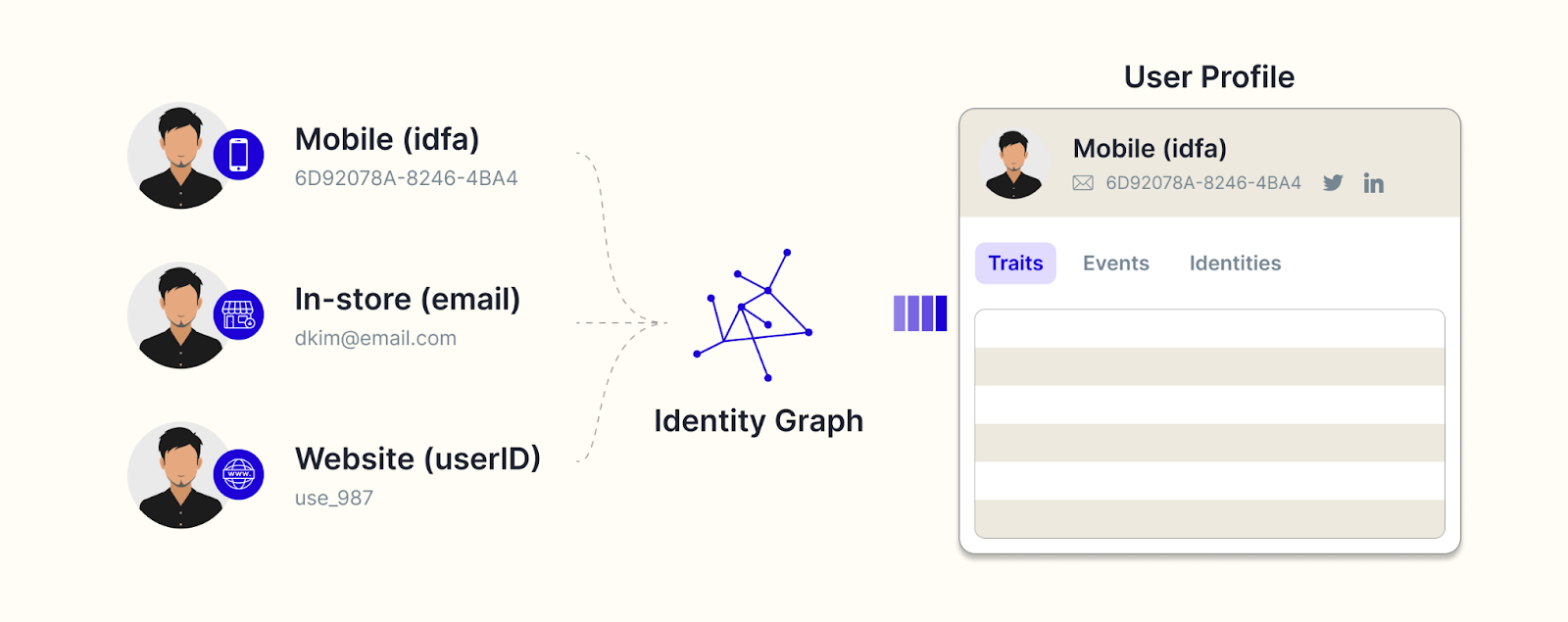
Identity resolution works by unifying customer data that already exists within your systems. This includes:
- Email addresses
- Phone numbers
- Device IDs
- IP address signals
- On-site events and browsing behavior
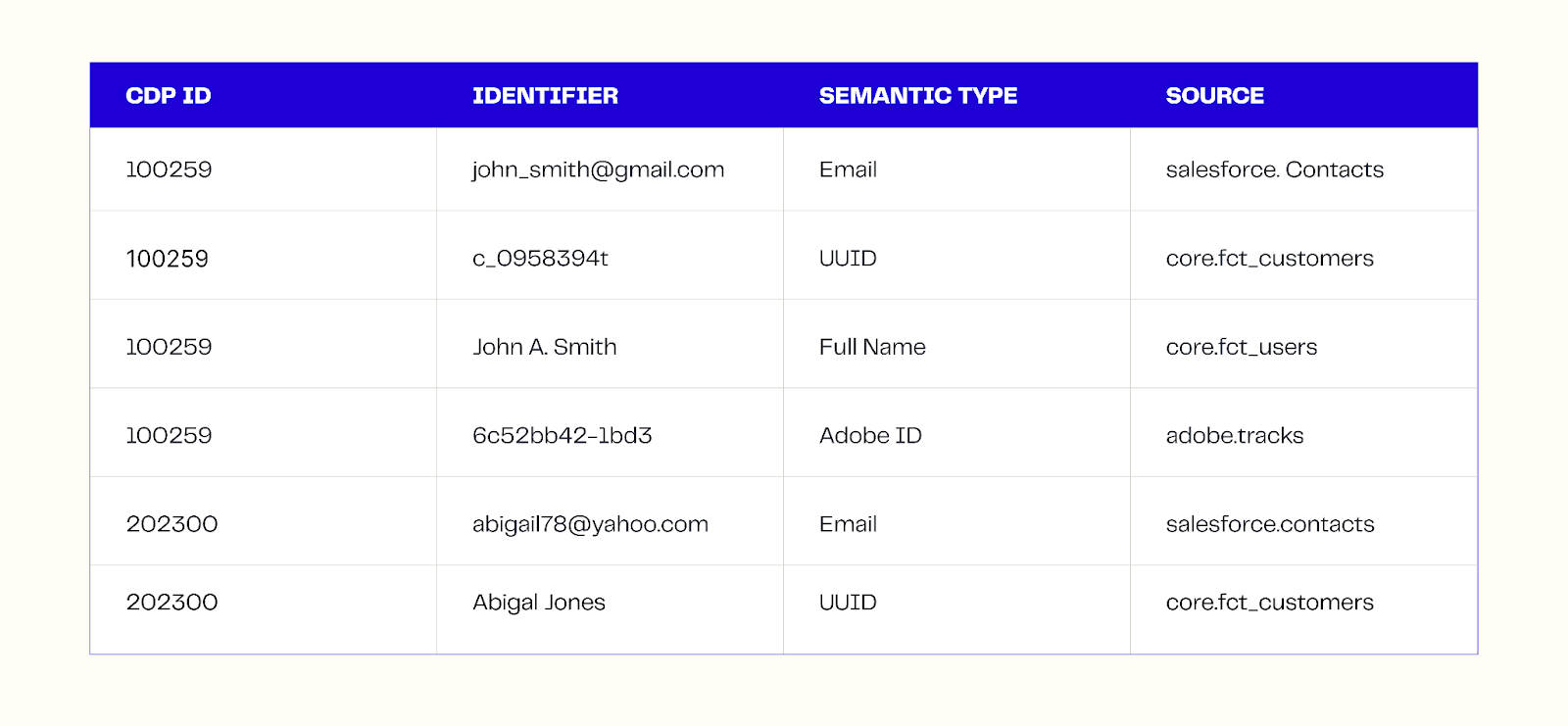
Each of these is an identifier. Individually, they explain very little. Together, they form a complete customer profile.
As a shopper moves across sessions and devices, identity resolution links these identifiers into one record. That record updates in real-time as new data points appear.
The outcome is a unified customer profile that reflects how someone actually interacts with your brand, not how your tools store data. This unified view gives you consistency across attribution, segmentation, and customer experience.
Identity graph
An identity graph is the infrastructure that powers identity resolution.
It’s a structured database that maps relationships between identifiers over time. When an anonymous visitor later becomes known, the identity graph connects their past activity to their confirmed profile.
Here’s how that would look:
- A visitor browses products using a device ID.
- Days later, they sign up with an email address.
- The identity graph links earlier browsing behavior to that email-based customer record.
This connection happens retroactively and continuously. You don’t lose product views, abandoned carts, or intent signals just because identification happened later.
The identity graph keeps customer records accurate, merged, and current as new identifiers appear. That’s what makes identity resolution reliable at scale and usable for real marketing actions, instead of just reporting.
“Many competitors falsely claim they are a graph without actually using a knowledge graph or AI to form connections between profiles. Our focus on building our graph on top of cutting-edge tools allows us to have the highest match rate in the world.”
Jonathan Kopnick, CTO at Tie
3 types of matching for website identity resolution
Identity resolution connects behavior across visits, so customer context doesn’t reset every time someone leaves your site. It works by capturing behavioral signals first, then resolving identity when reliable, consented identifiers become available.
You begin with anonymous traffic. As a visitor browses, views products, or adds items to the cart, those actions are recorded as session-level behavior. On their own, these sessions are not yet tied to a known person, but the intent is preserved.
When a visitor later shares a verified identifier, such as an email address, phone number, or account login, that earlier behavior doesn’t disappear. It attaches to the same profile and becomes immediately usable. This is how identity resolution turns fragmented sessions into a continuous customer journey instead of a series of disconnected visits.
Deterministic matching
Deterministic matching is the foundation of accurate identity resolution. It occurs when a visitor provides a verified, consented identifier.
When the same email address, phone number, or user ID appears across sessions or devices, the system can confidently recognize those interactions as belonging to the same person. No inference is required since identity is anchored on exact matches.
For example, a shopper may browse products anonymously on mobile, then later sign up with an email on desktop. Deterministic matching connects those sessions into one profile, preserving the full sequence of interactions instead of treating signup as the starting point.
This step establishes accuracy and stability. Once a deterministic identifier is present, future activity reliably accrues to the same profile.
Probabilistic matching
Before a visitor shares a direct identifier, identity systems can still preserve continuity at the session level.
Probabilistic methods evaluate whether multiple sessions are likely connected based on consistent signals such as device characteristics, IP patterns, and repeated behavioral activity.
This does not confirm identity, but it helps maintain intent and sequence while the visitor remains anonymous.
The role of probabilistic logic is limited and transitional. It keeps behavior connected early in the journey without asserting who the person is. When a deterministic identifier appears later, prior activity is validated and merged into the confirmed profile, ensuring historical behavior carries forward without compromising data quality.
Real-time data syncing
Identity resolution only works if profiles update the moment something meaningful happens.
With real-time syncing, customer profiles refresh the moment an identifiable action occurs, such as:
- Submitting an email in a form
- Starting checkout
- Logging into an account
- Clicking through from an email or ad
At that point, previously anonymous behavior (product views, carts, return visits) attaches instantly to the known profile. It does not wait in a batch job or sit in a reporting layer.
This real-time resolution is what makes identity usable for marketing. It allows browse, cart, and lifecycle workflows to trigger while intent still exists, rather than hours or days later when the opportunity has already passed.
Benefits of identity resolution for visitor identification
Identity resolution improves visitor identification by turning fragmented site activity into a continuous customer record you can act on.
When anonymous visits connect to known customer data, you stop working with partial signals. Instead of isolated sessions, you see how shoppers behave across visits, devices, and channels, and you can respond while intent is still active.
At a marketing level, this results in:
- Fewer returning visitors treated as “new”
- Cleaner customer profiles with fewer duplicates
- More accurate attribution across email, paid media, and lifecycle
- Segmentation based on real behavior, not assumptions
- Higher conversion rates from timely, relevant follow-ups
A complete customer view
Identity resolution gives you a complete customer view by linking activity that happens before identification with activity that happens after.
A shopper may browse products, compare categories, or abandon a cart while anonymous. When they later log in, sign up, or purchase, identity resolution connects that earlier behavior to their customer profile.
This gives you:
- Full visibility into the path to purchase
- Context behind each conversion, not just the final action
- A customer record that reflects how people actually move through your site
With this level of clarity, your reporting, segmentation, and lifecycle decisions align with real customer behavior instead of last-touch events.
Relevant personalization
Identity resolution allows personalization to respond to current intent, not stale segments.
When a known customer returns to your site anonymously, their behavior still maps back to their unified customer profile. You can see what they’re engaging with now and how it relates to their past actions.
This lets you:
- Trigger emails based on products viewed during anonymous sessions
- Adjust offers or messaging when a known customer shows renewed intent
- Continue conversations instead of restarting them
This is how personalization stays relevant. You respond to what the customer is doing, not just what they did last time.
Cross-device recognition
Identity resolution keeps the customer context intact as shoppers move across devices.
Many customers browse on mobile, compare on desktop, and complete purchases later. Identity resolution links these sessions to the same person, ensuring that their activity doesn’t split into separate records.
This allows teams to:
- Track intent across mobile and desktop without gaps
- Attribute conversions accurately across devices
- Maintain a consistent customer view regardless of how the visit happens
For ecommerce teams, cross-device recognition removes blind spots in the customer journey and keeps visitor identification accurate from first touch to purchase.
Why real-time visitor identification is the best solution
Real-time visitor identification solutions recognize and act on intent while it’s happening.
Instead of relying on delayed syncs or batch updates, these systems update customer profiles during the live session. That speed changes how you respond. You don’t react after the opportunity passes. You act while the visitor is still evaluating, comparing, and deciding.
This is where customer identity resolution moves from data collection to execution.
Immediate visibility into high-intent visits
High-intent visits lose value quickly if no one responds.
When a known visitor returns to your site and shows buying signals, real-time visitor identification solutions surface that activity immediately. The system recognizes the visitor, updates their customer profile, and makes that signal available to your tools without delay.
Use this to:
- Notify sales teams or trigger email flows when a known shopper returns to product pages
- Flag repeat visits from customers already in active deals
- Shorten response time when intent is strongest
Reaching out while the visitor is still evaluating keeps context fresh and intent high, which directly improves engagement and conversion.
On-site personalization during the session
Real-time identification also changes the browsing experience itself.
With real-time identity resolution, returning customers don’t experience your site as anonymous users. The moment they’re recognized, their customer profile informs the on-site experience.
This enables:
- Contextual messaging for returning customers
- Dynamic content based on past purchases or browsing behavior
- Continuity across visits instead of repeated “first-touch” experiences
With Tie, returning visitors can be recognized during the session itself. That allows brands to personalize on-site experiences (such as tailored product recommendations or contextual messaging) based on who the visitor is and what they’ve already shown interest in.
The result is a site experience that responds in real time, not one that resets every visit.
How to implement an identity resolution solution
Implementing an identity resolution tool is about fixing how customer data moves through your business.
You’re solving a core problem: fragmented customer interactions spread across tools, devices, and sessions.
Browsing lives in analytics, conversions live in Shopify, engagement lives in the ESP, and paid media only sees part of the picture. Identity resolution closes those gaps by collapsing these interactions into a single, usable customer record that marketing teams can actually act on.
This section breaks down how to implement identity resolution in a way that drives outcomes, not just insight.
Data integration
Start by consolidating your existing data sources into one operational layer. Most brands already collect large amounts of first-party data through:
- CRM systems
- Email marketing platforms
- Website and app events
- Paid media and ad platform interactions
- Analytics and conversion tracking
- Offline or in-store data (where applicable)
An identity resolution solution is effective when it connects these different data formats and datasets into one persistent customer profile and keeps that profile updated as activity happens, not hours or days later.
Some teams route this through a CDP, while others integrate directly with an identity graph. Either approach is fine as long as one rule holds: customer identity must stay consistent across tools and update in real time.
At this stage, governance matters. You should define how PII is handled, where consent applies, and how data flows downstream. Identity resolution only compounds if it’s compliant from day one, including alignment with GDPR, CCPA, and regional privacy requirements.
Choose a provider
Once data flow is clear, choosing the right identity resolution platform becomes easier.
For ecommerce and DTC teams, Tie is designed around effective identity resolution at the person level. It connects anonymous website activity to known profiles and enriches them with attributes that most brands can’t capture through first-party data alone.
In practice, teams use Tie to:
- Identify high-intent visitors who never filled out a form.
- Reactivate profiles that re-engage after long gaps.
- Enrich profiles with verified attributes that strengthen segmentation and targeting.
- Push resolved identities directly into tools like Klaviyo, Meta, and Google Ads in real time.
That real-time sync is critical. If identity sits in a dashboard instead of entering flows, retargeting, or lifecycle programs, it decays before it creates value.
Tie also integrates directly with platforms like Klaviyo, Meta, and Google Ads. Once a visitor is identified, their enriched profile flows into your marketing tools in real time, supporting omnichannel marketing efforts without manual syncing.
Some enterprise teams also evaluate platforms like LiveRamp or Neustar. These are commonly used in large-scale data environments, clean room setups, and enterprise advertising workflows.
Regardless of platform, your evaluation should focus on three aspects:
- How much previously unreachable traffic becomes identifiable
- How consent and compliance are handled across regions
- How quickly identity translates into activation inside your existing stack
If identification doesn’t translate into activation quickly, the solution won’t deliver results.
Test & measure
Identity resolution should be validated end-to-end, not by match rate alone.
Start by measuring how much anonymous traffic becomes identifiable. Then track how those profiles actually perform once they enter email, paid media, and lifecycle flows, based on conversions, revenue, and lift, not just match rate.
Key metrics to monitor include:
- Percentage of anonymous visitors identified
- Number of enriched profiles entering your CRM
- Impact on conversion rates, retention, and customer engagement
- Lift in performance across email, paid media, and lifecycle flows
For example, Cozy Earth, a premium home goods brand, struggled to activate high-intent visitors because most site traffic remained anonymous. This limited both retargeting and recovery flows.
After implementing Tie, they identified 62% of anonymous traffic, enriched each profile with additional attributes, and synced those profiles directly into Klaviyo and their ad platforms. With accurate identity data in place, they launched three focused flows and achieved a 15× ROI tied directly to resolved identities.

Ready to turn anonymous traffic into real customer insight?
Identity resolution closes the gap between traffic and revenue.
When you connect sessions, devices, and identifiers into a single customer profile, you stop losing context. You get to see how shoppers move across your site, how intent builds, and how customer interactions connect before and after identification. That’s what gives you a comprehensive view you can actually act on.
With a strong identity graph in place, your marketing efforts become sharper:
- Segments reflect real behavior.
- Email marketing triggers at the right time.
- Personalized experiences stay consistent across channels.
- Your marketing strategies work from a single source of truth instead of fragmented data.
Tie’s identity resolution platform matches a large share of anonymous visitors and enriches customer profiles with hundreds of verified demographic, behavioral, and intent attributes. This gives you high-quality customer insights you can use across email, paid media, and retention workflows, even when shoppers never filled out a form or logged in.
The result is simple. You identify more visitors, act with better timing, and capture revenue that disconnected data kept out of reach.
Want to see how identity resolution fits into your stack and what it can unlock for your business? Book a demo with Tie.