What Breaks Between Acquisition and Retention as Ecommerce Scales


There’s a point where ecommerce growth starts to feel different.
Revenue continues to grow, but it becomes harder to sustain. Retention doesn’t compound the way it once did. Teams stay busy and dashboards look reasonable, but the business feels more fragile than it should.
Zac Fromson has seen this pattern repeatedly. As co-founder at Lilo Social, he works with ecommerce brands as they move from early traction into paid media–led scale. The issue he sees most often is a growing disconnect between acquisition and retention as the business gets larger.
That changes once paid media becomes the primary growth channel.
As scale increases, teams optimize harder. Acquisition focuses on efficiency and volume. Retention focuses on repeat behavior and long-term value. Each function performs well on its own terms, but they’re no longer building toward the same customer outcome.
This is where growth starts to strain. In this piece, Zac breaks down where acquisition and retention drift apart as brands scale, why it happens so often, and what needs to change before growth can hold.
TL;DR: what actually breaks (and how to spot it)
- Acquisition and retention optimise for different customers: Customer acquisition costs (CAC) and volume look good, but LTV and margin quietly weaken..
- Efficiency pressure changes who you scale: Broader audiences and heavier promos bring in customers who don’t stick.
- Context drops after conversion: Retention loses sight of why the customer bought in the first place.
- Dashboards stay green while the business degrades: Local channel wins mask cohort-level decline.
- Teams fix symptoms: More flows and tools add complexity without restoring alignment.
The core break: acquisition and retention stop optimizing for the same customer
Zac Fromson has found that the breakdown doesn’t start with bad execution. It starts with how success gets defined.
“The disconnect usually starts when acquisition and retention are measured, and rewarded, on entirely different definitions of success.”
In most teams, those definitions diverge quickly:
- Acquisition optimizes for CAC, MER, and volume.
- Retention optimizes for LTV, repeat rate, and contribution margin.
Each set of metrics makes sense on its own. Together, they describe different customers. That’s where the system starts working against itself.
Separate scorecards push teams to win locally. Acquisition gets rewarded for cheaper traffic and higher volume. Retention absorbs the downside when those customers don’t return, rely on promotions, or never increase their value.
Over time, this creates a clear failure pattern. The business keeps scaling, but the customers coming in aren’t built to grow with it.
When efficiency-driven scale starts degrading cohorts
Zac Fromson sees the same pattern show up as brands move past early traction.
“This typically happens once brands push past early scale and begin optimizing aggressively for efficiency, often around the point where paid media becomes the primary growth engine.”
At that stage, your job changes. You’re no longer proving demand; you’re protecting efficiency. And that pressure reshapes acquisition decisions in ways that aren’t immediately obvious.
To keep CAC and MER within range, teams start to:
- Expand audiences faster than they can validate quality.
- Lean more heavily on promotions to maintain volume.
- Accept lower-intent traffic because it still converts on the first order.
None of this breaks performance overnight. In many cases, results actually look better in the short term. What breaks instead is cohort quality, which breaks quietly.
The customers acquired during this phase don’t disappear. They buy once and enter your lifecycle flows, but they behave differently from earlier cohorts. They repurchase less often, wait longer between orders, and contribute less margin over time.
You don’t see the damage immediately because retention doesn’t collapse all at once. It reveals itself weeks or months later, when those customers simply don’t come back.
By then, it’s easy to misdiagnose the problem. Teams tweak flows, add incentives, or question the retention strategy altogether. But the issue didn’t start there, and fixing retention alone won’t solve it.
The hidden failure: Acquisition context dies after conversion
As brands scale, Zac Fromson consistently sees the same issue emerge: acquisition context disappears the moment a customer converts.
“Most brands lose acquisition context the moment a customer converts.”
In practice, this means the reason behind the purchase rarely makes it past the checkout. The message that resonated, the objection that was resolved, the promise that closed the sale—all of it lives inside acquisition systems. Once the order is placed, that context is no longer available in a form that retention teams can actually use.
This creates a quiet but costly gap. Retention teams are responsible for building the post-purchase relationship, yet they don’t have visibility into what motivated the customer in the first place. Without that context, lifecycle messaging defaults to generic education, broad product recommendations, and one-size-fits-all follow-ups.
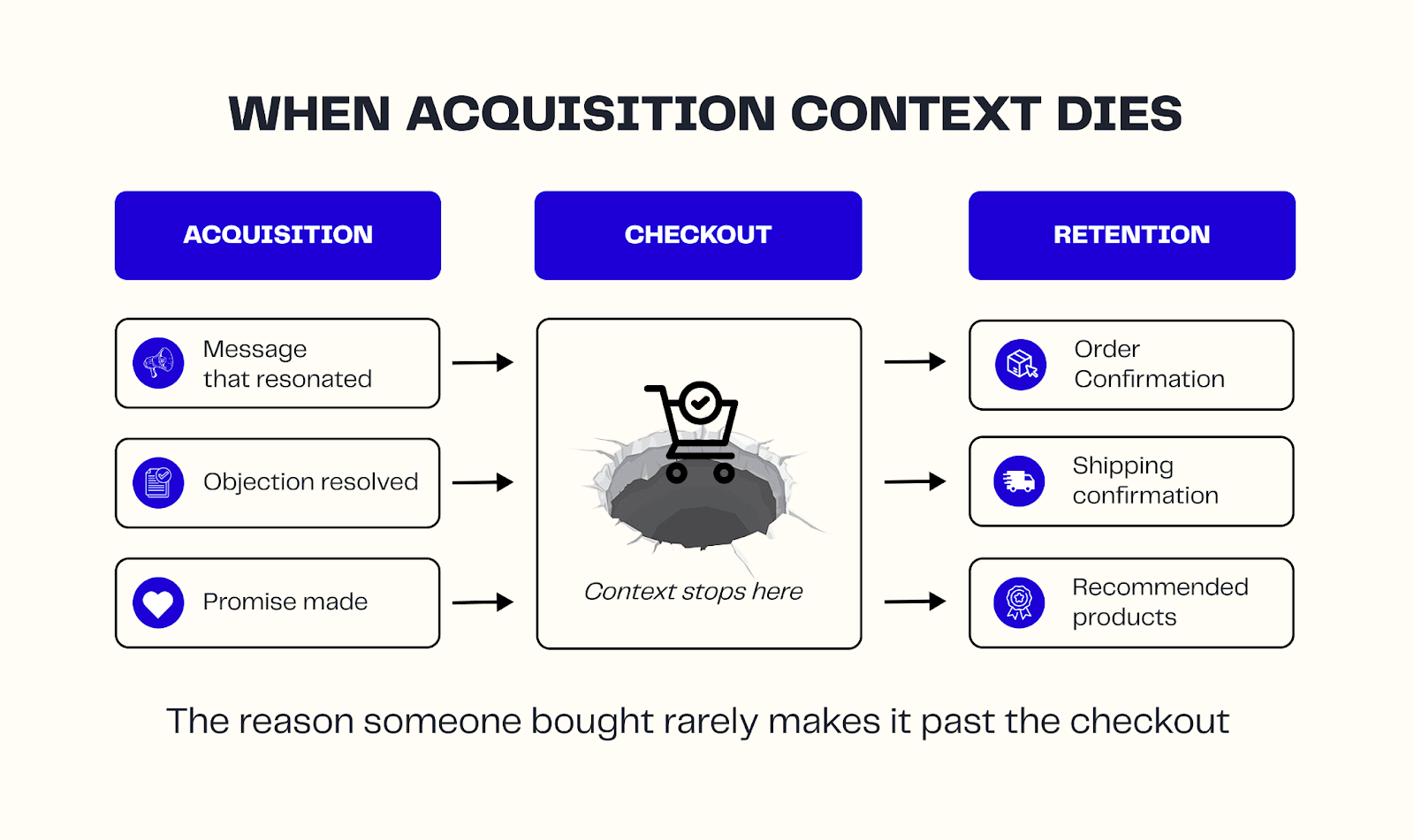
Over time, customers feel the disconnect. The communication no longer reinforces the decision they just made. Instead of extending the narrative that brought them in, post-purchase messaging starts a parallel one— loosely related to the brand but detached from the moment of intent that drove the conversion in the first place.
What this misalignment looks like in real performance
Once acquisition and retention drift apart, the damage doesn’t show up where most teams expect. According to Fromson, there’s rarely an immediate performance drop. Instead, a pattern emerges gradually.
“You’ll see strong blended ROAS paired with declining repeat purchase rates, increased promo dependency, and shrinking contribution margins.”
Early on, everything still appears healthy. Paid media continues to hit efficiency targets. Lifecycle channels keep contributing revenue. Each team can justify its performance in isolation.
What changes is how the business behaves over time:
- Repeat purchases slow down.
- Discounts start doing more of the work.
- Contribution margins tighten.
These shifts happen across cohorts and over weeks or months. There’s no single moment where performance breaks. Instead, the system quietly weakens.
This is what misalignment looks like in practice. Channels perform well independently while the business erodes underneath. When no one owns the customer across the full lifecycle, performance fragments without a clear failure point to react to.
Why most brands try to fix the wrong thing
As those signals accumulate, Fromson sees brands rush to fix whatever feels most immediately broken.
“The mistake is trying to automate around a broken system instead of fixing incentives, ownership, and shared definitions of success.”
The response usually focuses on activity: Teams add more flows, more logic, and more tools to compensate for declining outcomes. Each change makes sense on its own because it addresses a visible symptom: lower engagement, slower repeat purchases, or rising promo dependence.
What it doesn’t address is the structure underneath.
Fromson draws a clear distinction here. Problems within a channel can be solved with better execution. Problems between channels, however, require alignment. When acquisition and retention optimise toward different outcomes, automation doesn’t close the gap. It amplifies it.
What actually changes retention outcomes
Fromson is clear on one thing: retention doesn’t improve because you tweak flows later. They improve when acquisition and retention start making decisions from the same starting point.
“The teams that win focus on shared inputs, not just shared outputs.”
That shift changes what teams pay attention to before a customer converts, not just how they react afterward.
Once that alignment is in place, retention stops being a downstream clean-up job and starts behaving like a compounding system. Only then do tactical improvements actually matter.
Here are some ways to actually change retention outcomes:
1. Align on what a high-value customer actually means
Fromson doesn’t see this as a branding or persona exercise. He sees it as an operating agreement between teams. High-value customers are defined using signals that both sides can measure and influence:
- First-order margin, not just revenue
- Product or SKU mix on the first purchase
- Discount reliance at conversion
- Time to second order
- Early engagement behavior
2. Feed acquisition signals into retention workflows
Fromson consistently sees better retention performance when lifecycle teams understand how the customer entered the system.
At a minimum, retention should know:
- Where the customer came from
- What message or creative angle converted them
- What offer they responded to
- Which product they bought first
3. Treat creative and expectation-setting as retention levers
Fromson often points out that retention inherits expectations that acquisition sets.
“Audience strategy, offer structure, and creative framing have outsized downstream impact.”
If acquisition relies heavily on discounts or vague promises, retention inherits price-sensitive or uncertain customers.
When creative is specific, product-led, and honest about value, retention starts with clarity and intent, giving lifecycle programs something solid to build on instead of having to re-educate or correct expectations.
4. Optimize acquisition for first-order quality
Fromson sees one shift make a disproportionate difference— optimizing for first-order quality.
“One of the most impactful shifts we see is acquisition teams optimizing toward first-order quality, not just efficiency.”
In practice, this often means:
- Narrower, more intentional audiences
- Fewer blanket promotions that pull in price-sensitive buyers
- Clearer, product-led positioning that sets expectations early
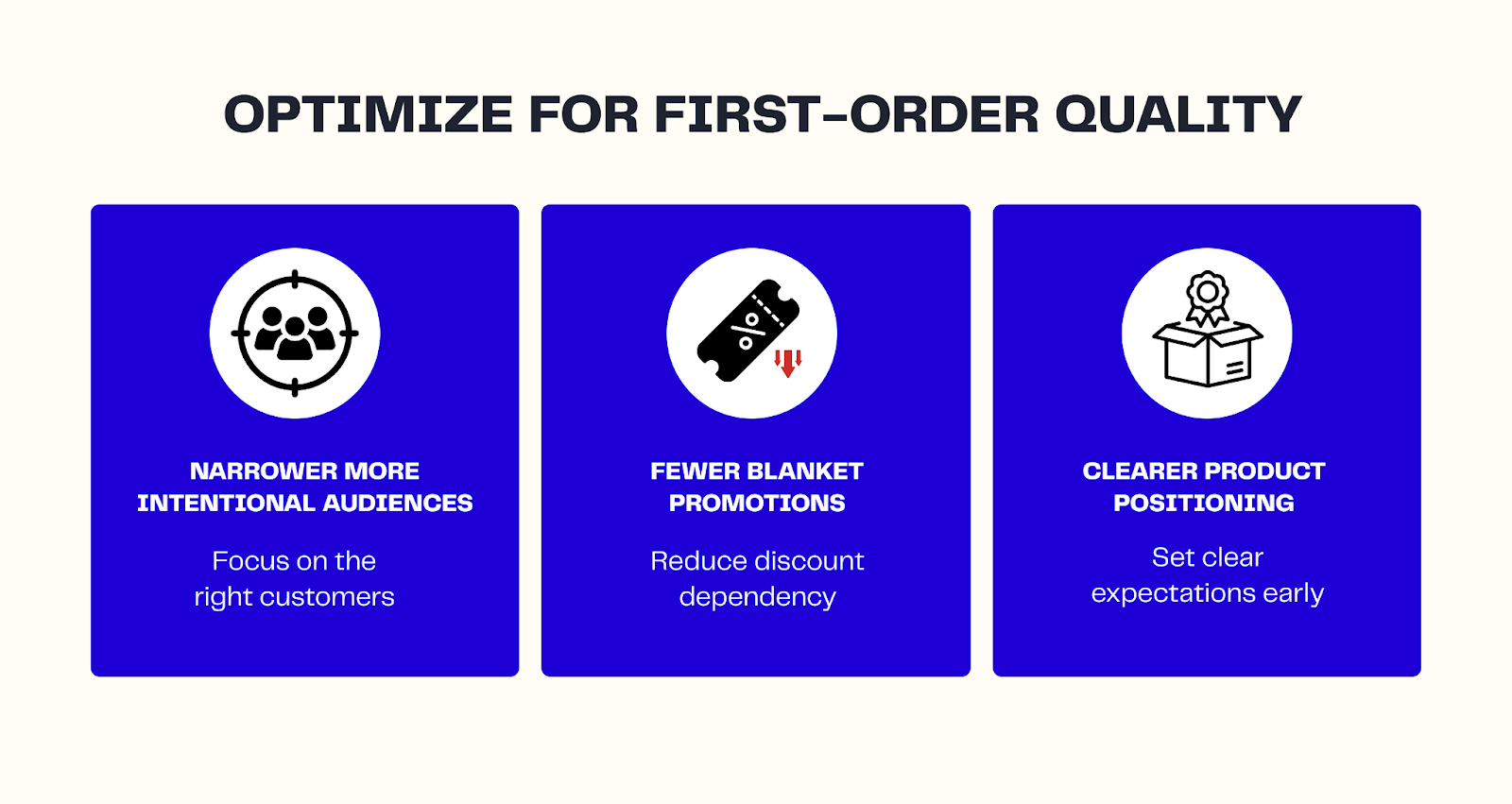
When acquisition prioritizes who converts, not just how cheaply they convert, retention inherits stronger cohorts. Repeat behavior improves, discount dependency decreases, and lifecycle programs gain real momentum to build on, rather than compensating for weak initial purchases.
5. Make decisions at the cohort level
Fromson closes the loop by changing how performance is reviewed.
“Evaluate decisions at the cohort level, not the channel level.”
Channel metrics show how traffic converts. Cohorts show whether growth compounds. Teams that align around cohort behavior track repeat rates, time between orders, and margin contribution across groups of customers.
That shift reframes how success gets measured. Instead of optimising for isolated channel wins, teams make decisions based on whether the customers they’re acquiring can actually be grown over time.
Where to start if you want to make one fix
Fromson’s advice is simple: don’t start by changing tools, flows, or tactics. Start by fixing alignment.
If acquisition and retention don’t agree on what a high-value customer looks like, every optimisation downstream works against itself. If you add flows, increase complexity, and chase marginal gains without building customers, the business can actually grow.
The teams that see retention compound do one thing first. They align on shared inputs, carry context across the funnel, and evaluate success at the cohort level.
Once that’s in place, execution starts to work. To act on that alignment, you need clean, connected customer data. Acquisition signals can’t disappear after checkout. Retention needs access to insights on how and why a customer converted.
That’s where Tie comes in. Tie identifies anonymous visitors, enriches customer profiles with real behavioural context, and syncs that data into your ESP so that your retention strategy can build on what has already worked.
If retention is a priority this quarter, start by fixing the foundation.
Book a demo to see how Tie can help your team align acquisition and retention around shared customer signals.