Limitations of Visitor Identification Software (What Vendors Skip)


Many brands see a common problem with their on-site traffic. They pay to drive visitors to their site, and their analytics show intent on product and cart pages, but most sessions still end without a signup, login, or purchase.
Once these visitors are gone, brands struggle to reconnect their next visit to the first one, and every session starts from scratch.
Visitor identification tools promise to fix this by revealing who those shoppers are and creating continuity across visits.
However, once the tool is live, things start becoming clear:
- Some visitors resolve cleanly into identifiable profiles. Others remain anonymous despite clear intent.
- Match rates fluctuate depending on device, geography,traffic source and vendor.
- US traffic resolves more consistently than EU traffic.
- Not every identified visitor behaves like a real buyer once they enter your CRM or lifecycle flows.
- Some resolved visitors would have been surfaced by your existing marketing tools anyway (via checkout, forms, or logins), while others are genuinely net-new.
This is where differences between visitor identification platforms start to matter. Many tools inflate match rates by surfacing visitors that your stack would have captured regardless. The real measure of value is how many net-new, previously unreachable visitors you can identify and whether those profiles translate into meaningful lifecycle engagement.
That distinction is what separates raw coverage from usable identity.
Google Analytics vs visitor identification tools
If you’re comparing Google Analytics with visitor identification tools, the mistake most teams make is treating them as competing products. They solve different problems, and confusing those roles is why a lot of traffic never turns into revenue.
This section breaks down Google Analytics vs visitor tracking tools in a way that actually matches how modern teams work.
How Google Analytics fits into traffic analysis
Google Analytics gives you a structured view of website activity. It aggregates sessions, pageviews, events, and conversions so you can see where traffic comes from and how visitors move across the site.
Rely on Google Analytics to:
- Track website traffic volume and trends.
- Attribute performance to channels and campaigns.
- Understand funnel progression and drop-offs.
- Evaluate experiments and optimization efforts.
Over time, this builds a strong understanding of where engagement concentrates and where friction exists.
The structural limitation you can’t work around
Google Analytics works on aggregated and anonymized data. Even when you configure GA4 deeply, you still operate at the level of sessions, devices, and modeled users.
As a result:
- You can’t connect web behavior to real contact information
- You can’t see which companies or decision-makers are visiting key pages
- You can’t route high-intent activity directly into CRM or outreach workflows
- You can’t trigger real-time follow-up based on individual visitor behavior
This creates a gap between insight and action. You see intent signals, but they stay anonymous and aggregated within dashboards.
You can see that a PDP view or cart addition indicates buying intent. But that insight stays within the dashboard. You can’t push it into a CRM, trigger a real-time follow-up, suppress ads, or route the visitor into lifecycle flows while intent is still active.
This is where insight stops short of execution.
Where visitor identification tools fit in the stack
Visitor identification tools sit downstream of analytics. They don’t replace reporting; they operationalize it. Their role is to:
- Turn anonymous website visitors into identifiable people
- Match sessions to company-level or person-level records
- Enrich visitor data with firmographic, demographic, or contact information
- Push high-intent activity into CRM systems in real time
- Consolidate multiple sessions and web activity to same individuals
This is what allows marketing and sales teams to act while intent is still fresh, not weeks later during a report review.
Privacy considerations teams have to work within
Visitor identification tools operate closer to identity and revenue, which introduces constraints:
- Identification depends on available signals
- Coverage varies by geography under GDPR and similar privacy laws
- Accuracy depends on how the data is sourced and verified
Used responsibly, these tools balance activation with data protection. Used poorly, they create compliance and data quality risks. That’s why implementation discipline matters more than raw match rate claims.
Tools like Tie operate within these boundaries by using consented, deterministic signals and verified identity sources, limited to US consumers and compliant with applicable regional regulations as data moves through the stack.
Key limitations of most visitor identification tools
Visitor identification creates leverage only when you understand where it naturally tapers off. Most problems don’t come from “bad tools.” They come from teams expecting identity resolution to behave like analytics or attribution software when it doesn’t.
Here are the constraints you run into once data starts flowing into your stack.
Identification coverage depends on consented data sources, not traffic volume
You can’t identify traffic just because it exists.
Across most visitor identification providers, only 15–25% of total sessions resolve into usable identities that a marketing team can follow up with. The ceiling is set by signal availability, not tooling. First-time visitors, mobile traffic, international users, and privacy-restricted sessions reduce match rates fast.
Tie reveals and enriches more anonymous visitors by leveraging a large, consented network and prioritizing deterministic signals over probabilistic inference. This allows profiles to be enriched with names, contact details, and demographics while maintaining high accuracy.
That’s why brands typically see 90%+ resolution on returning visitors, which often translates to 50–60% of total sessions in mature DTC stacks.
However, unresolved traffic remains unchanged. If consent or signal depth isn’t present, identity resolution can’t force a match.
Identity without activation stalls revenue
Many tools technically reveal visitor identities but fail at the next step.
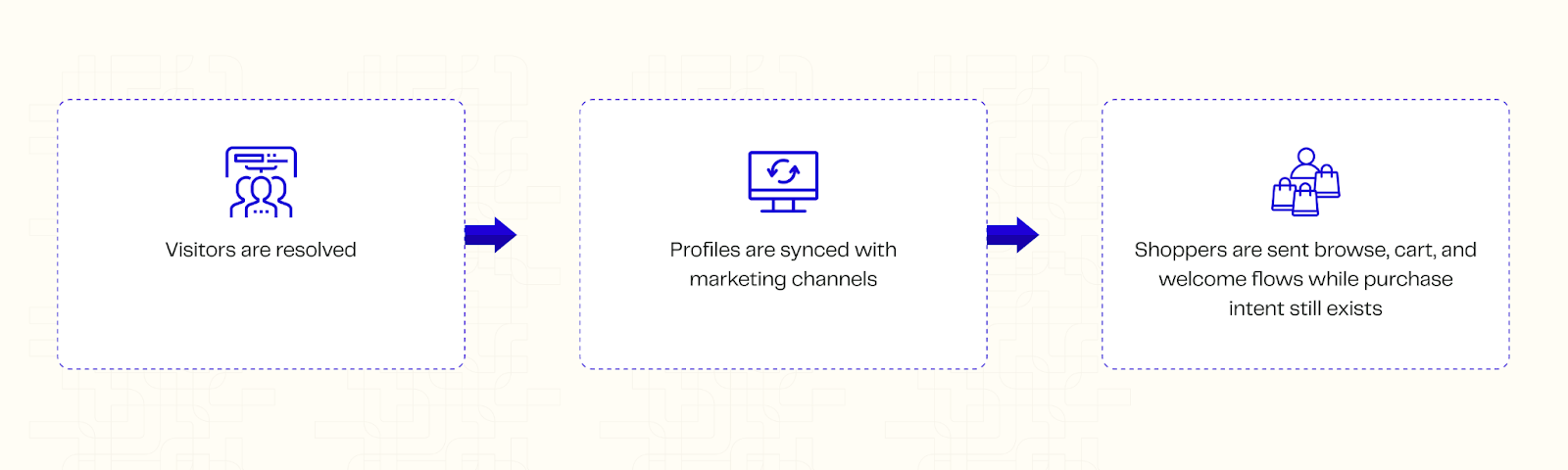
If identity data doesn’t enter Klaviyo, paid media, or lifecycle flows immediately, it decays. A resolved session that sits in a dashboard for days doesn’t recover carts or improve retargeting.
Tie is designed around this constraint. It resolves visitors in real-time and pushes profiles directly into Klaviyo, Attentive, Meta CAPI, and Google Ads. That’s how identity becomes usable by triggering browse, cart, and welcome flows while purchase intent still exists.
Company-level matches don’t solve ecommerce problems
A large category of visitor identification tools stops at company-level data. That’s useful for B2B sales, but it doesn’t work for ecommerce.
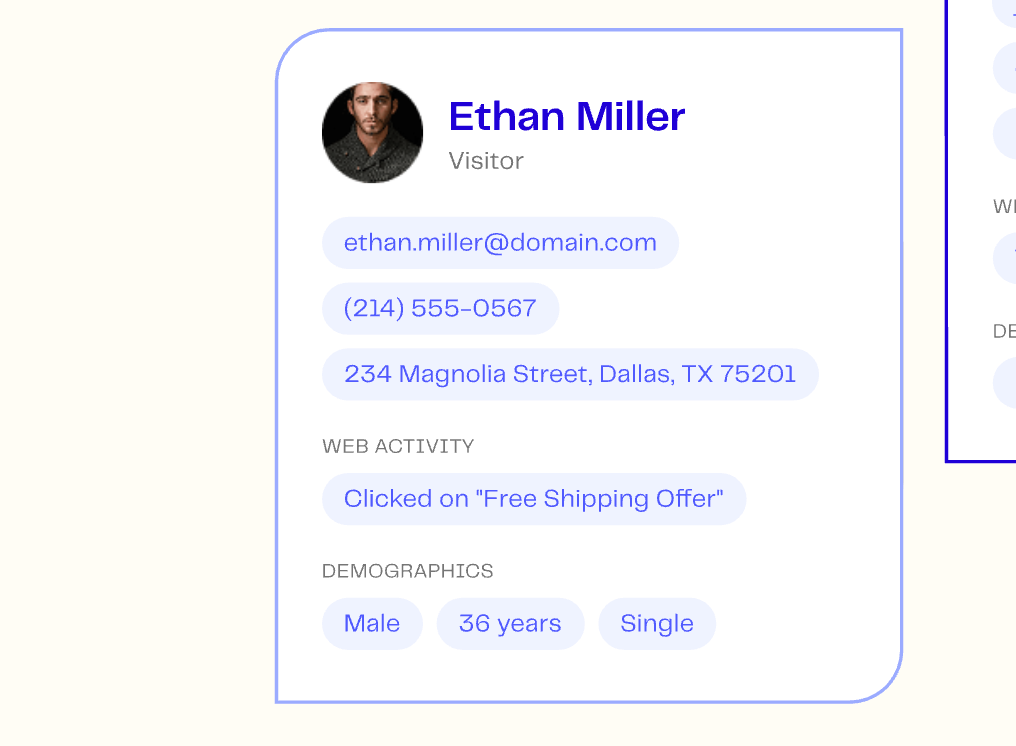
Recovering a cart, suppressing ads, or personalizing a PDP requires person-level profiles with email address, device context, geography, and intent signals tied to an individual shopper.
Tie is built specifically for consumer traffic. It resolves person-level identities and enriches them with attributes like ZIP code, device type, income band, and session behavior. That data feeds directly into lifecycle automation, not outbound prospecting.
Accuracy drops when signals overlap
Real traffic introduces ambiguity. Shared IPs, mobile carriers, VPNs, and households blur identity boundaries. When tools rely too heavily on IP lookup or loose probabilistic matching, two issues surface:
- Incorrect profiles enter your CRM.
- High-intent sessions fail to resolve cleanly.
Tie reduces this by enforcing confidence thresholds and filtering before identities sync into your stack. This keeps flows clean and avoids introducing polluted audiences to your data, especially when you’re running automated outreach at scale.
Data privacy rules shape what you can legally retain
GDPR and CCPA don’t just affect compliance checklists. They directly limit which identity data you can surface and store.
Tools that scrape or stretch consent often show higher raw match counts early, but then lose reliability once platforms tighten enforcement. Suppressed traffic, retroactive removals, and blocked campaigns follow.
Tie operates on a dual opt-in identity framework focused on US consumer traffic, matching on-site consented behavior with verified, opted-in third-party sources. While this reduces coverage in regions like the EU, it keeps identity durable and compliant, preventing downstream campaign and attribution issues.
Cost inflates when quality isn’t controlled
Visitor identification pricing usually scales with volume. Revenue doesn’t.
Costs compound without return when identified visitors aren’t filtered by intent—when low-quality traffic enters lifecycle flows, pollutes paid media audiences, or inflates identity counts without driving attributable orders.
This is where configuration matters. Tie lets teams control who gets identified and where those profiles flow, using filters based on on-site behavior, intent signals, demographics, and engagement thresholds. High-intent visitors can be routed into cart or browse recovery, while low-signal traffic is excluded entirely or kept out of paid audiences.
This control is why brands like G.O.A.T. Foods switched to Tie. After replacing Retention.com, they resolved 2.5 million anonymous visitors, generated 10,140 new orders, and tracked $596,383 in verified incremental revenue.
When to use visitor identification tools (and when not to)
Visitor identification isn’t a switch you flip across your site. It works best when it’s applied during moments where identity changes the outcome.
Most ecommerce teams already have enough data. What they lack is timing.
Don’t rely on it for all insights
Visitor identification doesn’t replace analytics. It builds on top of it.
You still need GA4 reporting to:
- Track website traffic trends over time
- Understand channel performance and funnel health
- Identify where visitors hesitate or drop off
- Spot pages and events that signal buying intent
This context tells you which actions signal intent and which ones are just casual browsing.
Once those patterns are clear, visitor identification starts to make sense. Pricing page views, repeat product views, high-value carts, and return sessions are situations where identity changes what you do next.
At that point, knowing who’s behind the activity lets you trigger flows, adjust retargeting, and prioritize follow-up while interest is still high.
Problems usually start when teams try to identify every session. That approach pulls low-intent visitors into workflows, clutters CRM data, and weakens results.
Consider privacy-friendly alternatives
Visitor identification should not be your only path to uncovering traffic.
Strong first-party data reduces dependence on external signals and improves long-term reliability. That includes:
- Account creation or login programs
- Email and SMS signups tied to clear value
- Preference centers that deepen profile quality over time
These methods identify visitors with explicit intent and consent, and they compound in value as your audience grows.
Tie is designed to work alongside this approach, not replace it. It resolves high-intent visitors who haven’t yet logged in or signed up, using consented, deterministic signals. Once those visitors enter your stack, first-party mechanisms take over—profiles deepen, engagement history builds, and reliance on identity resolution naturally tapers for repeat shoppers.
Visitor identification helps you bridge the gap before first-party relationships exist. It’s most effective when paired with systems that eventually make identification unnecessary.
Ready to turn anonymous traffic into usable customer data?
Visitor identification works when it connects website visitor tracking to clear intent data. Instead of losing high-interest sessions, you can carry context forward across visits and channels.
Used correctly, website visitor identification improves conversion rates by turning anonymous behavior into signals your marketing teams can act on.
- Real-time alerts surface buying intent as it happens.
- Clean data collection and data enrichment feed directly into your CRM, analytics tools, and lifecycle workflows.
- Metrics become clearer because sessions no longer reset every time a shopper returns.
Website visitor identification software like Tie combines AI-powered visitor tracking, real-time APIs, and consent-first data enrichment to help you identify high-intent visitors and act while interest is still fresh.
Instead of relying on IP addresses, bots, or surface-level lead forensics, you get reliable intent data that supports lead generation, lead scoring, and activation across your stack.
Want to see how Tie fits into your website visitor tracking and improves conversion rates with clean, compliant data? Book a demo to see it in action.