Consumer data changes faster than ever. Privacy rules like GDPR and CCPA limit third-party data, while emails, phone numbers, and devices expire in months, not years. To keep up, brands need real-time enrichment and hygiene.
Enrichment fills in missing attributes (demographic, behavioral, lifestyle) while hygiene ensures data accuracy by removing duplicates and outdated records. One without the other falls flat.
Yet most guides about enrichment focus on B2B, strategizing data collection around company size, job titles, and firmographics. That’s not what ecommerce brands need to predict churn, drive repeat purchases, or power customer lifecycle marketing strategies.
This guide bridges that gap, showing how B2C enrichment powers personalization, ROI, and lifecycle campaigns.
Tie was built for exactly this: connecting verified identifiers with live behavioral signals so your database stays clean, complete, and conversion-ready. That means you recognize visitors earlier, segment smarter, and target only high-quality customer profiles, without letting decay diminish your ROI.
What makes B2C data enrichment different from B2B
Most enrichment advice you’ll find is B2B-centric. It focuses on company size, revenue, or job titles. But B2C data works differently, and treating it the same way leads to wasted spend and irrelevant marketing campaigns.
Here’s what sets it apart:
1. Consumer data decays faster
You’re not dealing with company addresses that stay stable for years. Consumers switch emails, phone numbers, and devices constantly. On average, 20-30% of consumer records decay within a year.
If you’re not running frequent enrichment cycles, you’re working with expired datasets and losing revenue every week.
2. Personalization is the end goal, not lead scoring
In B2B, enrichment helps qualify a lead for sales. In B2C, enrichment directly drives personalization, which products you recommend, what promotions you trigger, and when you reach out.
If those attributes are wrong or missing, your campaigns land flat. Accurate enrichment directly translates into higher CTRs and conversion rates.
3. Lifecycle and behavior matter more than static attributes
A consumer’s value isn’t fixed. A “repeat buyer” behaves very differently from a “first-time visitor” or a “lapsed customer”.
B2C enrichment has to capture behavioral shifts, purchase recency, browsing frequency, and average spend, syncing them back into your CRM quickly enough to act on them. Without this, your flows run on outdated assumptions.
4. Compliance is non-negotiable
Consumer data is heavily regulated. GDPR and CCPA require consent for any attribute you append. Unlike B2B, you can’t lean on scraped databases or shady co-ops, since it risks fines and brand damage.
Your enrichment partner must show exactly how every attribute is sourced and verified.
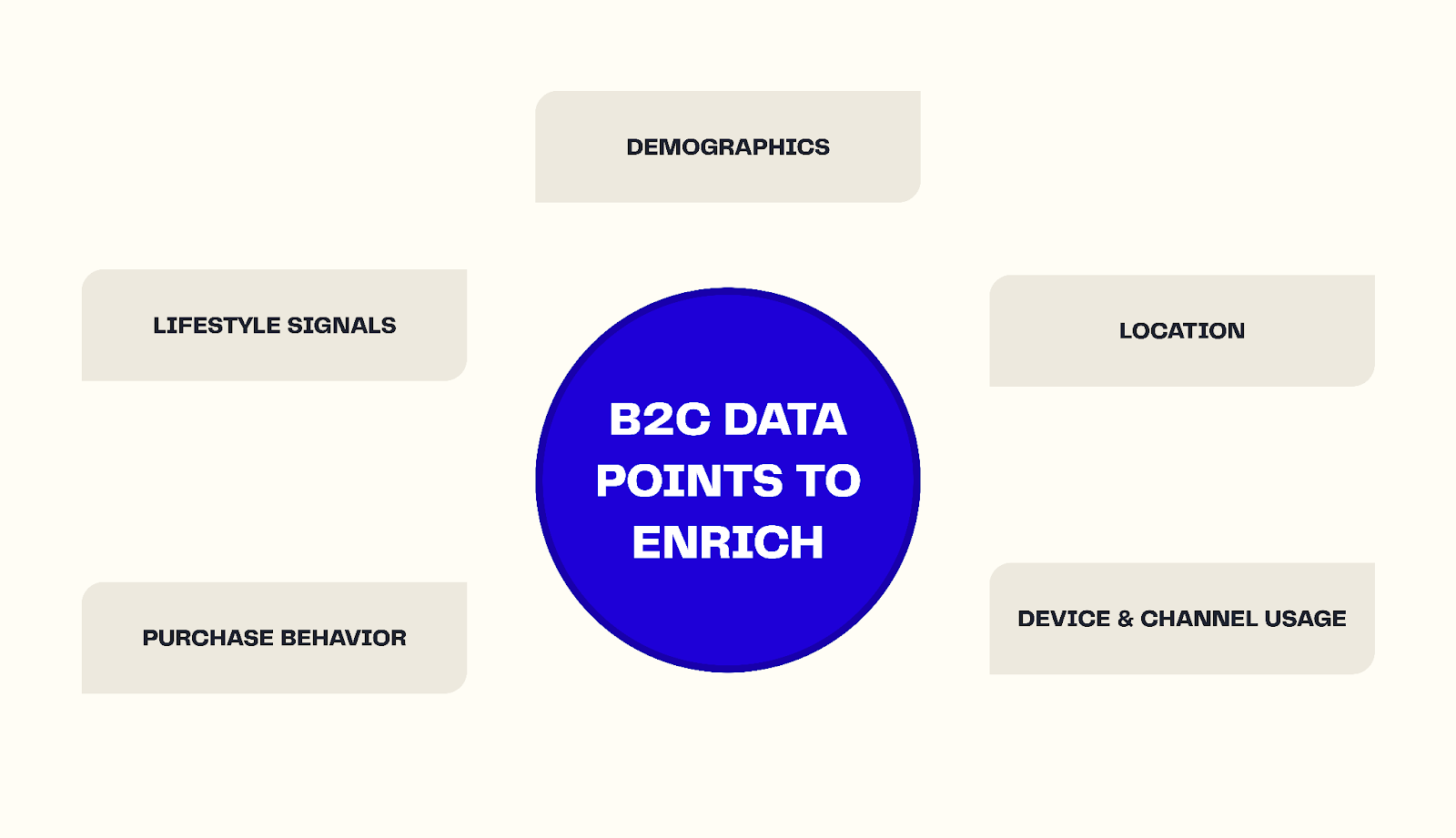
Key B2C data points to enrich
To make enrichment profitable, focus only on attributes that sharpen targeting and increase conversions:
- Demographics: Age, household size, income range
- Location: Region or neighborhood for shipping logic and localized offers
- Lifestyle signals: Interests, brand affinities, routines
- Purchase behavior: Frequency, AOV, product categories, churn risk
- Device and channel usage: Preferred device, response to email vs SMS vs ads
Database hygiene: The foundation of accurate enrichment
You can’t run enrichment on a broken database. If your records are outdated, inconsistent, or duplicated, every campaign built on this foundation will fail. Hygiene is about fixing those weaknesses before you add new attributes.
Here are some ways to clean your database:
Clean and standardize your database
Set a recurring cadence (monthly or quarterly) to scan for duplicates, bounced emails, and inactive contacts. Use rules to catch hidden errors, like different spellings of the same name, multiple accounts tied to one phone number, or abandoned carts linked to old emails.
Additionally, unify how data is stored:
- Phone numbers must include country codes.
- Addresses must follow the same formatting (no mixing abbreviations like “St.” and “Street”).
- Dates must be stored in a single format (e.g., YYYY-MM-DD).
This way, your system won’t misread the same customer as two different profiles.
Enrich profiles with missing data
Once the base is clean, fill gaps with high-value attributes: demographics, contact data, behavioral signals, and location data. Use only verified sources since bad enrichment is worse than not enriching at all because it adds inaccuracies that derail your B2C marketing efforts.
Build reliable integration workflows
Don’t let enriched data sit in spreadsheets. Push it directly into your CRM, ESP, and ad platforms through automated workflows. Every record should merge seamlessly with existing profiles, not create duplicates.
Use AI-powered accuracy checks to validate new entries in real time, such as flagging conflicting emails, invalid phone numbers, or mismatched attributes, before they enter your system.
Always-on enrichment gives you an edge in B2C, where customer data can shift in weeks. It keeps your profiles accurate, campaigns consistent, and targeting reliable without adding manual overhead.
Best practices for cleaning & enriching B2C lead databases
In B2C, your database changes daily, and if you don’t maintain it, you waste ad spend on inaccurate profiles and lose revenue opportunities.
Here are some best practices for B2C lead data enrichment and accuracy:
Run routine audits and cleaning cycles
Set a schedule for data cleansing—monthly for high-volume brands, quarterly for others. During each audit, check for:
- Duplicate records created by different capture points (checkout, pop-ups, lead ads).
- Hard bounces and invalid emails that hurt deliverability.
- Inactive profiles dragging down customer engagement.
Document these metrics so you can track how fast decay is happening in your system.
Use multi‑source enrichment for depth and accuracy
A single provider will always leave blind spots. Use two or more vetted sources so you can cross-verify data. For example, match an email address against both a behavioral source (shopping activity) and a demographic source (household info).
If they conflict, discard or flag it. Never assume the enrichment is correct just because it fills a field.
Moreover, don’t enrich for the sake of adding more fields. Only add attributes you can act on, such as:
- Cart size or purchase frequency used in predictive scoring.
- Lifecycle stage drives retention flows.
- Channel preference improves deliverability and engagement.
This way, every added attribute ties to a measurable action.
Validate third‑party data quality
Always test external data against your own system. For example, if an enrichment source appends a phone number, send a silent validation ping before importing it into your SMS platform.
Tie does this automatically by rejecting unverifiable identifiers, but if you’re using manual enrichment, you need to build this check yourself.
Maintain ongoing hygiene and enrichment
Consumer marketing data decays quickly, Emails churn, phone numbers change, preferences shift. You can’t afford to treat hygiene as a “spring cleaning” project.
Set up always-on enrichment and suppression rules so that invalid or outdated records never make it into campaigns in the first place.
Advanced B2C data enrichment tactics
Most brands stop at filling in emails or demographics. While that gives you a bigger database, it’s not a smarter one.
Advanced enrichment for B2C brands goes further. It uses real-time signals and predictive models to decide which target audience to focus on, when, and how much to spend. Done right, it directly improves campaign ROI while cutting waste.
Here are some advanced B2C data enrichment tactics that you can employ:
Real-time APIs for new lead generation
Batch enrichment leaves you reacting days or weeks later. By then, the customer has moved on. Real-time APIs let you capture identifiers the moment a visitor interacts with your site (mailing addresses, device ID, session activity) and immediately merge them into your CRM platforms like HubSpot or Salesforce.
For example, a new visitor browses a product, adds it to the cart, but bounces. If enrichment happens instantly, you can send a triggered email or SMS within minutes instead of losing them.
Additionally, make sure your API doesn’t just append fields but also runs dedupe checks so the same visitor isn’t created twice under different sessions.
Behavioral and intent-based layering
Demographics and geographic data don’t tell you why a customer might buy, but behavioral data does. Add enrichment fields like:
- Cart value and product categories browsed to identify high-AOV vs discount-driven shoppers.
- Session frequency to distinguish “window shoppers” from high-intent buyers.
- Engagement recency to separate active customers from those slipping into churn.
These attributes let you build micro-segments such as “cart abandoners with $200+ carts” or “loyalists showing first signs of drop-off.” These aren’t vanity tags. Instead, they decide which flows you trigger and which incentives you spend money on.
Power personalization with predictive scoring
Once your profiles contain verified behavioral signals, you can run predictive models that score customers on likelihood to buy, churn, or deliver lifetime value. This is where enrichment translates into measurable ROI:
- High-LTV shoppers: Fast-track into VIP flows with exclusive access or bundles.
- Medium-churn risk: Re-engage with tailored win-back offers before they lapse.
- Low-discount sensitivity: Hold back coupons, protecting margins.
- Predicted replenishment date: Trigger reminder flows at the exact time they’re most likely to reorder.
With Tie, these models update continuously because enrichment is always on. If a customer’s behavior changes (say, they move from browsing once a month to twice a week), their score updates in real time and your campaigns shift automatically, without ops teams reprocessing lists.
B2C-specific case uses & considerations
Enrichment looks different in B2C because the data you collect feeds directly into segmentation, personalization, and compliance. Here’s where it delivers the most value:
Segmentation refinement
Surface-level segments like “male vs female” or “new vs returning” don’t move the needle. When you enrich with purchase frequency, cart size, or engagement recency, you can separate profitable buyers from discount-driven browsers. For example:
- Customers with high AOV and repeat purchases: Send loyalty rewards or early-access drops.
- First-time buyers with single low-value purchases: Test nurture flows instead of discounts.
This kind of segmentation prevents wasted incentives and improves margin control.
Progressive profiling for personalization
Progressive profiling keeps your outreach relevant without over-collecting every attribute upfront. Start with core identifiers (email, phone) and then add context with every interaction, such as quiz responses, product preferences, and session behavior.
Over time, your profile becomes detailed enough to trigger one-to-one personalization, like recommending replenishment timing or upsell bundles. This reduces form abandonment because you’re not asking for everything at once, and it keeps your database naturally self-updating.
Compliance-conscious enrichment
Unlike B2B, B2C enrichment deals directly with personal data. Every field you append must be sourced with explicit consent and traceable to a verified provider. GDPR and CCPA require that you can prove where each attribute came from.
That means no co-op lists, no scraped data, and no “black box” enrichment vendors. If you can’t explain the raw data source to a regulator (or a customer), don’t use it. A single violation can undo years of trust and damage deliverability across your entire list.
Common pitfalls in B2C enrichment
Most ecommerce sales teams underestimate how quickly consumer data changes and end up with expensive databases that deliver poor returns. Here are the three mistakes you need to avoid:
Relying on a single data provider:
No single provider can give you complete and up-to-date coverage. If you depend on one source, you risk skewed data, low match rates, and blind spots in key segments.
A multi-source approach not only improves coverage but also lets you cross-verify and optimize data.
Running enrichment in silos
If enriched data lives inside one tool but doesn’t flow back into your CRM, ESP, or ad platforms, you don’t have a unified customer view. This creates inconsistencies in customer experience: the same customer could look “high-value” in one system and “inactive” in another.
Always integrate enrichment directly into your core systems so every channel is working off the same profile.
Ignoring data decay
Consumer data doesn’t stay valid for long, and brands that treat enrichment as a one-time project end up with inflated lists and wasted ad spend.
You need continuous enrichment and hygiene cycles to keep your database fresh and revenue-ready.
Measuring the ROI of enrichment
Enrichment only matters if it drives measurable business outcomes. To prove its value, you need to connect database improvements to engagement, conversion, and revenue rather than just count the number of fields filled.
Here’s how to measure the ROI of data enrichment solutions with precision:
Track engagement signals that reflect data quality
Start with open rates, click rates, and unsubscribe rates. A clean and enriched list should drive higher engagement because you’re reaching real, interested customers instead of invalid or unverified contact information.
If these numbers don’t improve after enrichment, it’s a red flag that either your provider’s data management is weak or your hygiene cycle is inconsistent.
Compare enriched vs. unenriched cohorts
Don’t just assume enrichment lifts performance, but prove it. Create an A/B structure where one segment receives campaigns with enriched profiles and another relies only on your raw CRM data. Monitor cart adds, purchase rates, and revenue per send.
The delta between the two segments tells you exactly how much enrichment is contributing.
Run campaign lift studies
One of the most overlooked steps is isolating enrichment’s impact from other factors like creative or timing. You can do this by running holdout tests.
For example, suppress enriched attributes in a control group and measure differences in conversion and lifetime value. This isolates enrichment’s ROI, independent of broader marketing changes.
Calculate ROI in financial terms
Finally, put numbers against it. Take the cost of enrichment (per record or per month) and compare it to the incremental revenue driven by higher match rates, better segmentation, and reduced wasted spend.
For instance, if enriched data adds 10,000 verified contacts who convert at a 2% higher rate, you should quantify the exact revenue gained and compare it against the spend.
How Tie strengthens B2C data hygiene and enrichment
Most enrichment tools focus on adding more fields. Tie goes further by keeping your database clean, verified, and continuously enriched so every profile is accurate and revenue-ready. Here’s how Tie’s data enrichment tool works:
- Stronger hygiene at the source: Duplicate removal, real-time validation, and deliverability checks prevent bad data from ever entering your CRM.
- Deeper enrichment: Tie connects behavioral and demographic data, and intent signals in real time, not just static contact details.
- Always-on workflows: Profiles update automatically as customers browse, purchase, or lapse, so your campaigns reflect today’s behavior and not last month’s.
- Compliance built in: Every attribute is sourced with explicit consent, keeping you aligned with GDPR/CCPA requirements.
Unlike platforms built for B2B data enrichment, Tie was designed specifically for ecommerce. That means higher match rates, session-level enrichment, and integrations that connect directly into your email and ad platforms.
By combining real-time identity resolution with always-on hygiene, Tie gives you cleaner lists, richer profiles, and campaigns that adapt instantly to customer behavior.
Want to learn how Tie can upgrade your B2C lead database? Book a demo now!