
Most content on “identifying visitors” focuses on B2B lead generation hacks like IP lookups, WHOIS databases, or LinkedIn profile scraping.
If you run an ecommerce brand, those don’t help. You don’t need company IPs; you need to recognize real shoppers on your site, connect them to verified identifiers, and re-engage them across email, SMS, and ads— all without relying on third-party cookies.
The problem, though, is that cookies are fading, and analytics tools only offer traffic numbers. Without being able to identify visitors, email list growth slows, cart recovery stalls, and personalization becomes tricky.
In this guide, we’ll break down how ecommerce brands are closing the cookie gap using consent-first, real-world methods like progressive checkout capture, back-in-stock opt-ins, and server-side event streams.
Why identifying visitors matters
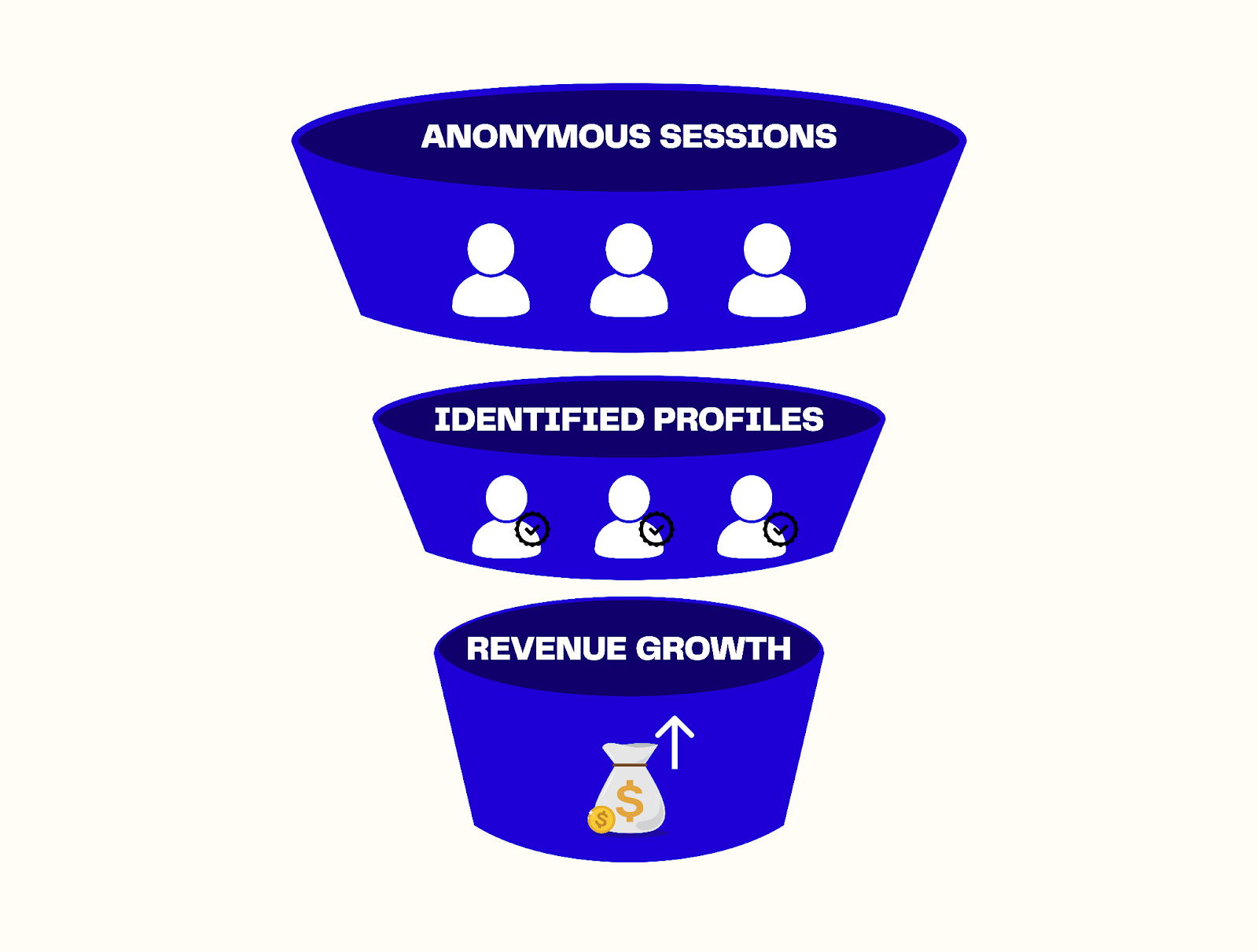
Every visit to your site represents intent. But if you only track traffic as anonymous sessions, you miss the real opportunity: converting visitors into identifiable contacts you can remarket, personalize, and ultimately turn into customers.
Traditional analytics stop at clicks and sessions. Website visitor identification goes further by linking a visitor’s behavior to verified details (like email or phone) so you can re-engage them beyond the website. That shift takes reporting from vanity metrics to revenue-driving growth levers.
How identification drives revenue
- List growth: Instead of waiting for checkouts or sign-ups, capture verified contacts from up to 75% of your traffic. That means faster CRM growth and more reach across email and SMS.
- Personalization: Once visitors are identified, you can send product recommendations or reminders based on the exact items they browsed or added to their cart. There is no longer any need for broader segments.
- Remarketing reach: Identified visitors can be retargeted across channels without depending on cookies or third-party pixels, cutting wasted ad spend and improving ROI.
For example, G.O.A.T. Foods, a premium, handcrafted, and gourmet food brand, used Tie to identify over 2,520,921 new shoppers, capturing $596,383 in additional revenue. This gave them the confidence to scale national TV campaigns, knowing the new traffic could be converted into measurable revenue.
Website traffic metrics to track
Generic metrics like sessions and bounce rates don’t show business impact. When you identify visitors, you gain access to metrics that connect directly to revenue:
- Identification rate: Percentage of site visitors matched to usable profiles.
- High-intent data coverage: Share of cart and checkout visitors captured for remarketing.
- Revenue from identified visitors: Incremental sales tied to contacts that would have otherwise stayed anonymous.
- Engagement lift: Comparison of open and click rates from enriched profiles vs. generic lists.
Cookieless shift: what breaks and what still works
The end of third-party cookies changes how you track and convert visitors. With privacy updates and browser restrictions, that model no longer holds up, leaving both analytics and marketing teams with critical gaps.
When cookies disappear, two core functions break:
- Attribution accuracy: You lose visibility into which channels drove conversions.
- Visitor identification: You can’t connect site actions to real people anymore.
Why analytics platforms aren’t enough
Free analytics platforms (like Google Analytics 4 or any website analysis site) show you high-level numbers, like traffic, bounce rates, and time on page. But they don’t identify anonymous website visitors.
Analytics tells you what happened (“1,000 sessions, 70% bounce rate”), not who it happened with.
Visitor identification changes that. Instead of just knowing “a cart was abandoned,” you know which shopper left $200 worth of items behind, and can set up outreach via email, SMS, or ads.
That’s why relying on analytics alone leaves revenue on the table.
The need for first-party data
Collecting first-party, consented data is critical to turn traffic into shopper profiles. By capturing emails or phone numbers with consent, you turn anonymous sessions into identifiable contacts you can track across devices. Visitors are already familiar with consent banners, and when you collect data transparently, you replace cookies with durable identifiers that enable website user tracking.
However, there is one downside to just relying on first-party data. It only covers sessions where shoppers willingly share details. Anonymous visitors still slip through the cracks.
Filling data gaps due to anonymous sessions
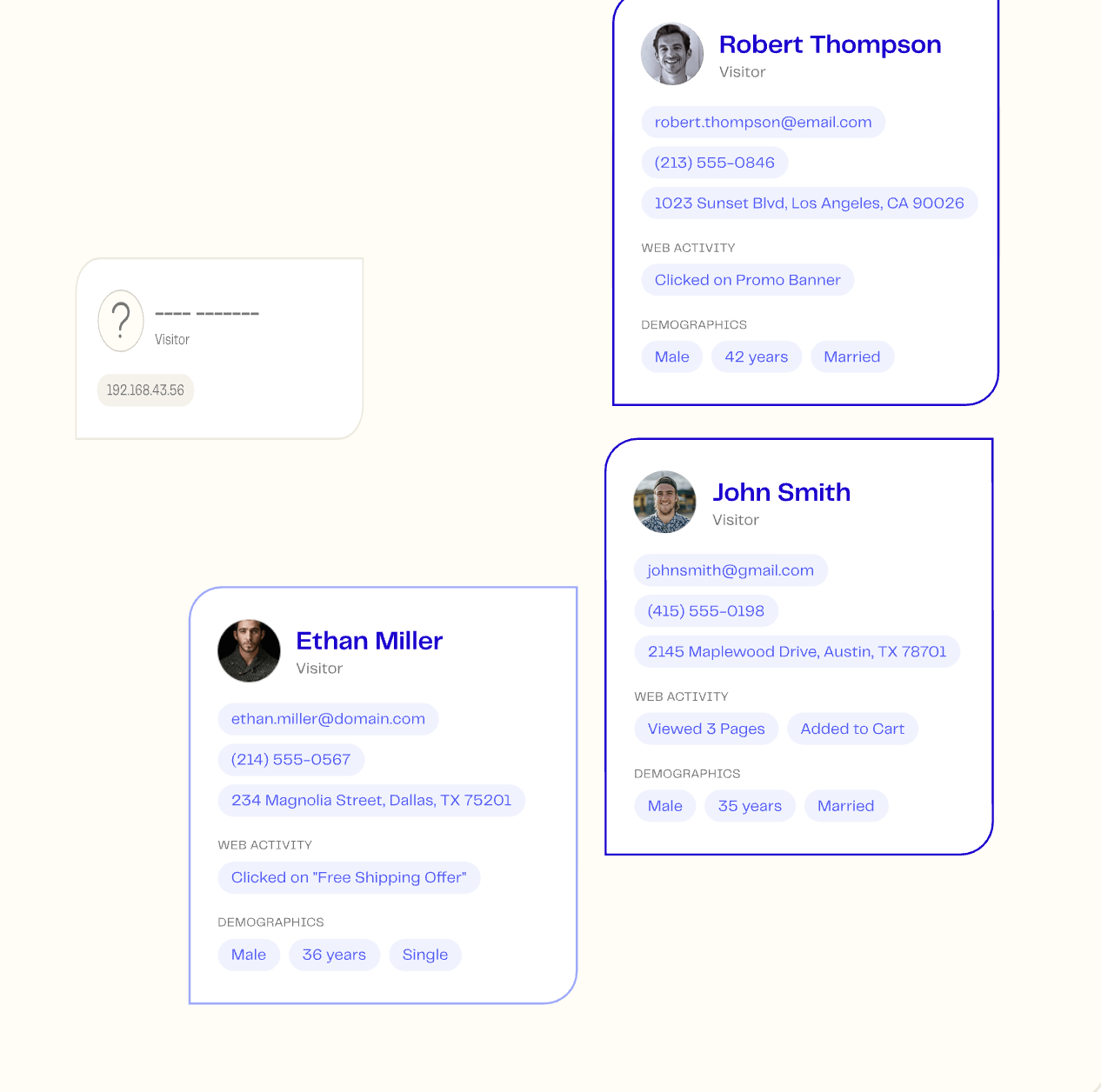
This is where identity resolution comes in. Even when visitors don’t provide personal details, identity resolution uses consented signals (like device ID, IP, and session behavior) to match anonymous traffic to real customer profiles. This gives you a comprehensive view of your shoppers, including demographic, behavioral, and intent details.
With this, brands can re-engage visitors across email, SMS, and paid media campaigns, capturing demand that would otherwise remain invisible and converting more traffic into revenue.
How brands actually ID visitors without cookies
Beyond third-party cookies, leading ecommerce brands use a mix of first-party identifiers, server-side pipelines, and lightweight signals to identify anonymous website visitors into real shopper profiles.
First-party identifiers
Since analytics tools typically only offer numbers, brands invest in website visitor tracking tools that focus on identity, not just traffic.
Big B2C brands build their visitor identity systems around durable identifiers that last beyond a single session, like:
- Account logins
- Checkout email capture (even if no order is placed)
- Loyalty program sign-ups
- Saved payment profiles
When these identifiers are routed through server-side systems, brands can unify sessions across devices and browsers that would otherwise look anonymous.

Server-side pipelines
Server-side tracking ensures visitor data flows directly into your stack—ESP, CDP, or ad platforms, without relying on fragile browser tags. This prevents data loss from cookie expiration or blocking, while keeping identifiers consistent across channels.
Lightweight privacy-aware signals
Not every shopper logs in or creates an account right away. To bridge that gap, brands use privacy-aware signals such as device IDs, IP addresses, and behavioral fingerprints.
Tie, for example, matches these signals against its opted-in identity graph to:
- Link a mobile browse session with a later desktop checkout.
- Reconnect a cart session even if the cookie has expired.
- Push enriched profiles into marketing tools like Klaviyo, Hubspot, Meta, or Google Ads for immediate remarketing.
This gives brands the reach cookies once offered without the compliance risk.
Progressive ID capture
You don’t have to wait until checkout to collect identifiers. You can build in progressive capture points that deliver value to the shopper while collecting the data needed to remarket:
- Save-cart prompts: “Enter your email to keep these items for later.”
- Back-in-stock alerts: Capture contact info in exchange for notifications.
- Newsletter gates: Exclusive access or perks in return for opt-in.
- Checkout forms: Capture the email the moment it’s typed, even before the payment step.
Each micro-identifier acts as a bridge. Instead of one big ask at checkout, you collect identifiers throughout the journey, steadily increasing your reach and ability to retarget and personalize.
Bridge between analytics and identity
Analytics tells you what happened. Identity tells you who did it. If you stop at analytics, you’ll know you had 10,000 sessions and a 3% conversion rate, but you won’t know which abandoned carts belonged to high-intent shoppers you could still win back.
Cookieless web analytics: what it offers
Tools like Google Analytics 4 (or any of its alternatives) track events at the session level. You can see:
- Pageviews and traffic sources
- Bounce rates and conversion funnels
- Devices, browsers, and location signals
This is useful for optimization, but it’s anonymous. You can’t email a “Chrome visitor from New York” or retarget a “session that bounced.”
Identity: how detecting visitors impacts your marketing
When visitors are identified, those same events tie back to durable identifiers:
- Cart activity linked to an email captured at checkout.
- Browse patterns matched to a phone number from a back-in-stock alert.
- Session history connected across devices through server-side IDs.
At this point, you’re not just analyzing traffic. You’re identifying people you can market to.
The hand-off: from event stream to revenue
Clicks and pageviews don’t drive revenue on their own. You need to connect behaviors to real identities and push them into your marketing stack. Here’s how leading brands turn raw events into conversions:
- Event stream: Every click, view, and cart action is logged.
- Identity graph: Those events are matched against first-party identifiers (email, phone, device ID, IP).
- Profile creation: A visitor becomes a contact with attributes like products viewed, cart size, and engagement history.
- Activation: That profile syncs instantly into Klaviyo, ESPs, or ad platforms, powering cart recovery emails, personalized SMS, and targeted ads.
Tools to use to track and identify visitors
When you evaluate website visitor tracking tools, you need to decide if you want to build your own stack or buy a solution that offers identity resolution.
The trade-off is simple. Analytics tools give you traffic counts, but identity platforms give you shopper profiles you can market to.
1. Google Analytics 4
Google Analytics 4 provides the baseline view of your traffic. It shows you sessions, referral sources, and conversion funnels, helping you understand which channels drive visitors.
It’s free, widely adopted, and useful for measuring overall performance, but it only tells you what happened, not who did it.
2. Intelligems
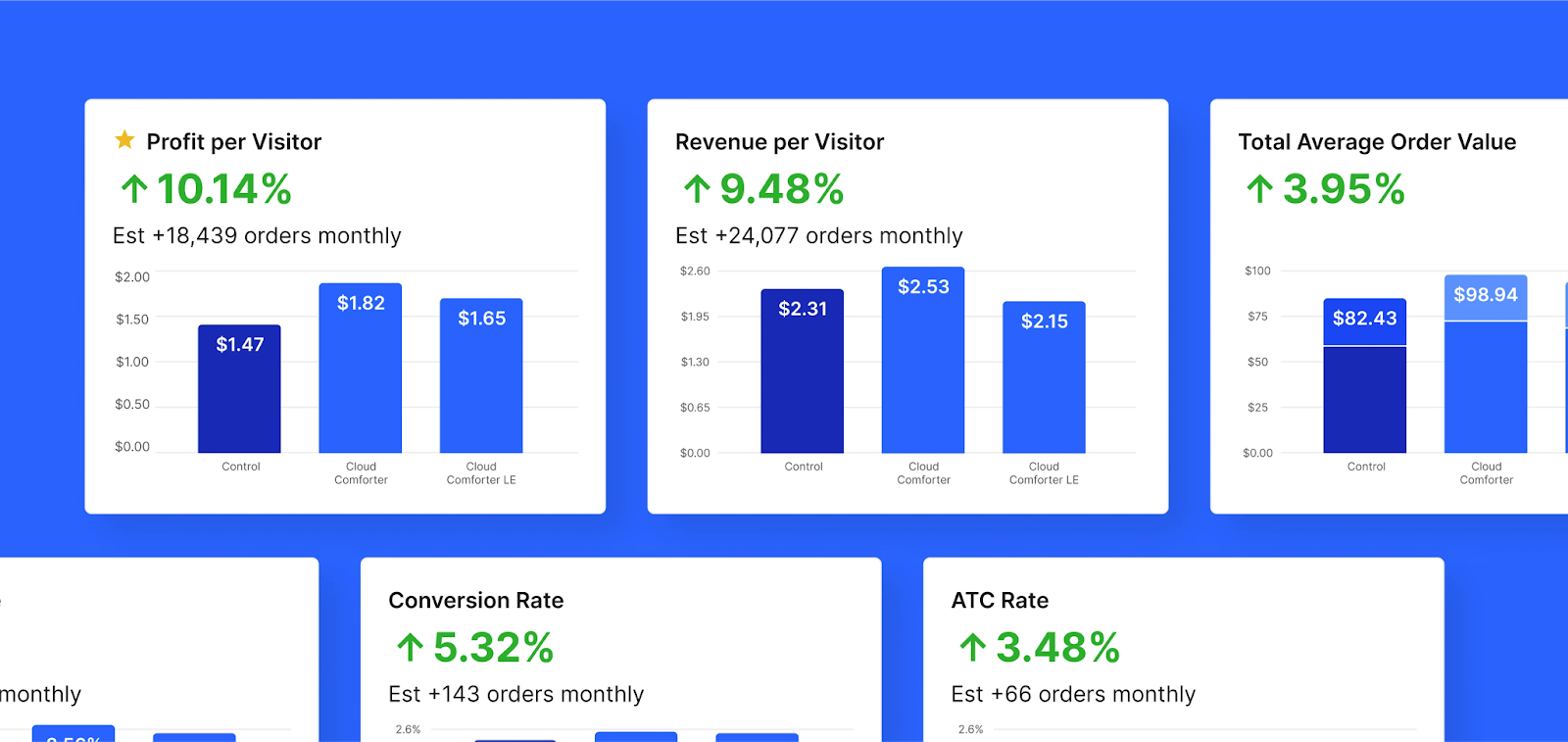
Intelligems focuses on A/B testing for pricing, bundles, and UX tradeoffs and gives you behavioral data tied directly to revenue impact. It’s especially useful for DTC brands optimizing for margins, discount elasticity, and offer experimentation.
While it provides outcomes-based data (what price or experience performs best), it does not provide user-level identity.
3. Tie
Tie identifies visitors in real time using consented first-party signals. It enriches profiles with verified attributes (email, phone, device, location, intent) and syncs directly into Klaviyo, ESPs, and ad platforms for instant activation.
While GA4 tracks activity, Tie connects that activity to people you can remarket, retarget, and personalize for.
Buy vs. build: what to weigh
Some brands consider building this tooling in-house, but building this in-house means managing:
- Consent flows across regions (GDPR, CCPA).
- Data pipelines to capture events server-side.
- Identity graphs to stitch sessions into profiles.
- Deliverability infrastructure to make sure IDs actually work in campaigns.
That requires engineering resources, legal oversight, and ongoing maintenance. Buying a tool like Tie gives you those capabilities out of the box, so you can focus on growth instead of compliance and infrastructure.
Evaluation checklist
When comparing visitor identification tools, weigh them against four criteria:
- Consent handling: Does it log explicit opt-ins by region?
- Match logic: Does it resolve sessions into usable profiles?
- Activation: Can you push IDs into ESPs and ad platforms without manual work?
- Privacy: Does it keep you compliant while still giving you identifiers you can monetize?
For a deeper comparison, read our blog on Website Visitor Tracking Tools.
Following compliance and trust by design
You can’t scale visitor identification without compliance. Every step (from how you request consent to how you store data) affects whether shoppers trust you and whether you stay within the law.
Consent flows tailored to the region
Privacy laws differ by geography. GDPR in Europe requires explicit opt-in, while CCPA in California focuses on opt-out visibility. To stay compliant, you need to:
- Display clear, non-buried consent banners the first time a visitor lands.
- Adapt language by region (cookie banners for the EU, “Do Not Sell” links for California, age consent for minors in certain states).
- Record proof of consent at the profile level, so you can always show regulators (and visitors) when and how permission was given.
Data minimization and retention discipline
More data isn’t always better. You need a strategy for capturing the right data that actually helps drive conversions:
- Capture only what you’ll actually use for marketing strategies (email, phone, cart behavior).
- Drop or anonymize stale identifiers after a set period (e.g., 12 months of inactivity).
- Segment out non-consented data from activation pipelines, keeping it for analytics but never for marketing campaigns.
This keeps you compliant and improves data quality by removing low-intent signals or irrelevant signals.
Cookieless web analytics vs identity data
With cookieless web analytics, you’re working with anonymous session data: no personal details, just pageviews, sources, and device info. This remains safe for aggregate insights, but not actionable for remarketing.
Identity data, on the other hand, begins once a visitor consents. Once a visitor consents, you move from anonymous to identifiable. That’s why you must make the value exchange explicit:
- “Share your email to save your cart.”
- “Opt in to get a restock alert.”
- “Join our list for early access.”
Why trust by design matters
Every consent banner, micro-conversion, and retention policy shapes your ability to identify visitors long-term. If shoppers feel tricked, they churn. If regulators see gaps, you face penalties.
By designing for trust first, you create a compliant identity layer that encourages more opt-ins, builds higher-quality profiles, and strengthens revenue growth.
Implementation quickstart
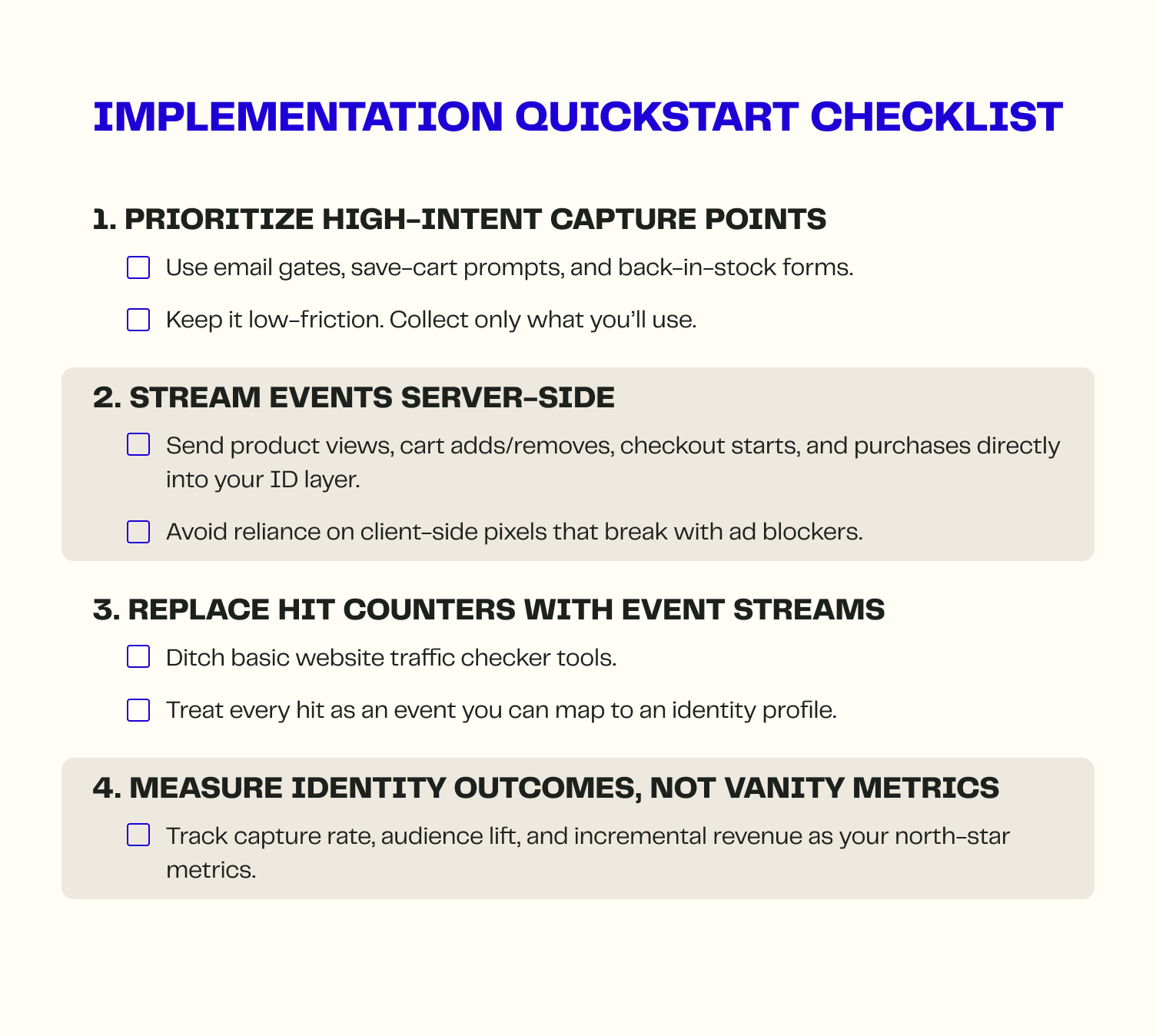
You don’t need dozens of tools or months of setup to start identifying visitors. You need to set up capture points that matter, stream the right events into your ID layer, and measure identity metrics, not vanity traffic stats.
Capture points to prioritize
Focus on moments where shoppers are motivated to exchange details for value:
- Email gates: Use for gated offers or early access campaigns. Don’t ask for more than an email since friction kills opt-ins.
- Back-in-stock alerts: Turn product interest into contact information you can retarget with urgency.
- Save-cart prompts: Let visitors store carts in return for an email or phone number.
- Progressive checkout capture: Record the email field the moment it’s entered, even if payment isn’t completed.
These touchpoints deliver identifiers tied to buying intent, not just casual browsing.
Stream events server-side
Client-side scripts break with ad blockers and cookie limits. If you want durable data, stream these events server-side into your ID graph. Focus on:
- Product views and category browsing, key for buyer intent lead scoring.
- Cart adds/removes to recover real revenue opportunities.
- Checkout starts to trigger automated remarketing flows if abandoned.
- Purchases to enrich profiles with conversion data.
This approach connects identity to visitor behaviors you can actually act on, instead of relying on unreliable pixels.
How to track hits on a website the right way
A website traffic checker only tells you someone landed. Instead, treat every “hit” as an event. Feed those events into your identity layer and resolve them to a profile when possible.
For example:
- A hit on a PDP becomes a known profile once paired with an email from a back-in-stock form.
- A hit on checkout becomes a recoverable cart once the email field is captured.
This is how you turn generic website user tracking into revenue-driving visitor identification.
Measure identity outcomes, not vanity metrics
Pageviews and bounce rates don’t prove ROI. Measure success with identity KPIs:
- ID capture rate: % of total traffic matched to usable profiles.
- Reachable audience lift: how many more contacts you can now target across email, SMS, and ads.
- Revenue impact: incremental sales tied to identified visitors compared to anonymous traffic.
These numbers show whether your setup is expanding marketing reach and revenue, not just inflating dashboards.
Identify website visitors with the right tools for effective targeting
Every ecommerce brand has a cookie gap. They pay to acquire traffic, but can’t retarget them because they stay anonymous. The brands that close that gap grow lists faster and run campaigns that actually match shopper intent.
With Tie, you replace cookie-based blind spots with a clear identity plan:
- Capture visitor details at natural points in the journey: cart saves, restock alerts, progressive checkout.
- Stream those events into a real-time visitor ID graph that turns a “session” into a shopper profile.
- Push those enriched profiles into Klaviyo, Meta, and Google Ads, so your remarketing and personalization reach actual people, not anonymous browsers.
Want to dig deeper before you act?
- See how G.O.A.T. Foods boosted revenue with identity resolution.
- Explore how customer identity resolution works in practice.
If you want to explore an effective way to identify website visitors, book a demo to see how Tie can help your ecommerce brand.