Managing a contact database sounds simple until you look closer. Most brands struggle with incomplete fields, outdated identifiers, and scattered lists across systems. One team owns the CRM, another controls the ESP, and no one is fully responsible for data quality. This results in emails that miss inboxes, segments that fall flat, and revenue that takes the hit.
Customer data enrichment fixes this by filling in contact information gaps while hygiene guarantees accuracy through deduplication, suppression, and validation. Together, they protect deliverability, grow email lists that actually perform, and power customer lifecycle marketing campaigns.
This guide shows you what to enrich, when to enrich, and how to activate enriched consumer data across channels to drive ROI.
What is a B2C contact database?
A B2C contact database is a collection of individual consumer information, including their names, addresses, phone numbers, email addresses, and demographics like age, gender, income, and interests.
Unlike a simple contact list, a modern B2C database combines static identifiers with real-time behavioral and engagement data, like website activity, purchase history, and campaign interactions.
This enriched view allows marketers to segment audiences with precision, personalize campaigns at scale, trigger automations based on behavior, and stay compliant with data privacy regulations like GDPR and CCPA
Core fields
For customer database management to be effective, you need complete and accurate fields:
- Identifiers: Name, phone number, business email (for B2B data), residential address (for homeowners).
- Behavioral data: Web sessions, app usage, cart activity, and telemarketing interactions.
- Engagement: Email clicks, SMS responses, LinkedIn engagement, and unsubscribes.
- Commerce data: Purchase history, AOV, LTV, product preferences.
- Demographic and firmographic: Age, location, and firmographic details for crossover with the B2B contact database.
Sources
A high-quality contact database integrates data across touchpoints like:
- Web: On-site forms, quizzes, identity resolution, data provider feeds.
- App: Logins, push notifications, in-app purchase data.
- POS: In-store loyalty, receipts, and coupon redemptions.
- ESP/CRM: Email lists, SMS subscriptions, customer service tickets.
Pulling all this together requires customer data integration tools or a customer data platform that syncs inputs in real-time. Without this integration, you end up with partial or conflicting contact data.
Single source of truth vs scattered lists
When customer data is scattered across CRMs, marketing automation tools, and spreadsheets, it becomes messy and unreliable. Different teams end up working with different versions of the truth, which limits segmentation, personalization, and even basic reporting accuracy.
A single source of truth solves this by consolidating all contact data into one unified system, often a data warehouse or a platform built on top of it. With this, you can:
- Apply validation rules to ensure data accuracy and consistency.
- Unify fragmented datasets into actionable customer profiles.
- Give sales, marketing, decision-makers, and customer support teams the same reliable view of the customer.
Instead of debating which CSV is correct, teams work off a shared, validated dataset, unlocking better personalization, smoother operations, and smarter decisions.
Data quality foundations
Your consumer database is only as strong as the quality of its data. When accuracy breaks down, every part of your system (from outreach and email marketing to marketing list targeting) loses impact.
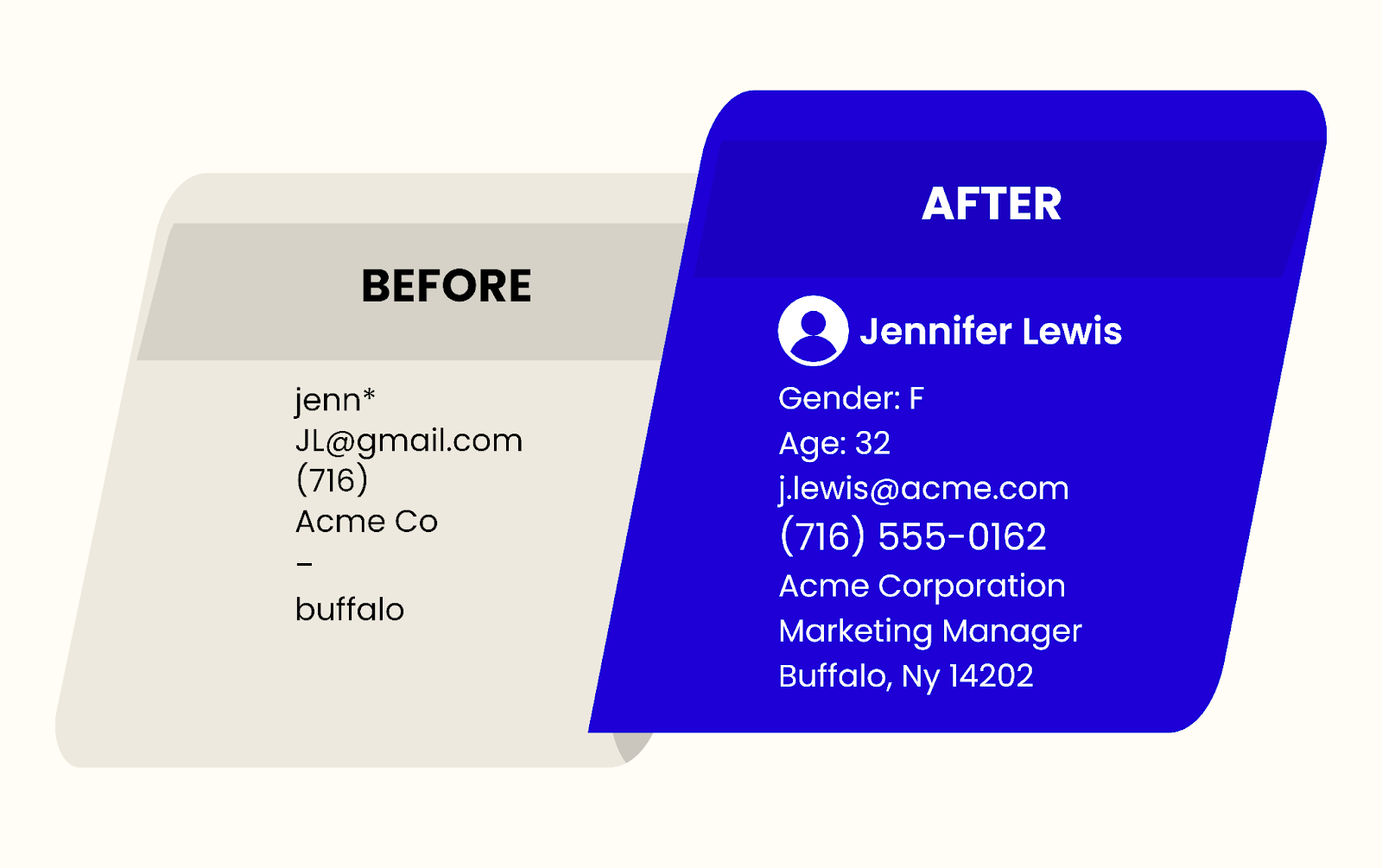
That’s why you need to look at data quality as an ongoing framework, instead of a one-time clean-up.
What defines data quality?
Four data quality parameters define whether your B2C contact data is strong enough to drive results:
- Validity: The contact info exists and passes validation.
- Completeness: Essential fields like phone number, address, or demographic data are present.
- Consistency: Formats align across platforms (no mismatched country codes or broken dates).
- Recency: Records reflect current behavior, not stale activity from years ago.
Building a data quality management system
Once the parameters are clear, you need systems to enforce them. Strong data governance tools and data management software help you create processes like:
- Deduplication and merge logic to collapse duplicates.
- Global suppression lists that streamline across CRM, ESPs, and business integration software.
- Validation at collection to block bad data before it enters your email database.
- Data enrichment from trusted data providers to fill missing contact info and add demographic depth.
Common data quality challenges
Even with tools, weak processes often derail progress. The most common data quality challenges include:
- Collecting data without standardized fields, which breaks segmentation and automation.
- Running siloed systems (e.g., POS vs CRM) that refresh at different cadences.
- Prioritizing list growth over health, which leads to disengagement and poor email deliverability.
Why deliverability depends on data quality
Data quality isn’t just about clean records. More importantly, it determines whether your emails even make it to the inbox.
Sending campaigns to invalid or unengaged contacts tells mailbox providers you’re a low-quality sender. Over time, your domain reputation drops, and even your most engaged customers stop seeing your emails.
What to enrich (and why)
A contact database is only as useful as the fields it contains. If all you store is an email, your campaigns will stay basic.
Data enrichment fills in the missing pieces, giving you the details needed to reach more people, understand them better, and personalize with precision.
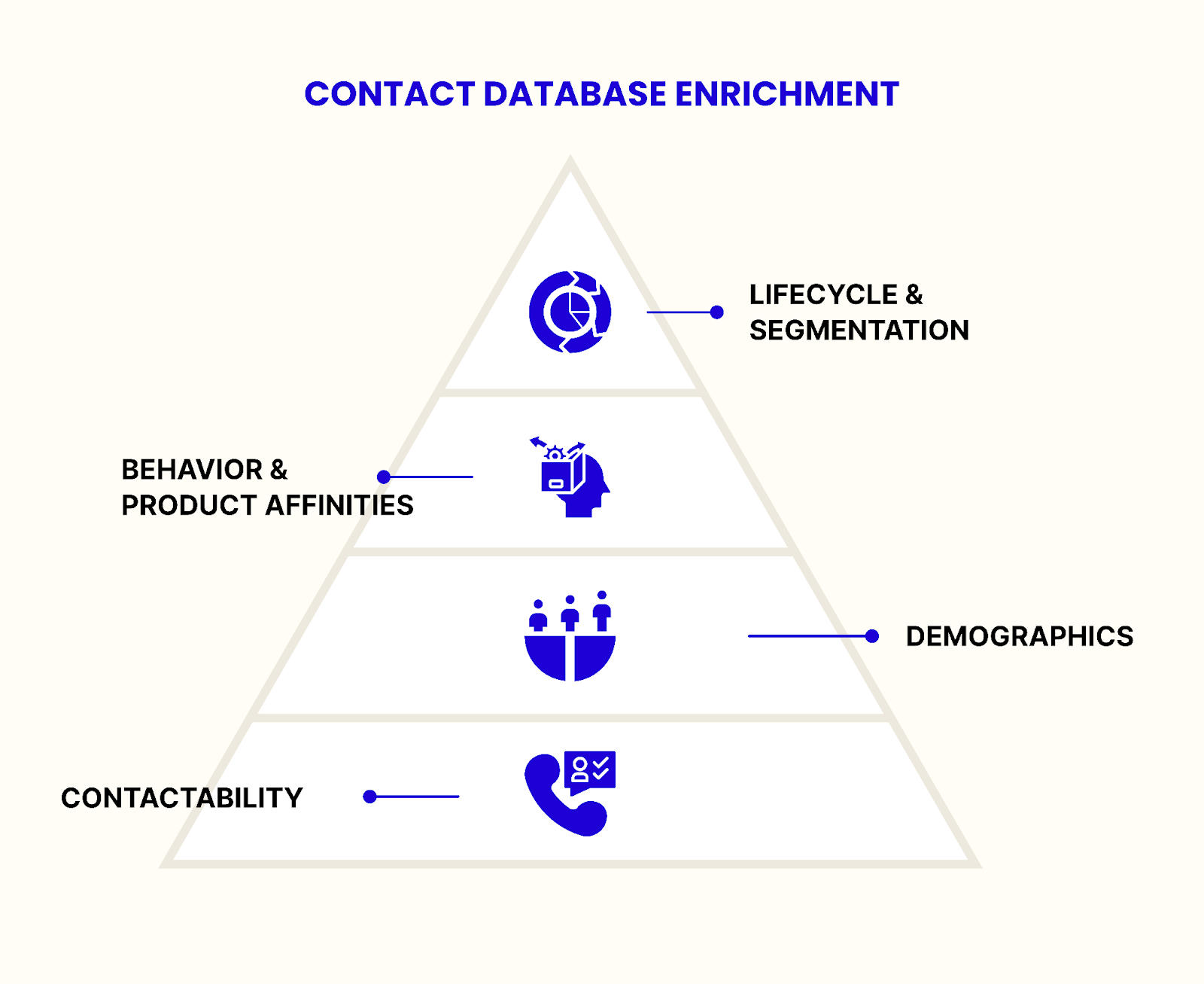
Contactability
The foundation of enrichment is making records reachable.
- Verified emails and phone numbers turn a record into someone you can actually reach.
- Geography and time zone fields make sure that outreach happens at the right local time.
Without these, you risk either losing half your list to invalid contacts or bothering customers with midnight pings.
Demographics
Basic demographic signals help tailor tone and offer positioning:
- Age range or life stage (student, parent, professional, etc.)
- Location-based lifestyle clusters (urban vs suburban, coastal vs inland)
- Language preference
This will allow you to send relevant messages. A loyalty campaign for a coastal lifestyle brand, for example, will land differently for a New York buyer vs a Phoenix shopper.
Behavioral and product affinities
Once you establish reliable contact channels, the next layer is behavioral and product affinities.
- Browsing history, cart activity, and category preferences reveal what a shopper cares about right now.
- Purchase frequency and average order value place them in the right lifecycle stage.
These signals fuel lifecycle-specific campaigns, from welcome flows for first-time buyers to replenishment reminders for loyal repeaters.
Segment utility
Every enrichment field should map to a campaign use case:
- Email and phone data let you choose the right outreach channel.
- Time zone data lets you optimize send time.
- Product affinity data enables personalized ads and recommendations.
- Lifecycle data triggers automated flows like winbacks, replenishments, or loyalty perks.
When each data point ties directly to campaign logic, enrichment stops being “extra info” and becomes the driver of effective segmentation.
Read our blog on ‘B2C Data Enrichment and Database Hygiene: Best Practices in 2026’ to learn how you can enrich your ecommerce brand’s data.
When to enrich customer data
Knowing what to enrich is only half the equation. Timing determines whether those fields actually improve performance. Too early and you collect noise. Too late, and you miss the engagement window.
You need a combination of real-time checks, planned refreshes, and event-driven updates to keep your database alive.
At capture
The best place to stop bad data is at the point of entry. Here’s how:
- Real-time verification: Confirm emails and phone numbers before they enter your system.
- Append demographics or location data: Capture context early, so new contacts are campaign-ready from day one.
Pre-campaign refresh cycles
Before major campaigns (holiday promos, new product launches, or seasonal flows), refresh the data you already have.
Update lifecycle tags, purchase history, or engagement scores so you’re targeting based on current behavior, not last year’s. This avoids wasted sends and makes sure your segmentation logic reflects the target audience you’re actually marketing to today.
Triggered enrichment
Set updates to fire automatically when key events occur:
- When a customer goes inactive for 90 days, verify their email before running a reactivation flow.
- When they hit a milestone (like first purchase or loyalty tier upgrade), update lifecycle fields instantly.
- When data syncs between your CRM, ESP, and data warehouse, trigger validation and deduplication to keep records consistent.
By aligning enrichment across capture, refresh cycles, and triggers, you turn a static list into a living database, constantly sharpening itself and fueling campaigns with current, high-quality data.
How to activate enriched data
Enrichment has no value until you turn it into action. Once your database contains verified contact details, behavior signals, and lifecycle context, you can activate that data in three ways: segmentation, cross-channel orchestration, and measurement.
Step 1: Build sharper segments
Use enriched fields to go beyond broad lists. Instead of a broad “active” bucket, group customers by purchase frequency, geography, or product preferences.
These segments dictate how you communicate. A high-value buyer is offered loyalty perks, while a low-frequency shopper receives replenishment nudges.
Add personalization tokens to boost impact: subject lines referencing a browsed product, SMS timed to the customer’s local timezone, or ad copy tailored to category interests.
Step 2: Orchestrate campaigns across channels
Once your segments are defined, activate them across the touchpoints your customers engage with. Since enrichment unifies data into one profile, you can sync the same audience across email, SMS, and ads without duplication.
That means you can retarget abandoned-cart shoppers with a Meta ad, suppress them from your next email blast to avoid overlap, and send them a personalized SMS offer; all coordinated from one profile.
This cross-channel orchestration prevents wasted spend and makes sure each channel plays its role in the conversion journey.
Step 3: Close the measurement loop
Activation doesn’t end with sending campaigns. You need to measure how enriched data performs.
- Track ROI at the segment level to see whether lifecycle tags, product affinities, or engagement scores are actually driving revenue.
- Layer in lifetime value to understand whether a segment is profitable beyond one purchase.
- Feed these insights back into your database strategy to double down on fields that create impact.
Tooling & integrations for contact database management
A contact database is only as powerful as the systems it connects to. The tools you choose (and how you integrate them) determine whether your data fuels campaigns or gets trapped in silos.
Building reliable data pipelines
The first step is integration. Your pipelines must pull in identifiers, behavior, and consent data from every touchpoint (site, app, POS, ESP) and map them to a single profile.
If one customer browses anonymously on mobile, checks out on desktop, and redeems an offer in-store, your integration layer must connect all of those actions. Without this, you end up with duplicates and wasted spend.
Choosing where the database lives
Once data flows are unified, you need a system to store and activate it. Brands usually choose one of three paths:
- Customer Data Platform (CDP): Best if you need activation-first workflows. A CDP resolves identities, applies suppression and consent logic, and pushes segments straight into email, SMS, and ad platforms. It’s built for marketers but is limited when you need cross-department analytics.
- Data Warehouse: Suited for scale and analysis. A warehouse can store massive datasets across teams and give you flexible reporting. But it’s not activation-ready; you’ll need modeling work and often an extra layer to translate raw data into segments.
- Hybrid: Many teams use both. The CDP manages identity resolution and campaign activation, while the warehouse holds long-term storage and business-wide reporting. When the CDP reads and writes from the warehouse, you get the best of both: clean activation plus enterprise-grade analytics.
A lean stack for growing teams
Not every business needs enterprise-grade infrastructure on day one. A lean setup might look like:
- CRM as the system of record
- ESP for activation
- Tie as the identity + enrichment layer
Tools like Tie identify anonymous visitors, verify emails in real time, enrich profiles with geography and behavior, and push them into your CRM or ESP— ready to run campaigns. That means you can run high-quality B2C lead outreach without waiting for enterprise infrastructure.
Data governance & stewardship
Enriched data only drives results if it remains trustworthy, compliant, and consistent. Governance is the structure that prevents errors, misuse, or compliance risks from creeping into your database. Strong stewardship gives your teams confidence to act quickly without second-guessing the integrity of the data they’re using.
Define ownership and accountability
Assign roles using a simple RACI model (Responsibility Assignment Matrix):
- Who updates records
- Who reviews changes
- Who consumes the data
This creates accountability and avoids the blame game when inconsistencies appear.
Control access and track activity
Not every role should see or edit the same fields. Sensitive details like phone numbers or addresses should have restricted access, while campaign managers only need the fields relevant to segmentation.
A governance system must enforce these access levels and keep audit logs. If a field changes, you should know who changed it, when, and why. These logs aren’t just for compliance, but they help you backtrack quickly when errors slip in.
Manage consent and preferences centrally
Customer preferences (from unsubscribing from email to opting into SMS) must cascade across all systems in real time, not scattered across your ESP, CRM, and ad platforms. If preferences aren’t synced, you risk violating consent or frustrating your customers with unwanted messages.
A strong governance process guarantees that opt-outs and opt-ins cascade across all channels in real time.
Document and standardize your data
Without shared definitions, a “customer” can mean different things to marketing, finance, and sales teams. This confusion breaks campaigns and reporting.
Build a data dictionary that defines each field, its format, and its use. Apply consistent naming conventions and formats (for example, standardizing country codes or lifecycle stages) so your warehouse and CRM speak the same language.
Govern the warehouse and integrations
Your data warehouse is the foundation for reporting, but without governance, it becomes a dumping ground.
- Validate before data enters the warehouse to keep it clean.
- Document every pipeline so teams know exactly what they’re querying.
- Ensure integration software preserves consent flags, suppression rules, and formatting.
Poorly governed integrations are one of the fastest ways for clean data to become dirty again.
Roadmap to manage customer data: Crawl → walk → run
Strong customer data management doesn’t happen overnight. You move through stages, each building on the one before it.
Think of it as a progression: you crawl by getting the fundamentals right, you walk by turning enriched fields into active campaigns, and you run when enrichment becomes predictive and continuous.
Here’s the process in detail:
Crawl: Validate and enrich at capture
Start by protecting your database from bad inputs.
- Validate emails and phone numbers at the point of capture.
- Append baseline enrichment like geography or device type right away so every new profile is usable from day one.
This ensures you’re not wasting budget marketing to invalid or incomplete records.
Walk: Trigger campaigns with enriched fields
Once the basics are in place, use enriched data to shape lifecycle triggers.
For example, cart activity can launch abandonment email flows, purchase frequency can power replenishment reminders, and geography can adjust send times.
At this stage, enrichment shifts from “extra information” to a direct revenue driver through automated lifecycle campaigns.
Run: Predictive segmentation with continuous enrichment
The final stage is turning enrichment into an always-on system.
- Build predictive segments based on likelihood to repurchase, churn risk, or lifetime value.
- Set a service-level agreement (SLA) for enrichment refreshes; for example, verifying inactivity every 90 days or updating product affinity scores weekly.
- Keep enrichment continuous so profiles sharpen themselves over time.
This transforms your database into a living system that supports advanced personalization and forecasting.
Ready to put enrichment into practice?
Don’t let your database stay static. Tie’s enrichment automatically fills gaps with real-time verification, geography and behavioral tagging, and consent-safe enrichment that keeps profiles updated as customers move through their journey.
When you’re ready, book a demo. We’ll walk you through how enrichment turns a static database into a living system that drives measurable revenue.