Creative Intelligence Meets Data Intelligence: Why the Best Email Programs Work on Both Levels


Most email programs separate data and creative decisions.
Data decides who receives an email and when it is sent. Creativity shapes the message afterward. Both are optimised, but they rarely inform each other.
Over time, this creates a familiar pattern. Campaigns continue to ship and revenue keeps coming in, but teams can’t explain why certain angles lift once and then fade, or why long-running campaigns stop producing new insight. Performance moves without clarity on what actually caused it.
The problem lies in how data and creative decisions connect.
High-performing email programs design them as a single system. Data informs creative decisions around who the message is for, what moment it belongs in, and how much pressure it should carry. Creative intelligence then turns that context into messages that feel relevant and timely.
We sat down with Khaled Bashir, CEO of Email Donut, to break down how strong teams connect data and creative decisions, and why that connection matters as email programs scale.
TL;DR: What actually drives top-performing email programs
The best email programs don't choose between creativity and data. Instead, they build systems where both work together.
- Data intelligence (backed by reliable identity) defines who to reach, what matters to them, and when to show up.
- Creative intelligence decides how the message lands: story, emotion, and perceived risk.
- Most teams stall because they measure results rather than the creative decisions that caused them.
- When identity, intent, and behavior are aligned, emails stop feeling like broadcasts and become timely nudges.
Where data intelligence actually does the work
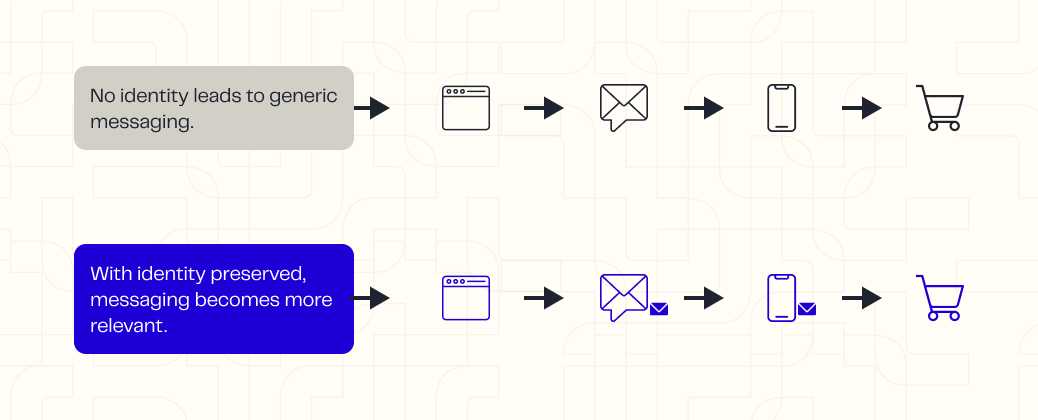
In strong email programs, data intelligence shows up early.
Its impact isn’t visible in subject lines or layouts. It appears in the quality of decisions made before creative work begins. Teams use data to understand the customer’s current situation, not just their attributes.
Over time, certain signals consistently shape those decisions:
- Recent behavior that shows intent or hesitation
- Purchase history that indicates familiarity and confidence
- Timing patterns that reveal when attention is available
As these signals accumulate, teams gain clarity on what kind of message the moment can support.
Bashir describes this as recognition rather than targeting.
“When you can recognize someone in the moment they’re engaging, the message starts to feel like a nudge instead of a broadcast.”
This recognition only works when identity is preserved across sessions, devices, and channels. When someone isn't recognized correctly due to cookie loss, device switching, or missing data, high-intent signals get lost, and they drop back into generic messaging.
This is why identity resolution becomes the infrastructure. It extends the window of recognition and prevents returning shoppers from being treated like strangers.
Data also brings discipline to incentive use. Some moments call for urgency, others for clarity, and many for neither. Signals make that distinction visible.
Recognition preserves context across interactions. When identity and intent stay connected:
- Prior behavior carries forward
- Messages reflect continuity
- Conversations progress instead of restarting
The teams that see consistent performance treat data intelligence as the system that defines when a message belongs and what it should support.
Data creates the conditions for relevance. Everything else builds on that foundation.
How creative intelligence drives real decisions
Once context is clear, creative intelligence shapes how the decision unfolds.
In effective email programs, creativity influences how the message is interpreted and whether the customer feels confident enough to act. The work centers on momentum and clarity.
Bashir frames creativity as an adoption mechanism.
“The role of creative is to make adoption easier. If it doesn’t help someone take the next step, it’s not doing its job.”
Most email programs operate within a narrow box, relying primarily on segmentation and value variation. While these are powerful levers, they're just two of many.
High-performing programs independently vary angles, persuasive cues, product selection, content types, and framing, based on real-time motivation. This keeps messaging relevant across customers without increasing creative volume.
This focus explains why strong creative work often appears simple. It aligns with what the customer already cares about and reduces unnecessary complexity.
Creative intelligence consistently shows up in a few ways:
- Attention is earned through relevance.
- Perception shifts through framing.
- Hesitation lowers through clarity.
Many of the most impactful creative decisions happen before execution. Choices about which product to feature, which angle to lead with, and which proof point to show shape readiness long before copy is written.
Bashir highlights this as one of the most overlooked creative levers.
“Choosing what to show is a creative act. Choosing what to leave out is a creative act.”
When these decisions are made deliberately, patterns emerge. Certain angles, formats, and cues reduce friction, support understanding, and/or build confidence.
Creative intelligence becomes easier to evaluate because decisions connect to observable outcomes. Over time, creativity turns into a system that carries learning forward.
That’s how creative work contributes directly to performance by shaping how the decision feels at the moment it’s made.
Why most teams fail at measuring creative performance
Creative performance becomes hard to manage when results move, but reasons don’t. Email programs keep running, revenue continues to appear, and reporting stays active.
Over time, teams lose clarity on which creative decisions influence outcomes and which changes are incidental. Performance shifts without producing insight, making progress difficult to repeat.
The sections below explain where that visibility breaks, how creative decisions disappear into execution, and why learning slows as volume increases.
Measurement is based on outcomes, not decisions.
Most teams review creative performance through campaign-level results.
They look at revenue per send, click-through rates, inbox placement, and downstream conversion. These metrics confirm what happened after an email was delivered. They do not explain which creative choices influenced behavior.
Bashir points to this gap directly.
“Most teams measure outcomes, but they don’t measure the decisions that created those outcomes.”
When decisions stay invisible, performance data lacks explanatory power. Teams observe change without understanding its source.
Creative decisions stay invisible
Every email is built from a set of choices, which product or category leads, how value is framed (education, urgency, reassurance), which proof points appear (reviews, guarantees, usage), and what tone carries the message.
Most teams make these decisions instinctively, but never label or track them. Since these inputs aren’t defined, they can’t be compared across campaigns.
As a result, performance reviews focus on surface metrics (opens, clicks, revenue) rather than the decisions that caused them. Teams tweak layouts or copy, but the underlying drivers stay the same, so learning stalls even as volume increases.
Bundled changes obscure learning
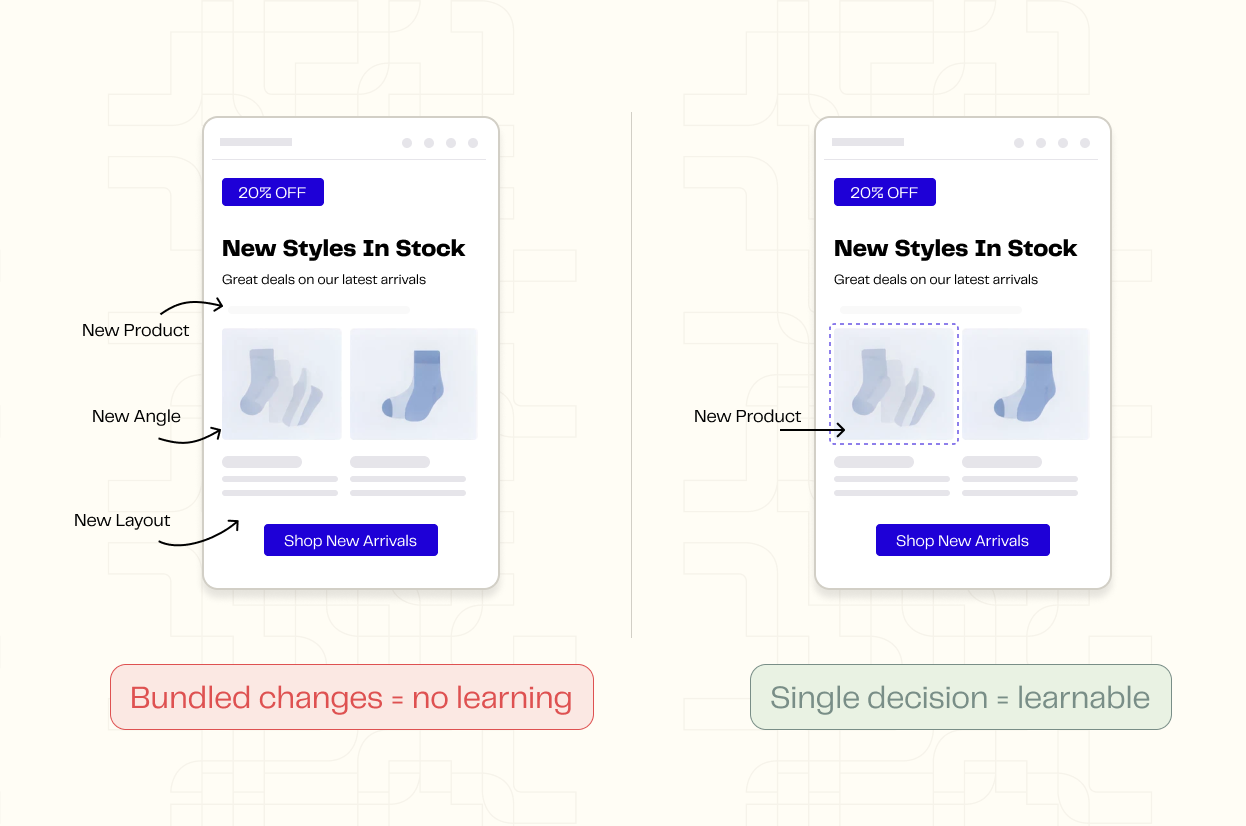
As email programs scale, teams ship more creatives at once. A single campaign often introduces a new angle, different products, a new layout, and updated copy—all in the same send.
When performance moves, there’s no way to tell which decision caused it. Revenue might lift or drop, but the signal is muddy. Attribution breaks at the decision level.
As Bashir puts it,
“When everything changes at once, nothing is learnable.”
Winning campaigns get reused without knowing why they worked. Losing ones get shelved without yielding insight. While output increases, learning slows and campaigns stop compounding.
Creative performance requires structure
Creative only compounds when it’s treated as a system, not a series of one-off executions.
High-performing teams make creative decisions explicit and repeatable. Instead of evaluating emails as whole artifacts, they track a small set of decision inputs across campaigns, such as:
- The customer context the message addresses
- The action the message supports
- The angle used to frame the value
- The product or proof point that carries credibility
- The cues used to support confidence
When these inputs stay consistent and visible, teams can compare performance at the decision level. That’s what makes it easy to interpret results and turn insights into improvements.
Learning compounds when decisions stay visible
Once creative decisions are consistently named and evaluated, patterns emerge.
- Teams can identify which angles move customers forward, which product choices build trust, and which cues reduce hesitation.
- Reviews shift from taste-based feedback to decision-based analysis.
- Iteration becomes faster because insight carries forward.
Creative performance becomes predictable because learning compounds. That’s when measurement fulfills its role: explaining behavior, guiding future decisions, and supporting repeatable growth.
The anatomy of a high-performing email system
High-performing email programs rely on a small set of decisions made consistently well. These systems work because each input supports the next. When one part lacks clarity, everything built on top of it weakens.
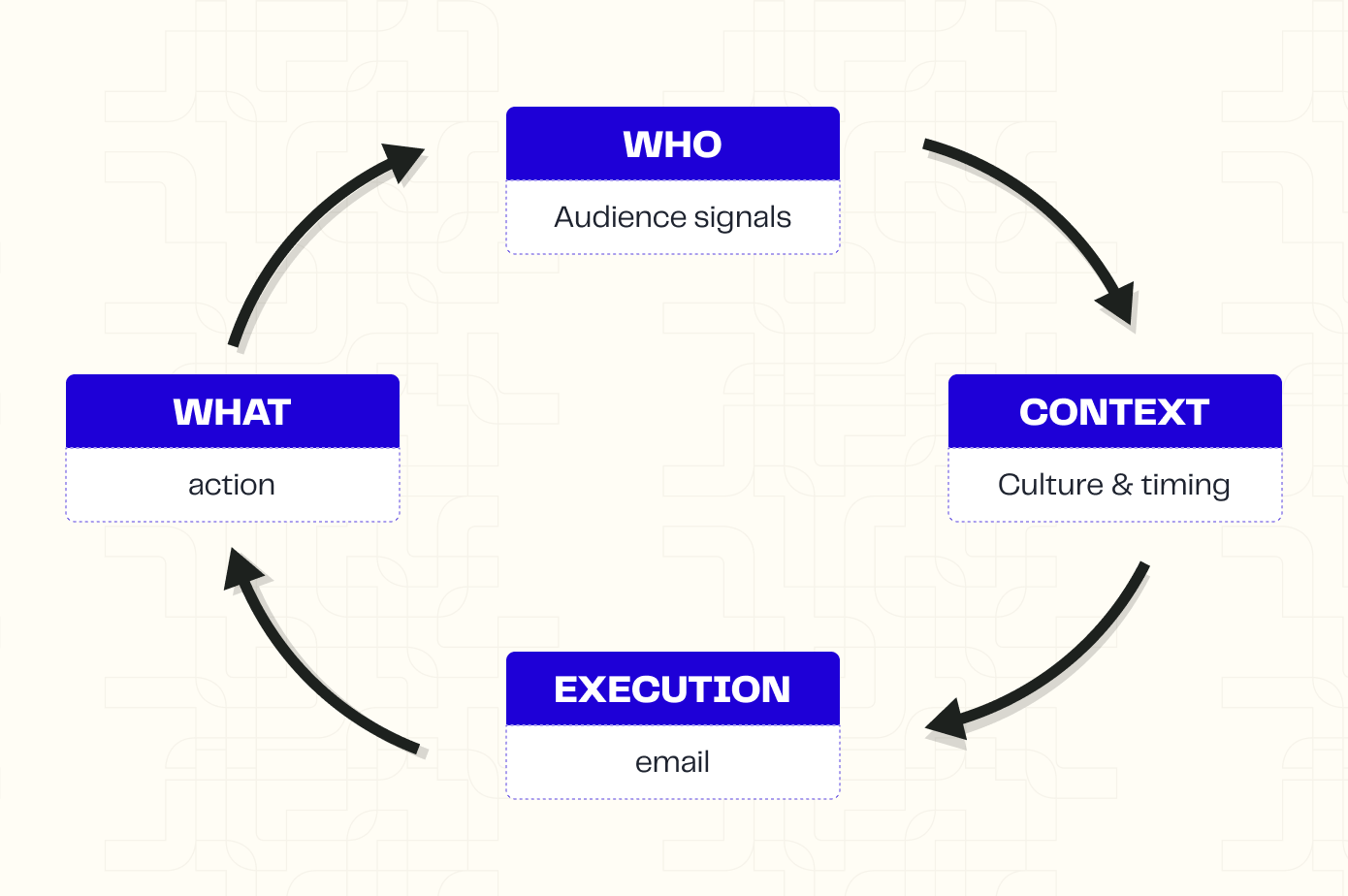
The structure below reflects how strong teams organise those decisions in practice.
1. Who are you talking to
Every email begins with audience clarity, who this message is for right now.
Strong teams define the audience for each message using signals that reflect current intent and readiness, not static attributes. This keeps messaging aligned with where the customer actually is.
Relevant inputs at this stage include:
- Behavioral signals that show interest, hesitation, or momentum
- Purchase history that indicates familiarity and confidence
- Recency patterns that reflect engagement timing
- Zero-party and inferred data that add intent context
This decision carries disproportionate weight. When audience context is unclear, teams compensate with volume, incentives, or generic framing. When it’s clear, messages can stay focused and specific.
Bashir explains why this decision carries so much weight:
“If you don’t know who you’re speaking to in that moment, everything downstream becomes guesswork.”
2. What are you asking them to do
Once the audience is defined, the next decision centers on action.
High-performing programs are explicit about the action each message supports. That clarity guides how the message is framed and what elements it includes.
This typically involves decisions around:
- Offer framing that aligns with readiness
- Content types that support the action (such as education, proof, or promotion)
- Marketing angles that connect value to intent
- Persuasive cues that reduce hesitation
As Bashir notes:
“A lot of emails try to do too much. The best ones are very clear about the action they’re supporting.”
Clear action intent keeps messages cohesive. Every element works toward the same outcome, reducing cognitive load for the reader.
3. Context matters more than most teams admit
Messages land within a broader context.
Cultural signals, shifting expectations, and market awareness influence how customers interpret language, claims, and offers. Strong systems account for this context rather than treating messaging as isolated communication.
Teams pay attention to:
- Cultural relevance and current norms
- Changes in customer beliefs or decision criteria
- Framing that reflects how people evaluate value today
When context is aligned, messages feel current and grounded. They match how customers are thinking at the moment of receipt.
Bashir highlights how quickly this can drift:
“What worked six months ago might still convert, but it doesn’t always resonate the same way.”
As frequency increases, rotating angles helps maintain relevance. The same offer framed through different lenses (relief from pain, aspiration, social proof) stays effective even as exposure increases.
4. Execution determines whether it lands
Execution turns decisions into experience.
This is where structure, clarity, and presentation either support the message or get in the way. Strong execution makes it easy to understand what matters and what to do next.
Key considerations include:
- Clear hierarchy that guides attention
- Repeatable blocks that support consistency
- Copy clarity that avoids interpretation gaps
- Visual reinforcement that manages cognitive load
Bashir sums this up succinctly:
“Execution works best when the thinking is already done.”
When audience, action, and context are clear, execution becomes simpler, faster, and more consistent. The message doesn’t have to work as hard because the decisions behind it are already sound.
How strong teams operationalize creativity
Strong teams treat creativity as a process with clear inputs, and not as a moment of inspiration.
Creative work starts well before copy or design. The first decisions occur at the psychological level: who the customer is at that moment, which problem is active, and what makes a message feel relevant rather than intrusive.
Bashir describes the creative process as moving through a deliberate order:
“Customer → Company → Competitors → Culture.”
Start with the customer’s mental state
Before anything is written, strong teams work to understand what’s happening in the customer’s head right now.
When identity and intent are connected, messages feel intentional. When they aren’t, messages default to safe, generic framing.
To ground creative in the customer’s reality, teams focus on:
- The problem the customer is actively trying to solve
- What the customer already believes about that problem
- What would make the message feel timely and useful
The most reliable inputs come from places where customers speak freely:
- Reddit threads and online communities where the ICP spends time
- Customer surveys and zero-party data
- Reviews and support conversations that capture unfiltered language
Bashir emphasises that this step shapes everything downstream.
“Before you think about copy or design, you have to understand what problem is active and what would make this message feel relevant.”
Ground creative in the brand’s real strengths
Once customer context is clear, teams anchor ideas in what the brand genuinely does well. This keeps creative work credible and consistent.
Teams look closely at:
- Where the product actually wins
- Which promises the brand can confidently support
- What messaging already performs across other channels
High-performing teams pay particular attention to:
- Paid social creative on Meta, YouTube, TikTok
- Organic content across short-form video and social feeds
- Broader brand campaigns, including TV spots where applicable
Email creative reflects these signals rather than introducing a separate voice. Messages feel like they come from the same company, not a different team.
Expand perspective through competitors and patterns
Once ideas are grounded in the customer and the brand, strong teams widen the lens.
They study competitor emails and adjacent categories using libraries like Email Donut and Milled, looking for recurring formats, angles, and structures that consistently show up in high-performing programs.
The goal is to recognize patterns. When the same approaches appear across strong programs, they become reliable inputs for creative decisions rather than one-off ideas.
Account for cultural context
Creative work also reflects the environment in which customers operate. Teams pay attention to culture at two levels.
- Within customer communities:
- Shared language
- Norms and beliefs
- Signals of credibility versus cringe
- Across broader platforms:
- Shifts in how people search and make decisions
- Platform behaviors shaping attention and expectations
- What feels current, dated, or overused
Bashir notes
“What resonates changes faster than most teams realise.”
Ignoring this layer is how messages quietly lose relevance, even when performance looks stable.
Make creativity operational
Creativity becomes scalable when ideas are captured and reused.
Strong teams build systems where creative insight lives:
- Shared Slack channels for discussions
- Notion docs for patterns, angles, and observations
- Figma files for reusable structures and layouts
This reduces reliance on memory and keeps learning accessible. Creative decisions stay visible, which allows insight to compound instead of resetting with every campaign.
When data and creative come together: Real examples
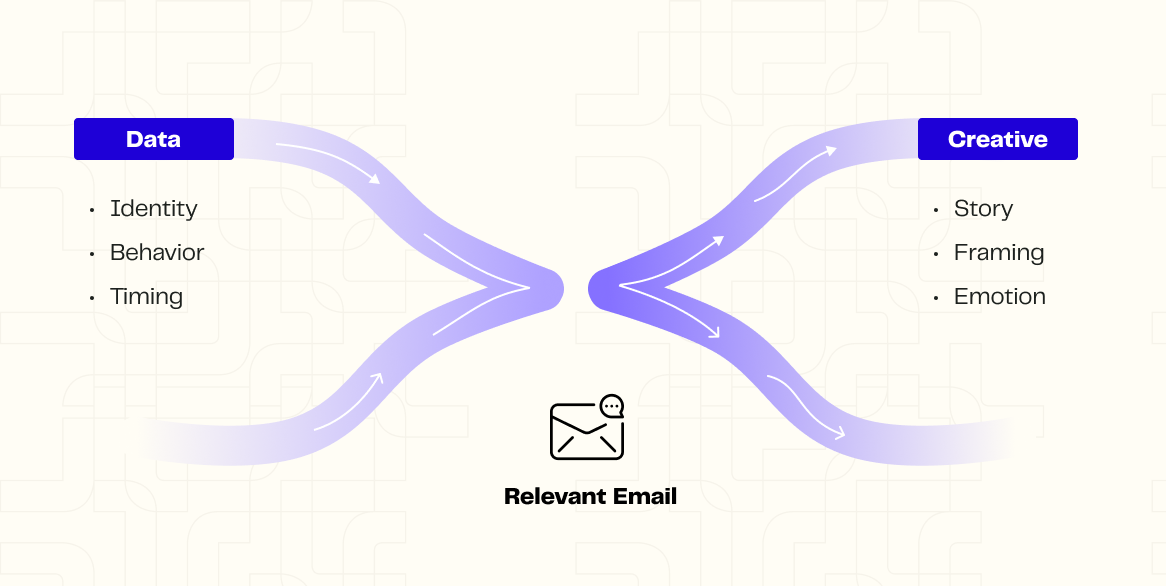
Alignment shows up most clearly when data insight and creative choice reinforce each other. Bashir shared two examples where that connection translated directly into measurable performance.
Example 1: Category-specific merchandising
For Viasox, behavioral data surfaced a consistent pattern.
Customers showed a strong tendency to repurchase within the same sock category they had bought from previously. Campaign performance improved when customers received emails featuring only the category they had already purchased from, even during launches that introduced new styles across categories.
The creative decision focused on narrowing what each customer saw. Product selection became the primary lever.
That choice aligned messaging with existing intent and drove incremental revenue. Data identified the opportunity. Creative applied clarity.
“Deciding what to show someone is a creative decision. Data just makes that decision obvious.”
Example 2: Translating paid creative into email
In another case, a client identified a paid ad that consistently drove strong performance. The creative was simple: a screenshot of a ChatGPT conversation.
The team adapted that exact concept into an email and saw higher revenue than other gifting-focused sends for the same brand.
The message reflected a real behavioral shift. Customers were already using AI tools to find thoughtful, affordable gifts. The email acknowledged that behavior directly and framed gifting around it, which reduced friction and guided the decision.
Once performance was validated, the same creative was moved into automated flows. Tools like Tie made it possible to identify customers reliably and trigger that content at the right stage of the journey.
The pattern underneath both examples
In both cases, performance followed the same sequence:
- Data revealed a real behavioral signal
- Creative made a focused, deliberate decision
- Performance validated the choice
How to diagnose email performance issues
Issues with email performance become easier to solve when teams diagnose in the right order.
The fastest path to clarity is to start with data. It exposes blind spots early and prevents teams from optimizing creative when the real constraint sits upstream. Bashir consistently recommends working through diagnosis sequentially: reach → visibility → content.
1. Start with coverage and reach
The first question to answer is simple. Are enough relevant people actually receiving emails?
Flat revenue often traces back to limited coverage rather than weak messaging. Teams assume creative is the problem while large portions of high-intent traffic never enter the lifecycle at all.
Common coverage gaps include:
- Segments defined too narrowly
- High-intent users failing to get identified
- Large sections of traffic and customers remain invisible
When reach expands to include more relevant people, revenue often moves without any creative changes. Coverage sets the ceiling for performance.
2. Check deliverability and frequency
Once reach is clear, the next checkpoint is visibility.
Emails must consistently reach the inbox and arrive at a sustainable pace. Low open rates usually point to issues upstream rather than problems with copy or design.
Teams should assess:
- Deliverability health across providers
- Spam placement and inbox consistency
- Sending frequency relative to engagement
Over-emailing conditions audiences to disengage. In many cases, adjusting frequency often improves opens without touching subject lines or creative structure. Visibility sets the conditions for engagement.
3. Evaluate content and creative
With reach and visibility established, content becomes the focus.
At this stage, performance signals are easier to interpret. Opens confirm messages are being seen. Clicks and downstream behavior show whether the message supports action.
Key questions to ask:
- Is there a clear next step or action?
- Does the angle match current intent?
- Does the message reflect where the reader is in their journey?
High opens paired with low clicks usually point to a content or framing issue. Decisions around product focus, angle, and persuasion cues determine whether attention turns into action.
Note: Click rates naturally decline as programs scale and frequency increases. This isn't a sign that creative got worse. Instead, it's a natural consequence of reaching broader audiences and higher email volume. The metrics that matter most are total conversions and incremental revenue, which often rise even as percentages fall.
4. Diagnose in sequence to avoid wasted effort
Teams often jump straight to creative changes because they’re visible and immediate. A structured diagnosis avoids that mistake.
- Coverage defines who can respond.
- Visibility determines whether messages are seen.
- Creative decisions influence whether action follows.
Working through this sequence keeps effort focused and prevents teams from optimizing in the dark.
Build email programs where creative and data reinforce each other
The strongest email programs work because creative and data decisions are made together.
Data provides recognition. It clarifies who the message is for, what moment the customer is in, and how much intent already exists.
Creative decisions build on that context, shaping messages that feel relevant and timely. When these layers stay connected, email functions like a system rather than a series of disconnected sends.
That connection is what allows learning to compound. But to operate this way, teams need data that preserves context across the lifecycle. Identity, intent, and behavior need to remain visible so that creative decisions can reflect what actually drove action, not assumptions or averages.
Tie supports this by identifying previously anonymous visitors and syncing real behavioral signals directly into your ESP. That keeps recognition intact across sessions and allows creative decisions to respond to what customers are actually doing, not what teams hope they’re doing.
If email performance is a priority this quarter, start by fixing the system it runs on.
Book a demo to see how teams use Tie to connect data and creative to drive repeatable growth.






Identity, intent and inbox placement for ecommerce brands, inside the tools you already run.
Klaviyo Preferred Tech Partner