
← All articles

AI Shopper Segmentation

·

6

min read

How to Use Tie Predict During BFCM to Prioritize The Right Shoppers

Learn how to use Tie Predict during BFCM to segment shoppers by Purchase, Open, and Click Scores and prioritize the audiences most likely to act.

John Levis

John Levis

Director of Product Marketing

, Tie ·

October 22, 2026

How to Use Tie Predict During BFCM to Prioritize The Right Shoppers

During BFCM, you’re making more audience decisions in a much shorter window. Your usual 30-, 60-, or 90-day segments show email engagement, but they don’t capture onsite behavior or other signals that indicate current purchase intent. That leaves you with limited visibility into shoppers who are actively considering a purchase but haven’t engaged with your emails recently.

The problem is bigger when you can’t identify most of your website visitors. A shopper can browse products or return to your site without that activity being connected to the email profile you use for segmentation.

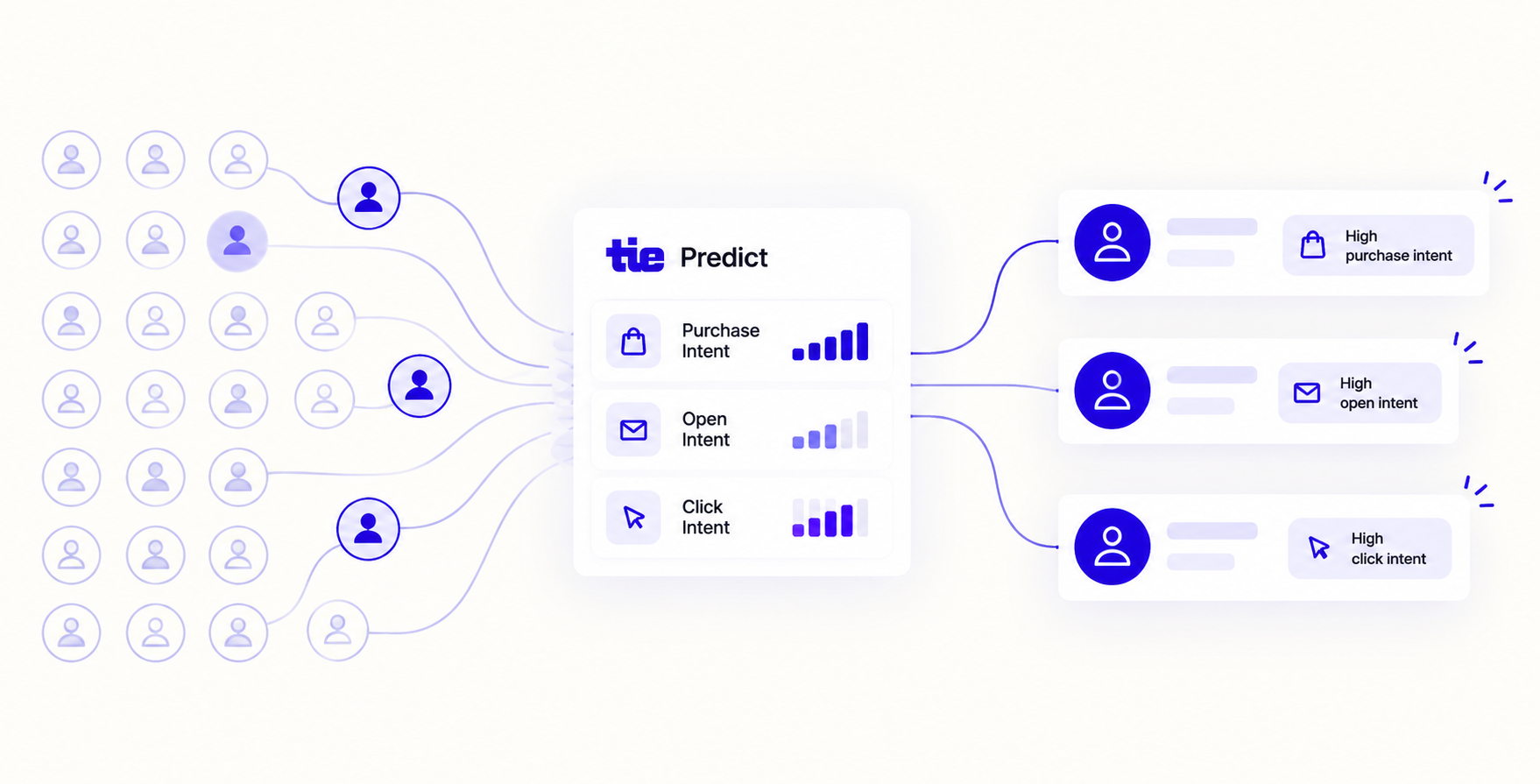
Tie Predict adds intent to that existing segmentation. Its three scores refresh daily:

  • Purchase Scores help you identify shoppers most likely to purchase.
  • Open Scores help you manage sending volume.
  • Click Scores help you prioritize shoppers for time-sensitive campaigns.

You can layer these scores onto your existing segments and adjust who you reach as intent changes throughout BFCM.
‍

1. Layer Purchase Scores onto your existing engagement segments

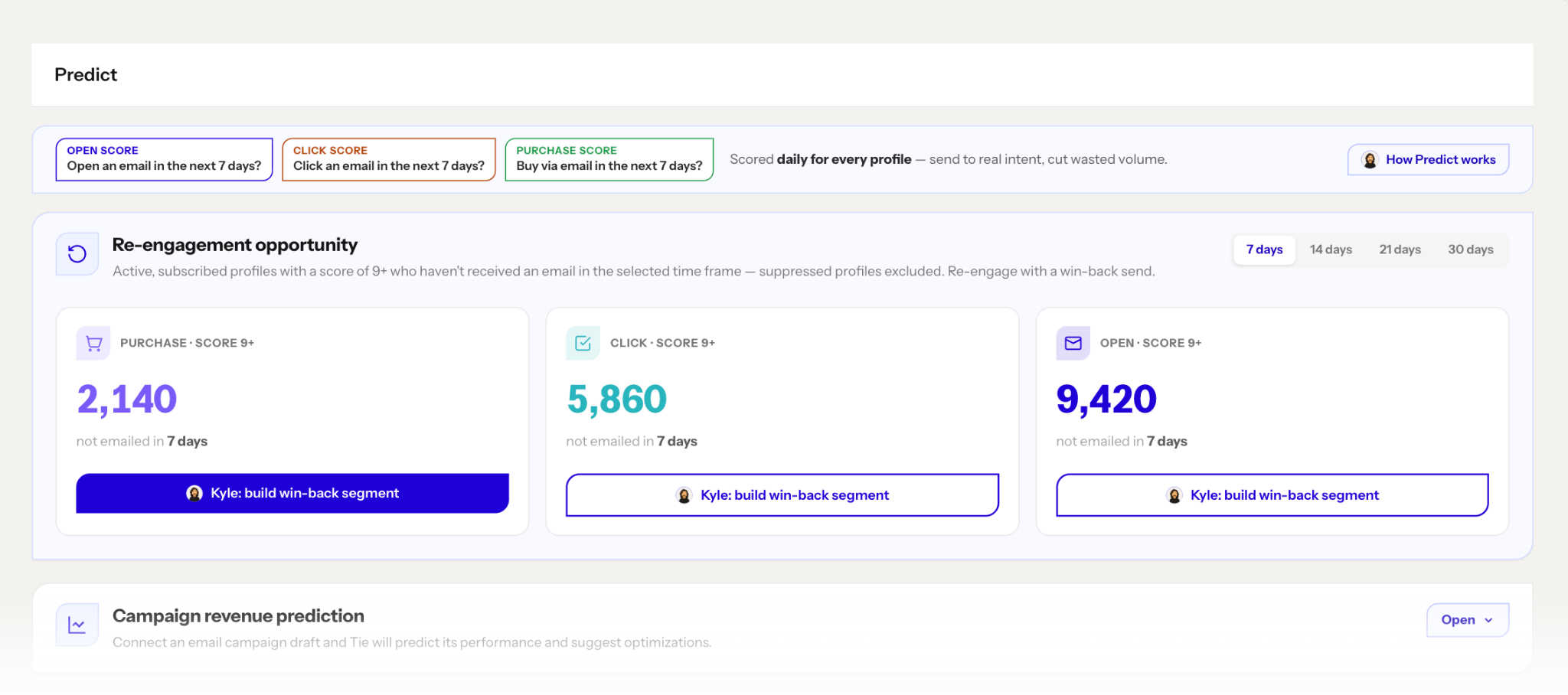
You don’t need to replace your existing 30-, 60-, or 90-day engagement segments before BFCM. Start by keeping those segments as your baseline and adding Purchase Scores to identify shoppers your existing rules may have excluded despite showing current buying intent.

Start with a Purchase Score of 7 or above to find shoppers your engagement rules have excluded despite showing current buying intent. This is a starting threshold, not a fixed rule, since the right cutoff can vary by audience.

You can also use overrides to refine your existing audiences:

  • Include override: Add shoppers with high Purchase Scores who your existing rules excluded.
  • Exclude override: Remove contacts with low Open Scores who your existing rules included.

We’ll look more closely at how Purchase Scores can help you reconsider shoppers filtered out by your existing exclusion rules later in this blog.

2. Use Purchase Scores to decide who gets the offer

Use Purchase Scores as the primary signal to decide who gets an offer during BFCM. Use it to prioritize shoppers for major campaigns and flows, from doorbusters to cart-abandonment messages, rather than treating everyone who meets an engagement rule the same.

For example, use your highest-intent shoppers for your strongest or most time-sensitive offers, while using lower-intent groups for less aggressive campaigns. 

Validate these groups against audience size and RPR to understand where each level of intent contributes most.

Keep consent and opt-out status separate from these decisions. A high Purchase Score never overrides an unsubscribe or complaint.
3. Use Open Scores to decide how far you can scale each send

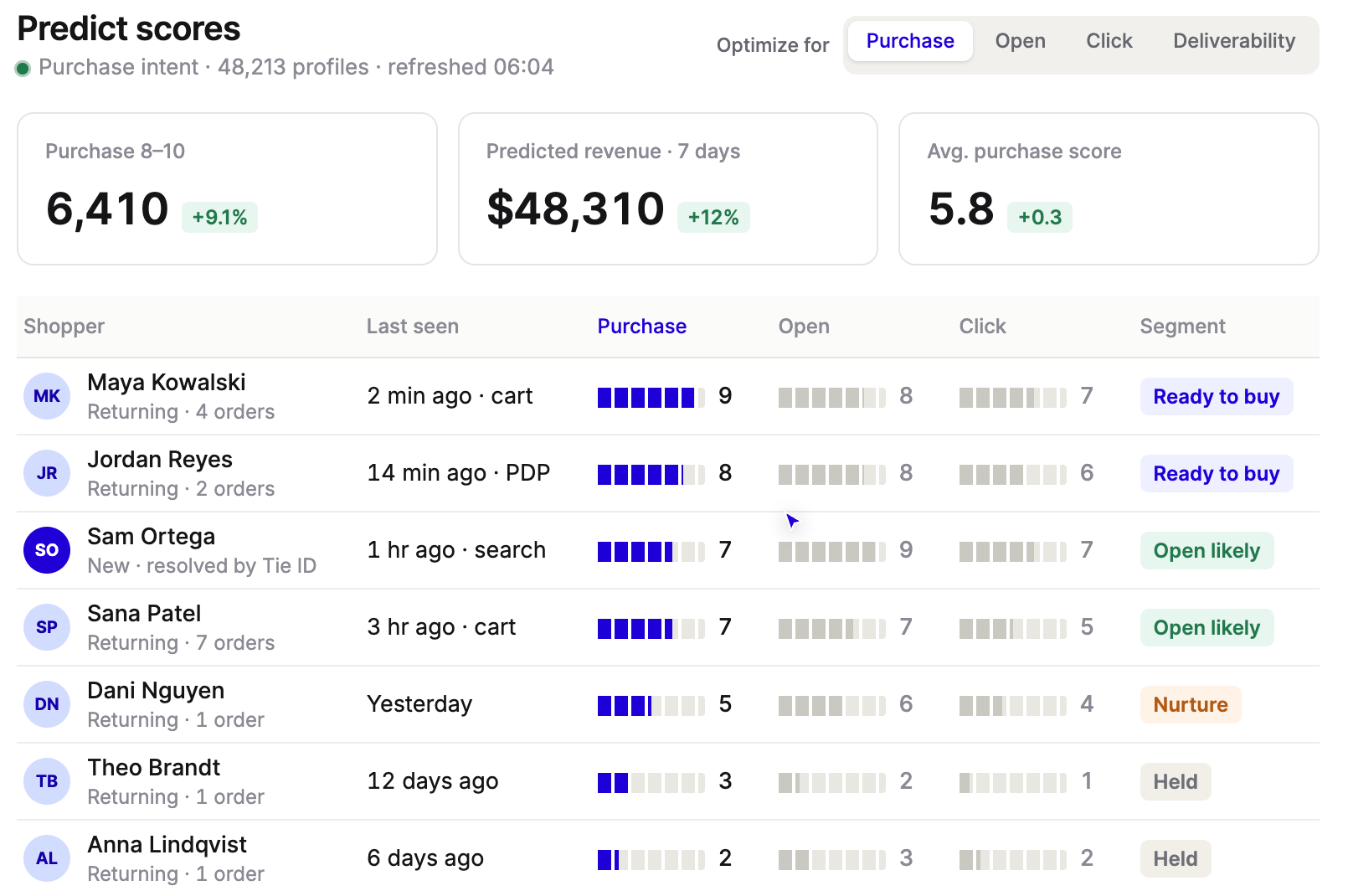
Open Scores helps you manage sending volume as BFCM approaches. Start relying on it 2–4 weeks before BFCM to shape your volume ramp, holding back contacts with low Open Scores as you increase send volume.

Contacts with high Open Scores but low Purchase Scores are also strong nurture targets. They’re likely to see your messages, making them a useful audience for campaigns designed to build purchase intent over time. Use early access, wishlists, gift guides, and similar content to keep them engaged and move them toward a higher Purchase Score before peak.

Keep them engaged with early access, wishlists, gift guides, and similar content to keep these shoppers engaged and give them opportunities to build purchase intent before peak. 
4. Use Click Scores for time-sensitive BFCM campaigns

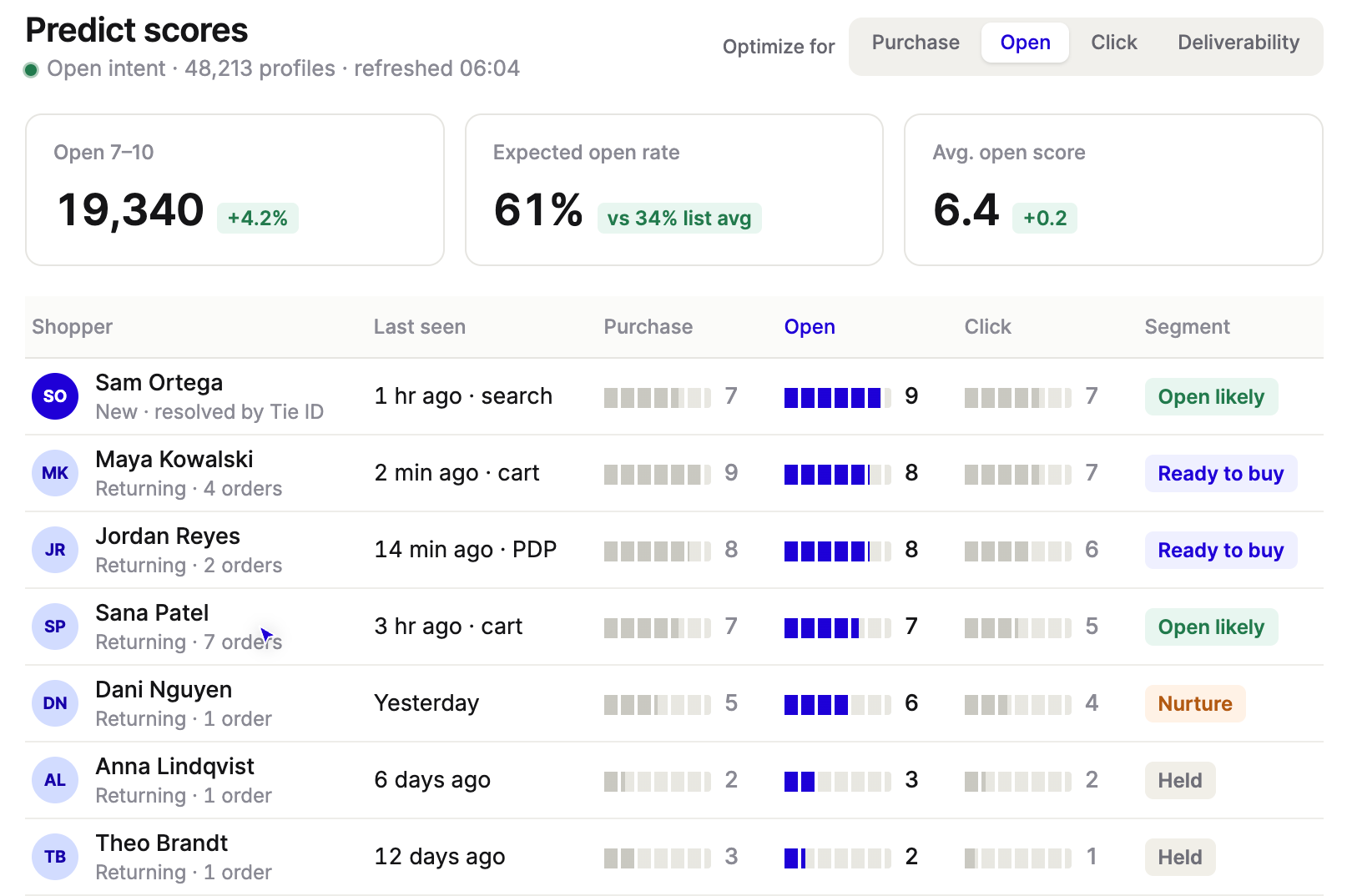
When the goal is immediate action, Click Scores help you identify shoppers most likely to click. It is particularly useful for doorbuster drops, limited-inventory campaigns, and offers that end at midnight.

For reminders and final-hours sends, use Click Scores along with recent campaign and site activity to narrow the audience further to focus on shoppers most likely to engage. 
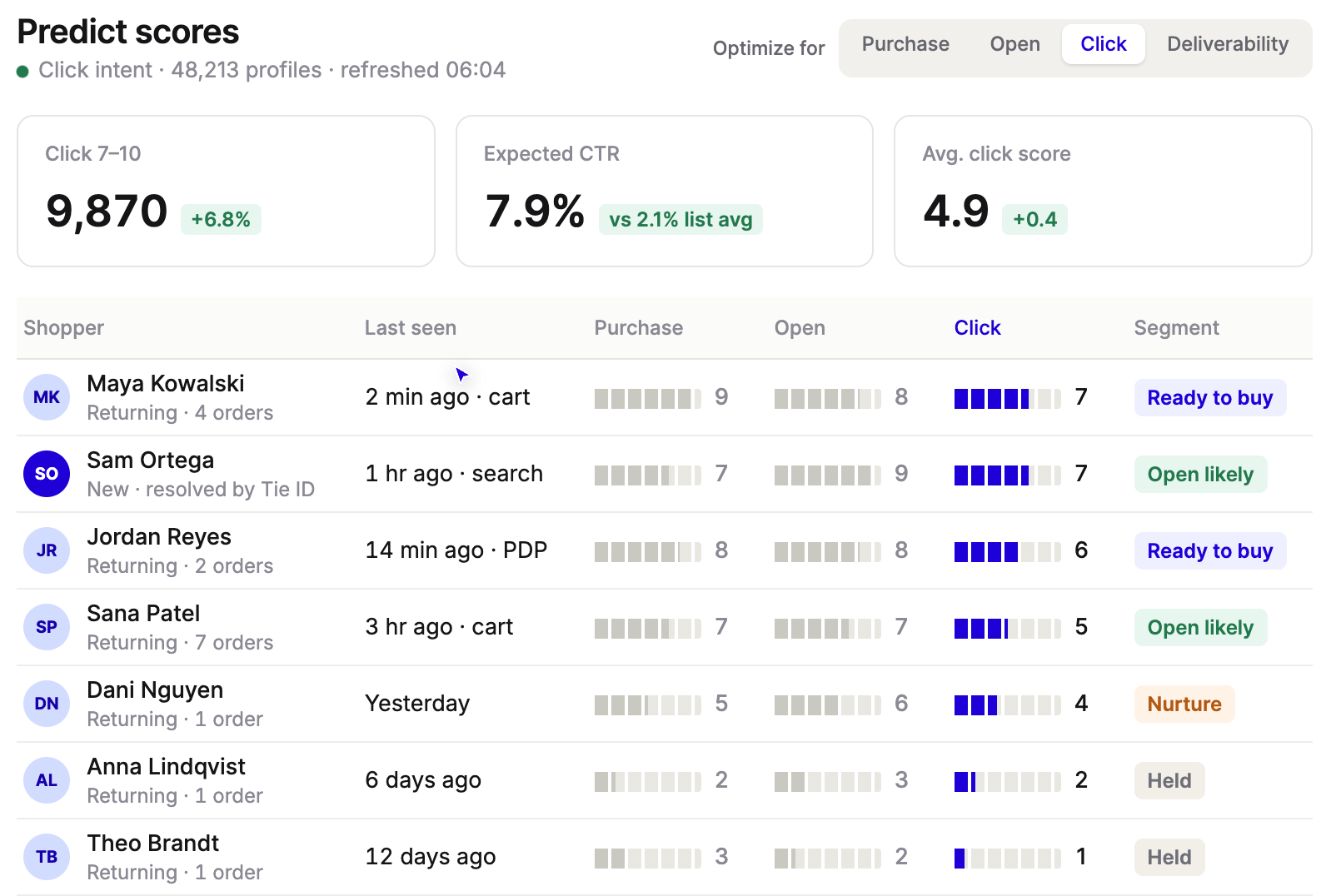
5. Rebuild your audiences daily during the sale week

During BFCM, don’t treat your segments as fixed lists. With Tie Predict, scores refresh daily, allowing you to rebuild your audiences each morning and move shoppers into or out of priority groups automatically as their Purchase Score changes.

That also lets you reassess shoppers whose intent drops instead of continuing to target them based on a segment you created long before BFCM.

For shoppers who’ve already purchased, use Purchase Scores to identify and include them in your second-purchase flow. For time-sensitive campaign sends, use Click Scores to decide who still belongs in your immediate-action audience.
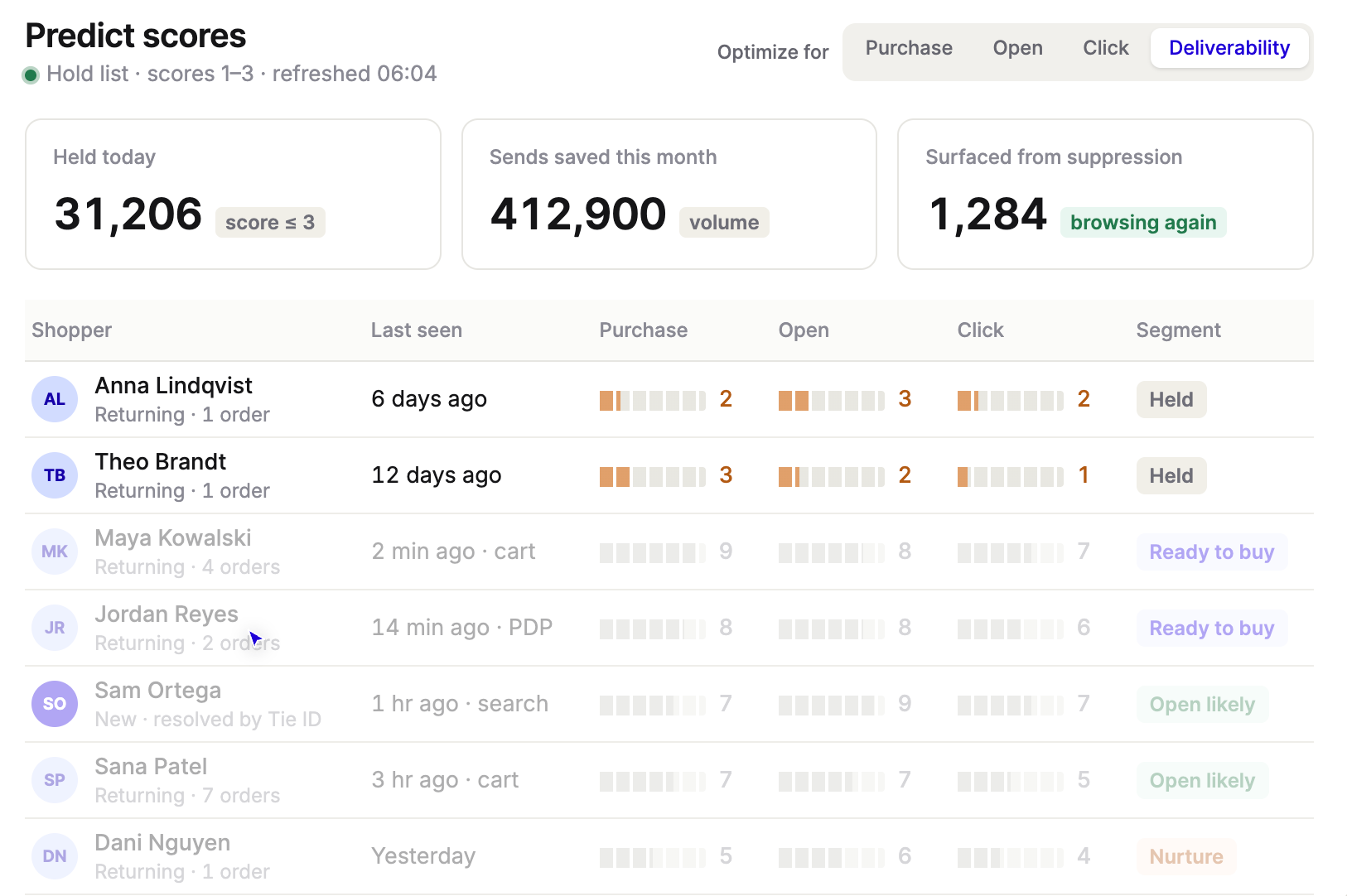
6. Reconsider the shoppers your engagement rules exclude

Your existing engagement rules can leave several high-intent groups out of your BFCM audiences. Purchase Scores give you a way to identify shoppers whose current buying intent isn't reflected in their email engagement history. Look for:

  • Silenced buyers: Shoppers with high Purchase Scores who your unengaged rules have excluded.
  • Day-one BFCM subscribers: New subscribers with high Purchase Scores and low email history.
  • Cross-device shoppers: Shoppers with high Purchase Scores and no recorded activity because their activity is split across devices or profiles. Tie ID helps connect that activity to the right customer profile, giving you a clearer view of their current buying intent.
  • Bot-inflated engaged contacts: Contacts with high opens but low Click and Purchase Intent.
  • External-intent shoppers: Shoppers showing Purchase intent through activity outside your existing Klaviyo engagement data.
  • Paid crossover: High Purchase Score audiences you can also use in Meta or Google.

7. Allocate frequency toward your highest-intent shoppers

Don’t increase frequency across your entire list during BFCM. Treat frequency as an allocation decision, not a blanket increase.

Use Open Scores to hold back shoppers who are less likely to engage while using Purchase Scores to identify shoppers who are most likely to respond to additional sends.

SharperImage.com faced a similar challenge with their high-frequency promotional program. The team wanted to reduce unnecessary sends without giving up revenue, so they moved away from broad list-wide campaigns and focused on subscribers most likely to engage and purchase. 

This helped the brand generate 10% more revenue per campaign while sending 22% fewer emails, with 41% higher revenue per recipient, 17% higher open rates, and 36% higher click-through rates.
8. Measure Revenue Per Recipient by intent groups

Open and click rates tell you whether people engaged. During BFCM, you also need to understand whether each intent group is generating enough revenue to justify the sends.

Compare Revenue Per Recipient (RPR) across your high-, medium-, and low-intent groups, and then compare each group with your broader engaged audiences. Use the results to understand which intent groups are worth expanding, maintaining, or reducing.

For instance, if a lower-intent group contributes enough revenue to justify the additional sends, keep it in your mix. If it doesn’t, concentrate more of your volume on higher-intent shoppers.

The goal is to validate your audience thresholds against revenue, rather than assuming that higher engagement or a particular intent score will automatically produce better results.

Put Tie Predict to work before, during, and after BFCM

BFCM planning starts weeks before the first major promotion. Use that runway to test your audience strategy, build sending volume gradually, and make sure your segments are ready to adapt as shopper intent changes.

Here’s how to use Predict across the BFCM timeline:

  • 6–8 weeks before: Start with your suppression list. Identify contacts with high Purchase Scores and reintroduce them at a capped volume. Give these shoppers time to re-engage before your biggest campaigns. Give these shoppers time to re-engage before your biggest campaigns instead of bringing them back for the first time with a Black Friday promotion.
  • 2–4 weeks before: Use Open Scores to guide your volume ramp. Increase sending gradually and hold back contacts with low Open Scores as volume grows.
  • During Cyber Week: Rebuild your audiences daily as Predict scores refresh. Use Purchase Scores to decide who gets the offer, Open Scores to manage sending volume, and Click Scores for time-sensitive campaigns.
  • After BFCM: Move first-time buyers with high Purchase Scores into your second-purchase flows. For campaign targeting, use Click Scores rather than historical open behavior to identify shoppers for time-sensitive sends.

If you want to see how Tie Predict can fit into your BFCM targeting strategy, book a demo.
Written by

John Levis

Director of Product Marketing

, Tie

John leads product marketing at Tie, where he focuses on positioning, messaging, and helping ecommerce brands make better use of customer identity and behavioral data.

Maya K. identified · score 9Jordan R. synced to KlaviyoSana P. landed in PrimaryDani N. ready to buy

See what Tie finds on your site.

A 20-minute walkthrough on your own traffic — positive ROI within 30 days.

Book a demoSee pricing
October 22, 2026

How to Use Tie Predict During BFCM to Prioritize The Right Shoppers

Written by
John Levis
Director of Product Marketing
John leads product marketing at Tie, where he focuses on positioning, messaging, and helping ecommerce brands make better use of customer identity and behavioral data.

During BFCM, you’re making more audience decisions in a much shorter window. Your usual 30-, 60-, or 90-day segments show email engagement, but they don’t capture onsite behavior or other signals that indicate current purchase intent. That leaves you with limited visibility into shoppers who are actively considering a purchase but haven’t engaged with your emails recently.

The problem is bigger when you can’t identify most of your website visitors. A shopper can browse products or return to your site without that activity being connected to the email profile you use for segmentation.

Tie Predict adds intent to that existing segmentation. Its three scores refresh daily:

  • Purchase Scores help you identify shoppers most likely to purchase.
  • Open Scores help you manage sending volume.
  • Click Scores help you prioritize shoppers for time-sensitive campaigns.

You can layer these scores onto your existing segments and adjust who you reach as intent changes throughout BFCM.

‍

1. Layer Purchase Scores onto your existing engagement segments

You don’t need to replace your existing 30-, 60-, or 90-day engagement segments before BFCM. Start by keeping those segments as your baseline and adding Purchase Scores to identify shoppers your existing rules may have excluded despite showing current buying intent.

Start with a Purchase Score of 7 or above to find shoppers your engagement rules have excluded despite showing current buying intent. This is a starting threshold, not a fixed rule, since the right cutoff can vary by audience.

You can also use overrides to refine your existing audiences:

  • Include override: Add shoppers with high Purchase Scores who your existing rules excluded.
  • Exclude override: Remove contacts with low Open Scores who your existing rules included.

We’ll look more closely at how Purchase Scores can help you reconsider shoppers filtered out by your existing exclusion rules later in this blog.

2. Use Purchase Scores to decide who gets the offer

Use Purchase Scores as the primary signal to decide who gets an offer during BFCM. Use it to prioritize shoppers for major campaigns and flows, from doorbusters to cart-abandonment messages, rather than treating everyone who meets an engagement rule the same.

For example, use your highest-intent shoppers for your strongest or most time-sensitive offers, while using lower-intent groups for less aggressive campaigns. 

Validate these groups against audience size and RPR to understand where each level of intent contributes most.

Keep consent and opt-out status separate from these decisions. A high Purchase Score never overrides an unsubscribe or complaint.

3. Use Open Scores to decide how far you can scale each send

Open Scores helps you manage sending volume as BFCM approaches. Start relying on it 2–4 weeks before BFCM to shape your volume ramp, holding back contacts with low Open Scores as you increase send volume.

Contacts with high Open Scores but low Purchase Scores are also strong nurture targets. They’re likely to see your messages, making them a useful audience for campaigns designed to build purchase intent over time. Use early access, wishlists, gift guides, and similar content to keep them engaged and move them toward a higher Purchase Score before peak.

Keep them engaged with early access, wishlists, gift guides, and similar content to keep these shoppers engaged and give them opportunities to build purchase intent before peak. 

4. Use Click Scores for time-sensitive BFCM campaigns

When the goal is immediate action, Click Scores help you identify shoppers most likely to click. It is particularly useful for doorbuster drops, limited-inventory campaigns, and offers that end at midnight.

For reminders and final-hours sends, use Click Scores along with recent campaign and site activity to narrow the audience further to focus on shoppers most likely to engage. 

5. Rebuild your audiences daily during the sale week

During BFCM, don’t treat your segments as fixed lists. With Tie Predict, scores refresh daily, allowing you to rebuild your audiences each morning and move shoppers into or out of priority groups automatically as their Purchase Score changes.

That also lets you reassess shoppers whose intent drops instead of continuing to target them based on a segment you created long before BFCM.

For shoppers who’ve already purchased, use Purchase Scores to identify and include them in your second-purchase flow. For time-sensitive campaign sends, use Click Scores to decide who still belongs in your immediate-action audience.

6. Reconsider the shoppers your engagement rules exclude

Your existing engagement rules can leave several high-intent groups out of your BFCM audiences. Purchase Scores give you a way to identify shoppers whose current buying intent isn't reflected in their email engagement history. Look for:

  • Silenced buyers: Shoppers with high Purchase Scores who your unengaged rules have excluded.
  • Day-one BFCM subscribers: New subscribers with high Purchase Scores and low email history.
  • Cross-device shoppers: Shoppers with high Purchase Scores and no recorded activity because their activity is split across devices or profiles. Tie ID helps connect that activity to the right customer profile, giving you a clearer view of their current buying intent.
  • Bot-inflated engaged contacts: Contacts with high opens but low Click and Purchase Intent.
  • External-intent shoppers: Shoppers showing Purchase intent through activity outside your existing Klaviyo engagement data.
  • Paid crossover: High Purchase Score audiences you can also use in Meta or Google.

7. Allocate frequency toward your highest-intent shoppers

Don’t increase frequency across your entire list during BFCM. Treat frequency as an allocation decision, not a blanket increase.

Use Open Scores to hold back shoppers who are less likely to engage while using Purchase Scores to identify shoppers who are most likely to respond to additional sends.

SharperImage.com faced a similar challenge with their high-frequency promotional program. The team wanted to reduce unnecessary sends without giving up revenue, so they moved away from broad list-wide campaigns and focused on subscribers most likely to engage and purchase. 

This helped the brand generate 10% more revenue per campaign while sending 22% fewer emails, with 41% higher revenue per recipient, 17% higher open rates, and 36% higher click-through rates.

8. Measure Revenue Per Recipient by intent groups

Open and click rates tell you whether people engaged. During BFCM, you also need to understand whether each intent group is generating enough revenue to justify the sends.

Compare Revenue Per Recipient (RPR) across your high-, medium-, and low-intent groups, and then compare each group with your broader engaged audiences. Use the results to understand which intent groups are worth expanding, maintaining, or reducing.

For instance, if a lower-intent group contributes enough revenue to justify the additional sends, keep it in your mix. If it doesn’t, concentrate more of your volume on higher-intent shoppers.

The goal is to validate your audience thresholds against revenue, rather than assuming that higher engagement or a particular intent score will automatically produce better results.

Put Tie Predict to work before, during, and after BFCM

BFCM planning starts weeks before the first major promotion. Use that runway to test your audience strategy, build sending volume gradually, and make sure your segments are ready to adapt as shopper intent changes.

Here’s how to use Predict across the BFCM timeline:

  • 6–8 weeks before: Start with your suppression list. Identify contacts with high Purchase Scores and reintroduce them at a capped volume. Give these shoppers time to re-engage before your biggest campaigns. Give these shoppers time to re-engage before your biggest campaigns instead of bringing them back for the first time with a Black Friday promotion.
  • 2–4 weeks before: Use Open Scores to guide your volume ramp. Increase sending gradually and hold back contacts with low Open Scores as volume grows.
  • During Cyber Week: Rebuild your audiences daily as Predict scores refresh. Use Purchase Scores to decide who gets the offer, Open Scores to manage sending volume, and Click Scores for time-sensitive campaigns.
  • After BFCM: Move first-time buyers with high Purchase Scores into your second-purchase flows. For campaign targeting, use Click Scores rather than historical open behavior to identify shoppers for time-sensitive sends.

If you want to see how Tie Predict can fit into your BFCM targeting strategy, book a demo.
On this page
Stay Connected to the Latest
New articles delivered to your inbox—no strings attached.