Your shoppers interact with your brand across multiple touchpoints, devices, and channels, often anonymously.
A potential buyer might browse on their phone, click an ad on desktop, but eventually buy through email. Without a unified view of these interactions, you’ll identify them as different people. Even worse, if you never recognized the shopper while they browsed on mobile, you’ll miss the opportunity to retarget them with an ad.
This is where identity graphs help. They connect fragmented data points to build a single, accurate view of each customer.
In this article, we’ll explain what identity graphs are, how they work, and how ecommerce brands are using them to uncover anonymous shoppers, enrich their customer data, personalize marketing, and increase conversions.
What is an identity graph?
An identity graph is a database that connects every customer identifier to a single, unified customer profile. These can include:
- Phone number
- Device ID
- Ad ID
- IP
- Location
- Transaction and session data
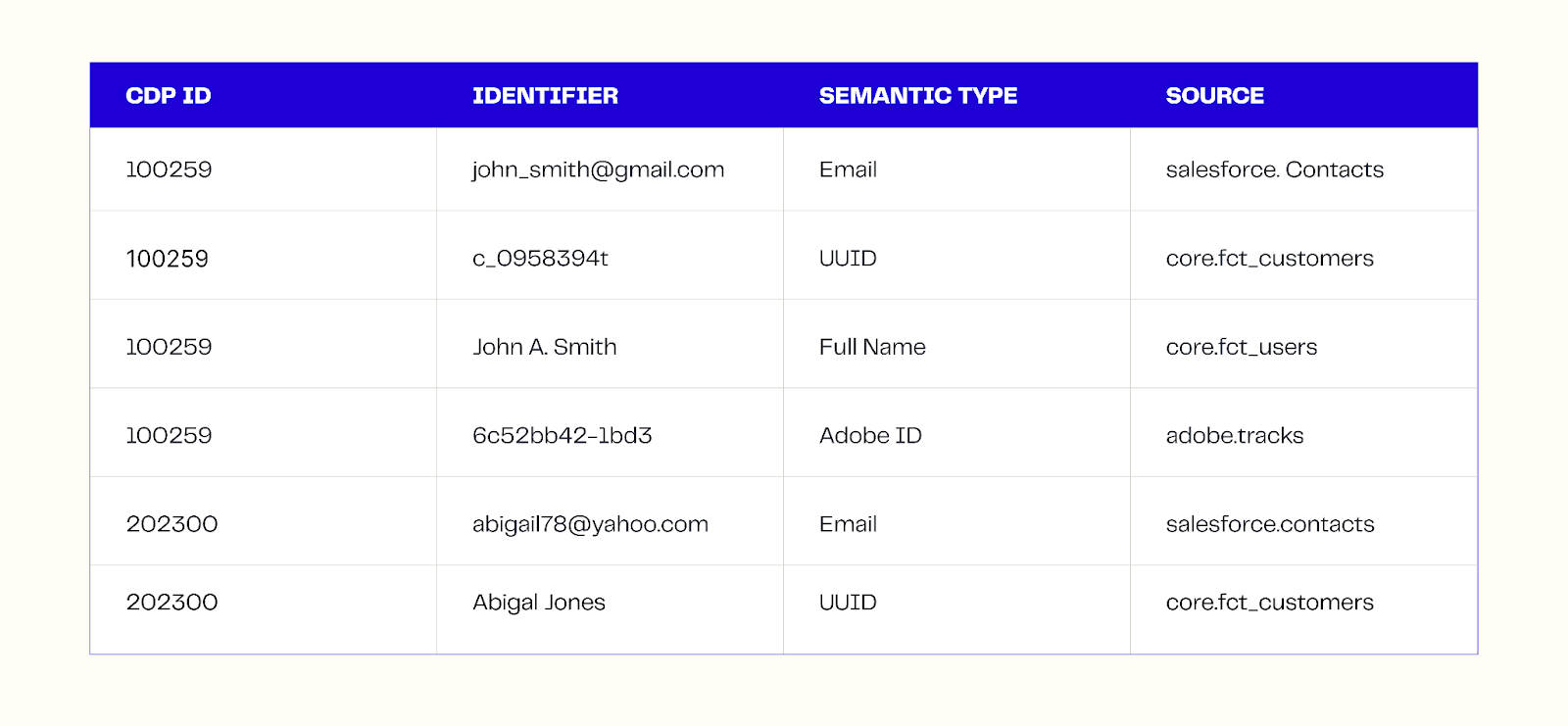
These identifiers are often scattered across tools like your CDP (customer data platform), CRM (customer relationship management), website analytics, ad platforms, and email systems. Due to this disconnect, the same customer might appear as five different profiles within your records.
A customer identity graph processes and links every identifier across devices and sessions in real time. So if a shopper visits your site from mobile and then again from desktop using a different email, you don’t tag them as two different people. Instead, the ID graph stitches those sessions together into one profile.
Merging these identifiers, a process called identity resolution, turns anonymous, fragmented customer data into clear, actionable records.
What is identity resolution?
Identity resolution is the process of matching customer data from different sources, platforms, and devices to a single person or household.
Here’s how it works:
- Collect data across every session, channel, and platform
- Clean and normalize it to remove duplicates and fix inconsistencies
- Match identifiers across devices and touchpoints to tie actions to the same user
- Enrich the profile with additional attributes you typically can’t capture on your own, like household income, interests, or ad IDs (This is only available on platforms like Tie)
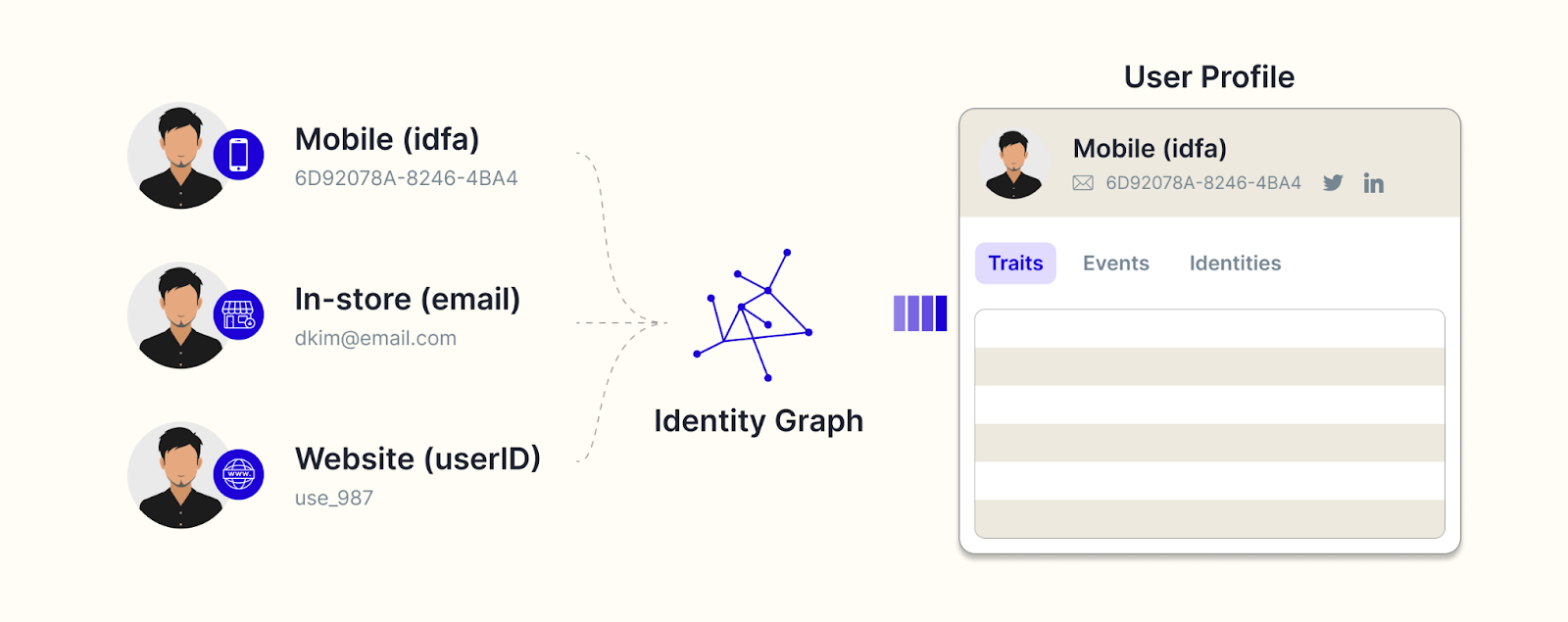
When done right, it removes duplicate records, builds richer segments, and gives your team a real-time and accurate view of your customers’ activities.
Here are some scenarios that identity resolution solves for:
- Connect a shopper's mobile browsing session with their desktop checkout, treating them as one customer, not two.
- Track a subscriber who stops opening emails but actively clicks on your social media ads, and recognize them as a single profile across these platforms.
- Detect when multiple people use the same account, and group their devices to understand who’s buying.
- Enrich your database with new attributes about shoppers, like demographics and interests. (Only available on platforms like Tie)
- Add new shoppers to your database that haven’t filled out forms or purchased, but engaged on your website. (Only available on platforms like Tie)
Tools like Tie recognize and enrich up to 90% of previously anonymous traffic, giving you a clean, high-match-rate identity graph that powers all your downstream campaigns, from Klaviyo to Meta.
Unlike typical customer data platforms (CDPs), Tie isn’t restricted to just your existing data or attributes. Instead, it includes consented third-party data that enriches your profiles with new demographic and behavioural attributes, uncovering anonymous shoppers whose details you didn’t have before, letting you retarget shoppers you didn’t have access to, and improving marketing personalization.
Want to see how Tie’s identity graph works? Book a demo.
How does an identity graph work?
An identity graph works by linking all the identifiers your customers leave behind across sessions, devices, and channels into a single, usable profile. To do this, it relies on identity resolution, which uses a mix of precision matching and predictive modeling to determine each customer’s holistic profile.
Here’s how it works in practice. Say a visitor browses your site on mobile without logging in. Two days later, they return via desktop and check out using their email. A basic system treats this as two users.
However, an identity graph stitches that journey together into one profile, using both the email they shared and behavioral signals that match across sessions.
This process uses two methods:
- Deterministic matching ties data together with complete certainty. If a user logs in or submits a form, you can link that action across platforms using exact identifiers like email, phone number, or account ID.
- Probabilistic matching uses logic to infer connections between sessions, even if no form was submitted. It compares IP addresses, device types, browsing times, screen sizes, and more.
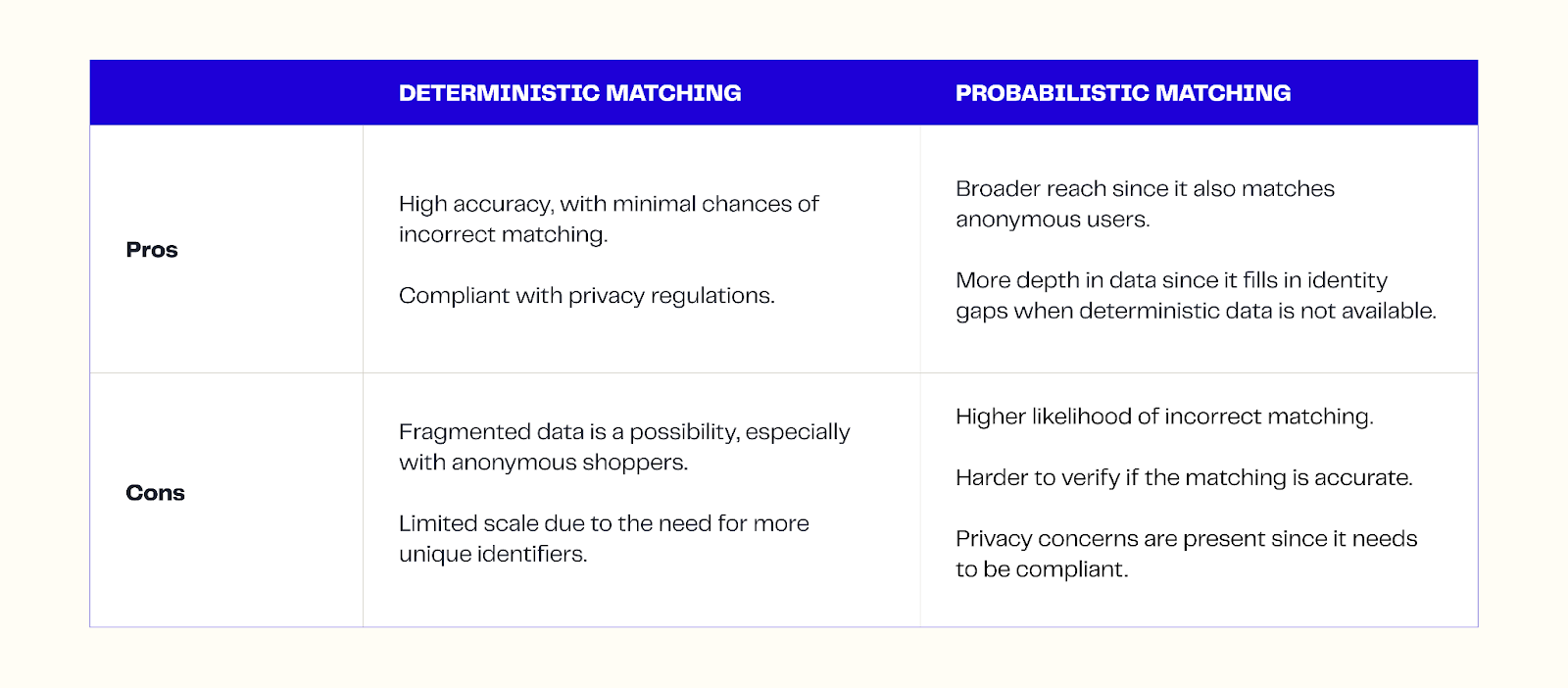
Most identity graphs use a mix of both types of matching to effectively create a comprehensive customer view.
What kind of data does an identity graph use?
To build accurate profiles, identity graphs rely on a mix of:
- First-party data: Collected directly from your website, emails, checkout, and CRMs (e.g., login info, email, purchases)
- Behavioral data: Pages viewed, time spent, cart activity, click paths
- Technical data: Device ID, browser type, IP address, session timestamps
- Third-party data: Demographics, psychographics, and intent signals, sourced from vetted external data partners with consent. (Note: not all platforms collect third-party data.)
For most brands, third-party data is only accessible through enrichment data platforms like Tie. Platforms like Tie have collected consented data from verified vendors. Using this, the platform can uncover anonymous visitors (something that your first-party data usually fails to help with).
Use cases of identity graphs
Identity graphs give you the accurate and consolidated data that you need to set up segmentation based on new behaviors or attributes, trigger more campaigns by shopper activity, inform personalized messaging, and ultimately maximize your marketing budget. Below are some use cases for identity graphs:
Identity matching
A portion of a shopper’s data is commonly siloed across multiple systems, making it impossible to find and undermining the usefulness of the data. This is because your CRM, ad platforms, email tool, and analytics platform all collect different identifiers, but none of them tie together by default.
Identity graphs fix this by stitching those identifiers into one clear customer record. So, if someone browses your site anonymously on mobile, later returns via desktop, and eventually signs up via email, the identity graph links all three sessions back to the same user.
Uniting data points like ad IDs, click IDs, and Klaviyo IDs allows marketers to attribute activities from previously anonymous shoppers to known customers, giving a more holistic view of marketing impact across channels.
You’re no longer looking at scattered events but at a single, connected customer profile. This lets you eliminate duplicate records, sync user data across platforms, and improve how you trigger journeys.
Customer journey mapping
To truly map a customer journey, you need more than session data. You need a unified view of how someone moved across channels, what they interacted with, and when they dropped off or converted. Identity graphs make this possible.
You can track which touchpoints a customer engaged with, including visitors who didn’t leave their details behind.
You can then use this data to pinpoint drop-off stages, refine messaging, and prioritize interventions, whether that’s retargeting, winback flows, or live support nudges. This is especially important if you're running multi-step funnels across email, ads, and site visits.
Without identity stitching, you're guessing. With it, you know exactly where each customer is on their buying journey.
Cross-device attribution
Customers don’t always convert after just one session. They may browse on mobile, read reviews on desktop, click an ad through social media, and come back to mobile two days later to check out. Without identity resolution, these touchpoints look like different users, and you can’t credit the right channels.
Identity graphs help unify customer interactions across devices and channels, giving you a clearer picture of the full conversion path. This allows you to assign value to each channel in the conversion path more accurately. Based on this, you can allocate your budget better, stop investing in channels that don’t drive real conversions, and double down on what’s actually moving shoppers down the funnel.
Platforms like Tie also push these profiles into your ad tools in real-time. Your retargeting campaigns would stop showing ads to people who’ve already converted, and instead, focus on high-intent shoppers who are still in consideration. With accurate identity stitched across devices, your ads follow the person, improving relevance, lowering customer acquisition costs (CAC), and ensuring every dollar supports real conversion paths rather than misattributed clicks.
Personalization
You can only personalize effectively when you have an accurate and complete context of who your customer is across devices, sessions, and channels. Identity graphs give you that context, letting you set up personalization that goes beyond just name or location. You can tailor offers, product recommendations, and messaging based on behavior and intent.
Here’s what that looks like in action:
- Website: Show dynamic content or homepage banners based on recent product views, geography, or buyer type.
- Email: Recommend items tied to previous cart activity or similar customer segments, not just past purchases.
- Ads: Run upgrade or cross-sell campaigns only for customers who have purchased specific SKUs or based on purchase cycles.
- SMS and push notifications: Trigger messages based on individual customer buying timelines or churn signals, not guesswork.
Platforms like Tie enrich identities with over 250+ Attributes pulled from verified, consented third-party networks. This means you can personalize for customers even if they’ve never created an account, using real, behavioral, and demographic data.
With this level of detail, you can build more accurate segments, deliver targeted offers, and set up dynamic messaging that is based on your shoppers’ actual actions.
Benefits of identity graph for ecommerce brands
When you have comprehensive customer data you can rely on, you can set up effective marketing and improve your conversions. Here are some key benefits of using identity graphs:
Accurate targeting
If you're only targeting customers within your CRM, you're ignoring a huge percentage of your traffic, especially high-intent visitors who browse but never log in or convert.
Third-party cookies are commonly used to help bridge this gap, but with cookie deprecation and iOS privacy updates, your targeting is now based on incomplete or outdated signals.
Identity graphs solve this problem by pulling together identifiers across devices and sessions. This helps you create full profiles of who your shoppers are and what they’re doing, even if they’ve never filled out a form.
This lets you create granular segments like:
- Shoppers who viewed the same product three times across devices
- Users who engaged via SMS but haven’t purchased in 30 days
- Anonymous browsers who showed high intent but never opted in
For example, Hollow Socks, an apparel brand with tight working capital, faced this exact challenge. Their targeting was broad, and audience overlap led to wasted spend.
After implementing identity resolution, they identified 70% of their previously anonymous traffic, built precise segments, and redirected their budget toward high-intent users across Meta and Google.
This resulted in a 5x ROI on paid campaigns and a 50% lift in email list growth within just two months.
Better compliance
Privacy regulations like GDPR (General Data Protection Regulation) and CCPA (California Consumer Privacy Act) now require brands to collect, process, and store customer data only with explicit, informed consent. They also mandate that users have the right to opt out, access, or delete their data at any time.
In addition, platforms like Apple and Google have phased out third-party cookies and cracked down on cross-site tracking, making traditional ad targeting unreliable and, in some cases, non-compliant.
Identity graphs built on consented, first-party data give you a compliant way to retarget and personalize while staying compliant with privacy regulations.
For example, Tie’s identity resolution is cookieless and fully privacy compliant. It works within your existing consent and data management framework and gives you full visibility into user preferences and opt-out history.
Effective marketing
You can’t run relevant marketing campaigns if you can’t rely on your data. Identity graphs give you accurate and consolidated data that gives you the ability to reach previously anonymous shoppers, understand existing customers better, and track real user journeys.
That means fewer broken flows and duplicated outreach. Instead, your messaging is more relevant to your shoppers, timed correctly, and reaching them at key moments in their buying journey.
Let’s say a shopper adds to the cart on mobile and checks out later on desktop. Instead of triggering an abandoned cart flow for the cart they left on mobile, unified data ensures that your system recognizes it as one journey and adjusts automatically.
Platforms like Tie integrate directly with platforms like Klaviyo, Meta, and Google Ads. Once a visitor is identified, their profile (complete with behavioral signals and enriched fields) flows into your marketing tools in real time.
Better ROI
When your customer data is scattered across platforms and your profiles are incomplete or duplicated, you end up wasting your marketing budget on people who’ve already purchased, can’t be retargeted properly, or were never qualified in the first place.
Identity graphs used within the identity resolution process fix this by consolidating fragmented profiles, eliminating overlaps, and giving you a full picture of who your customers actually are. This leads to four direct improvements to your ROI:
- Lower acquisition costs: By resolving duplicate identities and matching anonymous visitors to known profiles, you avoid wasting ad spend on the same users across devices. You also stop targeting low-intent or misidentified shoppers, which helps you reduce CPMs and CAC.
- Smarter, more accurate targeting: Instead of running broad lookalike audiences or static lists, you can target specific, behavior-driven segments like: “Viewed product X 3+ times but didn’t convert” or “High AOV customers inactive for 60+ days.”
- Stronger attribution: Identity graphs link touchpoints across sessions and channels, giving you clean multi-touch attribution. You finally know which campaigns drive conversions and which ones are wasting budget.
- Higher conversion rates: With complete profiles and real-time enrichment, your campaigns reach the right person, at the right time, on the right channel, whether it's email, SMS, or paid ads.
How to use an identity graph to set up better customer profiles
If your customer data is spread across sessions, emails, CRMs, devices, and ad platforms and none of it is connected, your segments are unreliable, your retargeting is inaccurate, and your personalisation is mostly guesswork.
An identity graph fixes this. It consolidates known and anonymous interactions across tools, channels, and time into single, accurate customer profiles. But to do that right, you need an identity resolution engine within your backend to merge fragmented data, eliminate duplicates, and keep everything updated in real time.
That’s where platforms like Tie come in. Let’s dive into how the process works and what you need to know to use identity graphs effectively.
Can businesses set up and use identity graphs internally?
While businesses can set up and use identity graphs internally, most brands don’t. Building an identity graph means designing and maintaining an algorithmic system. This is complex, resource-heavy, and rarely sustainable.
Here’s why:
- Proprietary logic is required. You can’t just use email matching. Identity resolution combines deterministic (e.g., exact email or login match) with probabilistic logic (e.g., similar behavior + IP + device). This requires advanced algorithms that aren’t easily built in SQL or dbt (data build tool).
- Data ingestion across platforms is time-consuming. You’ll need to pull in and normalize data from Shopify, Klaviyo, your CRM, your ad platforms, and your analytics tools, all of which use different schemas and identifiers.
- Profiles need to be continuously merged and rewritten. If a user browses on mobile and then checks out on desktop using a different email, your graph has to merge both profiles, resolve the duplication, and rewrite the session logs. Doing this at scale and in real time requires infrastructure that most teams don’t have.
- No access to third-party enrichment: Even if you build the graph, you’re limited to your first-party data. You won’t be able to enrich anonymous visitors with verified attributes like email, name, or location unless you’ve already integrated with a large consent-based data network.
- Only technical teams can manage it: The identity logic sits in code. Marketers and lifecycle teams can’t touch it, test it, or update it without engineering support, which becomes a bottleneck.
This is why most brands choose to opt for an identity resolution platform that’s already built a powerful identity graph, has access to consented third-party data, and works with experts to maintain and manage the entire data consolidation and enrichment process.
How brands can work with identity resolution platforms
Identity resolution platforms like Tie are built to handle what your internal stack can’t: matching fragmented sessions to real users, enriching profiles, and syncing them across your stack instantly. Here’s how it works:
1. Ingest your disconnected data
The platform starts by pulling your existing customer and behavioral data from tools like Klaviyo, Shopify, and your CRM. This includes:
- Session data (cart events, page views)
- Historical email and phone identifiers
- Purchase logs
- Ad interactions
It standardizes your data and prepares it for resolution, resolving naming inconsistencies, parsing timestamps, and preparing it to match logic.
2. Resolve existing profile fragmentation
Most of your traffic isn’t new. It’s just not recognized. Your ID resolution tool resolves this by stitching together different types of identifiers:
- Hashed emails used across different devices
- Phone numbers that appear in SMS logs but not in email flows
- Ad IDs and UTM sources used in paid campaigns
- Cross-device session signals like IP, browser fingerprints, and behavior overlap
If a shopper adds to their cart on their iPhone and returns on a desktop browser using a different email address, the platform combines both sessions into one profile, without any manual input.
3. Link anonymous visitors in real time
Your identity resolution platform uses session data like device type, IP, browsing history, and behavioral signals to match anonymous visitors against a verified identity network of opted-in users. If a match is found:
- You get their name, email, and location (if available).
- Their profile is instantly enriched with demographic and behavioral traits.
- It is synced into your Klaviyo, ESP, or ad platform as a real, trackable user, without needing a form fill.
4. Merge, de-dupe, and rewrite session history
Once a user is identified, whether it’s from your CRM or the platform’s third-party data network, it applies profile merging logic and automatically:
- Matches overlapping attributes (IP, preferences, events)
- Eliminates duplicate entries automatically
- Rewrites session logs automatically to reflect continuous, cross-device customer journeys
Suppose a shopper views a product 3 times, adds it to the cart, leaves, and returns 4 days later via an ad. The platform links all those actions across devices and lets you treat that flow as one journey. This makes sure that your cart abandonment, upsell, or winback emails won’t be wrongly sent.
5. Sync into your channels and campaigns
Once resolved, all profiles are pushed in real time into your downstream tools for your team to access and use. You can immediately:
- Trigger browse or cart abandonment flows in Klaviyo.
- Exclude recent purchasers from retargeting audiences on Meta or Google.
- Run dynamic segments like “high-intent anonymous traffic from California”.
For example, Cozy Earth, a premium home goods brand, was losing a significant portion of its high-intent visitors because most of its traffic was anonymous and couldn't be activated. This limited both email recovery and retargeting efficiency.
After implementing Tie, they identified 62% of that traffic, enriched each profile, and synced them directly into Klaviyo and their ad platforms. With this, they successfully set up 3 high-performing flows, seeing a 15x ROI.
How to choose an identity graph vendor
Choosing the wrong identity graph partner can break your targeting, mess up attribution, and waste budget. The right vendor gives you accurate, real-time customer profiles that power smarter campaigns across every channel.
Here are six factors to look at before you decide on your identity resolution platform:
1. Data quality
Your personalization, retargeting, and attribution depend on the accuracy of the identity graph. That depends on the data it's built on.
Make sure the vendor sources data from verified, high-integrity partners and shares where that data comes from. You should also confirm they enrich profiles with relevant, updated attributes, not outdated or recycled datasets.
“Tie is built on the next generation of identity graph which gives us a unique advantage. Our competitive advantage of using AI reinforcement learning on top of community detection allows us to bring principles made newly available by the AI revolution to how we match our client's data.” Jonathan Kopnick, CTO at Tie
Here are some questions that you can ask your identity graph vendor to guarantee high data quality:
- Do they use consented third-party data?
- Are their sources transparent and verified?
- Do they enrich IDs with behavioral, demographic, and intent-level data?
2. Match rate
Match rate tells you how much of your anonymous traffic your identity resolution platform can accurately identify and turn into usable profiles. A low match rate (20-30%) means most of your visitors stay anonymous, making it hard for you to retarget them, personalize their journey, or include them in lifecycle flows.
Instead, look for vendors that can consistently resolve at least 50% of your traffic. For example, platforms like Tie offer up to 90% match rate by combining identity resolution with third-party data enrichment. This gives you a larger, more accurate base to activate across channels without needing cookies or relying on form fills.
“Many competitors falsely claim they are a graph without actually using a knowledge graph or AI to form connections between profiles. Our focus on building our graph on top of cutting edge tools allows us to have the highest match rate in the world.” Jonathan Kopnick, CTO at Tie
When assessing your potential vendor’s match rates, here are some questions that you can ask:
- What’s your average match rate across industries like mine?
- How do you handle cross-device and multi-session resolution?
- Do your match rates hold up across both desktop and mobile sessions?
3. Resolution method
Vendors use either deterministic or probabilistic identity resolution, or both. The best platforms combine both methods to balance accuracy and scale. Look for vendors who also offer real-time matching and deliver enriched profiles directly into your tools (email, ads, CRM).
Ask your potential ID resolution platform these questions to understand their methods:
- Do you use a deterministic, probabilistic, or hybrid approach?
- Is resolution handled in real time or batch-based?
- Do you rely on third-party data for identity resolution? If so, how is it sourced and used?
4. Compliance
Since you’re handling personal data, any identity graph vendor you choose must be fully compliant with GDPR, CCPA, and other applicable data privacy laws. Make sure their data is consented and that they integrate with your consent management platform.
To make sure of compliance, here’s the information you can ask for from providers:
- Is your data collection cookie-free and privacy-compliant?
- Can I see your documentation for GDPR and CCPA compliance?
5. Cost
Some vendors charge based on profile volume, some by traffic matched, and others by data access tier. Avoid vendors with inflated CPM pricing or steep minimums. Usage-based models like Tie’s <$0.01 per identified visitor give you more room to scale efficiently.
Evaluate platform costs based on a few factors:
- Is pricing based on usage, profile count, or is it a flat rate?
- Are there any additional fees for setup, integration, or ongoing support?
- How does pricing compare across different platforms, considering the features, methods, and support they offer?
6. Customer support
The right identity resolution platform isn’t just delivering a high-quality data consolidation and enrichment process. They also need to help you implement, troubleshoot, and optimize for your workflows, like cart recovery, winback flows, and ROAS attribution.
Here are some customer support-related questions to ask providers:
- Will I have a dedicated success manager or support team?
- Do you help with onboarding, integration, and testing?
- Can you advise on segmentation and activation strategies?
Match up to 90% of your anonymous visitors and improve customer profile data with identity resolution
Identity graphs give you a complete view of every shopper, even the ones who leave their details behind. By stitching sessions, devices, and data points together, you get real customer profiles that power better targeting, personalization, and lifecycle campaigns.
Tie’s identity resolution platform matches up to 90% of anonymous visitors and enriches your customer profiles with 250+ demographic, intent, and behavioral Attributes. This allows you to build smarter segments, set up email flows that are more accurate and targeted, and capture more revenue that you couldn’t because of disconnected data.
Want to see how a high-match-rate identity graph can boost your email, ad, and retention performance? Book a demo with Tie to learn more.