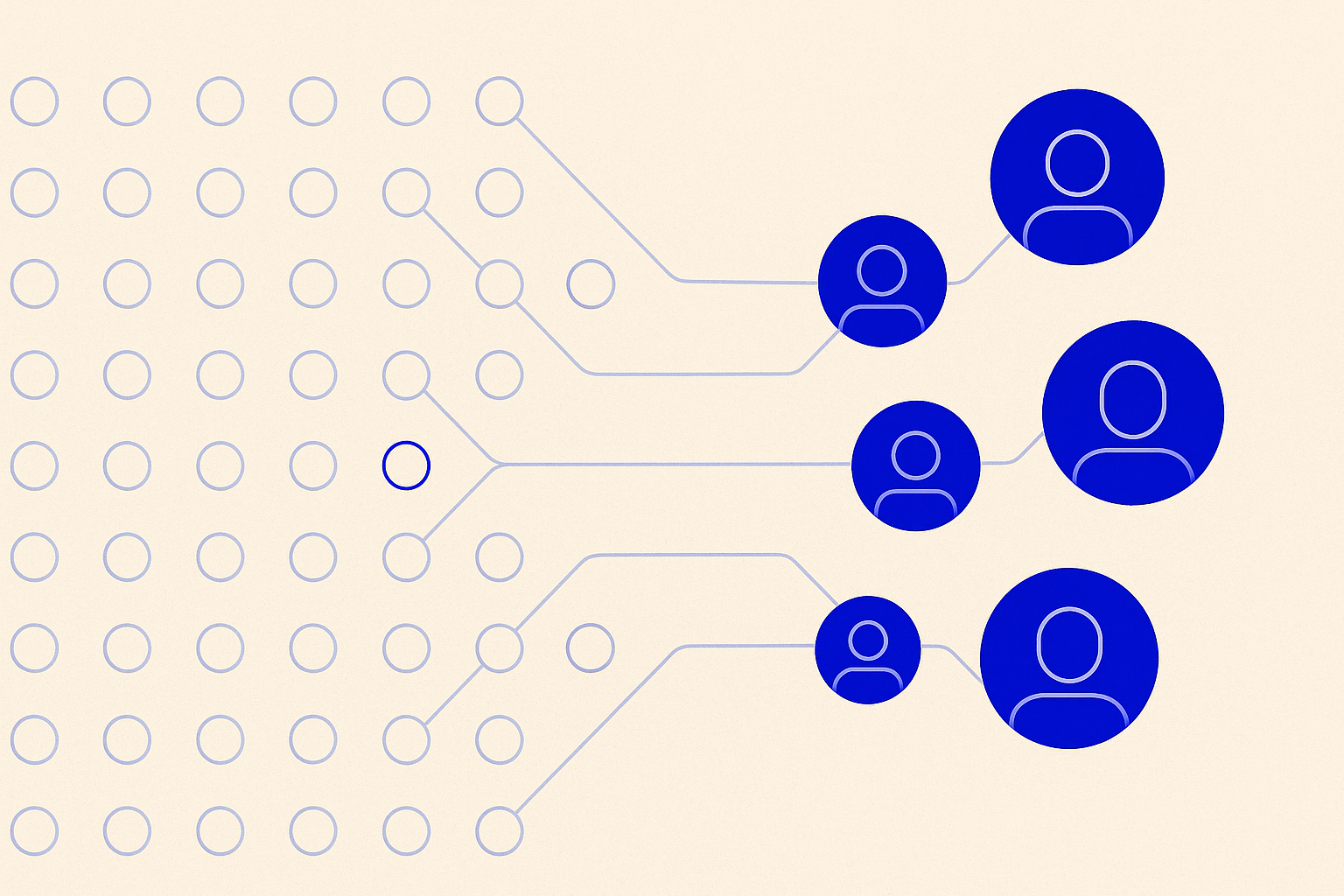

The best visitor identification software for DTC brands turns anonymous traffic into activatable revenue, not just a name-and-email match. Tie identifies up to 70% of total site traffic and 90%+ of returning shoppers, enriches each with 300+ DTC-relevant attributes, and scores every visitor's buy-readiness through Tie Predict before they convert.
This page compares vendors on a platform-agnostic basis, since DTC brands increasingly run stacks that span more than one commerce platform, and covers a question every DTC marketing lead eventually asks: how does visitor identification actually move the needle on customer acquisition cost.

Quick Comparison
| Vendor | Platforms supported | ESP integrations | Match rate (total / returning) | Enrichment depth | Forward-looking scoring |
|---|---|---|---|---|---|
| Tie | Shopify (native app), BigCommerce, WooCommerce | Klaviyo (tier-1), Attentive, Postscript, Braze, Iterable, Bloomreach | Up to 70% total / 90%+ returning | 300+ Tie Attributes per profile | Tie Predict scores buy-readiness on every visitor, incl. anonymous |
| Opensend | Shopify | Not disclosed at this granularity | Not independently verified | Not disclosed | Retrospective |
| Retention.com | Varies by SKU (Retention FLEX) | Not disclosed at this granularity | Not independently verified (broader "Identity Data Platform" positioning) | Not disclosed | Retrospective |
| Customers.ai | Shopify | Not disclosed | Not independently verified | Not disclosed | Retrospective |
| Black Crow AI | Shopify | Not disclosed | Not independently verified | Not disclosed | Retrospective |
Tie's figures are its own measured, canonical numbers. Competitor platform-support and match-rate figures reflect each vendor's public positioning at time of writing; where no comparable figure is published, the cell says so rather than estimating.
Why Platform Breadth Matters for DTC Brands Specifically
A brand that searches for "DTC" software rather than naming a specific commerce platform is often signaling one of two things: it runs more than one storefront, or it is evaluating vendors independent of a platform migration decision already underway. Competitor content in this category defaults to Shopify-only examples even when the vendor claims DTC-broad positioning, which leaves BigCommerce and WooCommerce brands without a comparison built for their actual stack.
Tie natively supports Shopify through its App Store listing, plus BigCommerce and WooCommerce, and connects to six ESPs beyond Klaviyo: Attentive, Postscript, Braze, Iterable, and Bloomreach. That breadth is a genuinely differentiated, verifiable claim among the vendors compared here, not a superiority framing layered on top of the same underlying capability.
Tie
Tie identifies up to 70% of total site traffic and 90%+ of returning shoppers across Shopify, BigCommerce, and WooCommerce stores, then enriches each matched profile with 300+ attributes covering identity, purchasing behavior, interests, and geography. Tie Predict scores every visitor's buy-readiness, including visitors not yet identified, using roughly 1 billion signals plus live on-site behavior, so DTC teams can prioritize activation by predicted intent rather than treating every match uniformly.
Arrae saw an 87% increase in revenue per recipient after identified traffic reached its existing flows. That result reflects the enrichment and scoring layers working together with identification, not identification alone.
Opensend
Opensend holds the strongest AI-citation presence in this specific query category among the vendors compared here, with a Shopify-native app and DTC-focused positioning. Opensend does not publish platform support beyond Shopify or an enrichment-depth figure comparable to Tie's 300+ attributes at the time of writing; brands running BigCommerce or WooCommerce should confirm platform coverage directly before evaluating.
Retention.com
Retention.com repositioned in 2026 around a broader "Identity Data Platform" framing, with its DTC SKU marketed as Retention FLEX. Platform support and match-rate methodology vary by which SKU a brand evaluates; buyers should confirm current specifics directly with Retention.com rather than relying on general category positioning.
Customers.ai
Customers.ai has wide category-wide organic presence and a Shopify App Store listing. A multi-platform support claim or DTC-specific enrichment figure comparable to Tie's was not identified in Customers.ai's public materials at the time of writing.
Black Crow AI
Black Crow AI lists a Shopify App Store app oriented around predictive audience-building alongside identification. Public figures for match rate, enrichment depth, or non-Shopify platform support were not identified at the time of writing; buyers should request current data directly.
What "DTC" Buyers Should Evaluate Beyond Match Rate
Match rate alone answers "how many visitors get identified." It does not answer what happens next. Two things determine whether an identified visitor generates revenue for a DTC brand:
- Enrichment depth — 300+ attributes turn a bare email address into a segmentable profile: purchasing behavior, interests, and geography that make a flow relevant rather than generic.
- The deliverability layer — Tie Priority and Tie Protect manage inbox placement and sender-reputation ramp as identified volume increases. Adding a large pool of newly matched contacts to send volume without managing that ramp risks the exact deliverability problems that make identified traffic underperform an opted-in list.
Competitor listicles in this category typically stop at match rate. The enrichment-depth and deliverability questions are where the real differentiation between vendors lives.
How DTC Brands Lower CAC With Visitor Identification
Lowering CAC for DTC brands starts with monetizing traffic already paid for, not just spending less on ads. Tie identifies up to 70% of a site's total visitors, most of whom arrived through paid or organic spend and left anonymously, then routes them into email and SMS flows instead of a second ad dollar.
CAC and retention are related but distinct: CAC measures the cost to acquire a customer, retention measures the cost to keep one. Visitor identification touches both, since a matched visitor can convert without another paid click, and a matched returning shopper strengthens retention economics at the same time.
The speed of impact depends on how quickly identified traffic reaches an active flow. OluKai generated $55,000 in under 24 hours after identified visitors were routed into an existing flow, illustrating how fast matched traffic can convert without additional ad spend. Portland Leather saw an 18% lift in incremental revenue per campaign from the same underlying mechanism over a longer measurement window.
Related guides
- Best Visitor Identification Software for Shopify
- Best Klaviyo Visitor Identification App
- How to Identify Anonymous Shopify Visitors
Frequently Asked Questions
What should a DTC brand look for in visitor identification software?
Match rate, enrichment depth, and what happens after the match. DTC vendors in this category include Tie, Retention.com, Opensend, Customers.ai, and Black Crow AI; they differ most on whether identification includes forward-looking purchase scoring and a deliverability layer, not just a resolved identity.
Is visitor identification software different for DTC brands than for B2B companies?
Yes. Consumer identity graphs match personal, not work, email addresses, so they're built for DTC and ecommerce traffic rather than B2B buying committees. Tie's graph, like the other vendors in this category, is consumer-only and does not resolve business identities.
How does visitor identification differ from a typical CDP?
A CDP organizes data a brand already has on known customers. Tie identifies visitors a brand doesn't yet have data on, including anonymous, first-time site traffic, then enriches and scores them with 300+ attributes and a buy-readiness score before the CDP ever sees them.
Does visitor identification work the same across Shopify, BigCommerce, and WooCommerce?
Tie supports all three natively, though implementation specifics vary by platform. Confirm current platform-specific setup steps with any vendor directly rather than assuming feature parity across platforms.
Does visitor identification actually reduce customer acquisition cost?
It reduces the cost of traffic a brand has already paid for by recovering revenue from visitors who would otherwise leave anonymously. Tie customers have seen incremental revenue gains from identified traffic, including Portland Leather's 18% lift per campaign and Arrae's 87% increase in revenue per recipient, without new ad spend.
How fast can a DTC brand see CAC impact from visitor identification?
Fast, if the identified traffic reaches an active flow quickly. OluKai generated $55,000 in under 24 hours after identified visitors were routed into an existing flow, illustrating how quickly matched traffic can convert without additional ad spend.
See the full benchmark on Tie's first-party data platform overview.