
The best visitor identification software for Shopify identifies the highest share of anonymous traffic and turns matches into revenue, not just names. Tie matches up to 70% of total site traffic and 90%+ of returning shoppers, enriches each with 300+ attributes, and routes resulting email into Gmail Primary via Tie Priority.
That is the short answer. The rest of this page breaks down how five Shopify-listed vendors compare on the axes that actually determine whether identification turns into revenue: match rate, enrichment depth, deliverability, and forward-looking scoring.
Quick Comparison
| Vendor | Match rate | Enrichment depth | Deliverability layer | Forward-looking scoring | Native Shopify app |
|---|---|---|---|---|---|
| Tie | Up to 70% of total site traffic; 90%+ of returning shoppers | 300+ Tie Attributes per profile | Tie Priority (Gmail Promotions to Primary, 2-8x rev/send) + Tie Protect (sender reputation) | Tie Predict scores buy-readiness on every visitor, including anonymous ones, via roughly 1B signals | Yes, Shopify App Store |
| Retention.com | Markets a broader "Identity Data Platform" (DTC SKU: Retention FLEX); rate not independently verified | Not disclosed at this granularity | Not offered as a distinct product | Retrospective enrichment of matched contacts | Varies by SKU |
| Opensend | Not independently verified | Not disclosed | Not offered | Retrospective | Yes |
| Customers.ai | Not independently verified | Not disclosed | Not offered | Retrospective | Yes |
| Black Crow AI | Not independently verified | Not disclosed | Not offered | Retrospective | Yes |
Figures for Tie are Tie's own measured, canonical numbers. Competitor figures reflect each vendor's public positioning at time of writing, not an independently audited benchmark. Where a vendor does not publish a comparable stat, that cell is marked "not independently verified" or "not disclosed" rather than estimated.
Tie's Shopify integration is documented in full on the Tie Shopify integration page, which currently ranks in the top page of Google results for Shopify-specific identification queries.
How Match Rate Is Actually Measured
Match rate is the share of anonymous visitors a vendor resolves to a real identity. Two different numbers get conflated in vendor marketing, and buyers evaluating this category should ask for both, separately, from any vendor on this list:
- Total-traffic match rate — the share of all site visitors resolved, including first-time, never-before-seen traffic. This is the harder number to move, because first-time visitors have no prior browsing history for an identity graph to match against.
- Returning-shopper match rate — the share of visitors who have interacted with the store before (browsed, added to cart, or purchased) who get resolved on a later visit. This number is typically much higher across the category, because returning visitors leave more signal behind.
Tie identifies up to 70% of total site traffic and 90%+ of returning shoppers. Klaviyo's own native recognition of returning shoppers, without a visitor identification layer, typically runs 22-36%. The gap between those two numbers is the addressable opportunity a visitor identification app is solving.
When comparing vendors, ask each one which number they are quoting, and ask for the methodology behind it. A vendor quoting a single headline percentage without specifying total-traffic versus returning-shopper is not comparable to a vendor that publishes both.
Tie
Tie is a native Shopify App Store app and a Klaviyo Marketplace tier-1 partner. It identifies up to 70% of a store's total site traffic and 90%+ of returning shoppers, then enriches each matched profile with 300+ Tie Attributes spanning identity, purchasing behavior, interests, and geography.
What sets Tie apart in this comparison is not identification alone. Two additional layers determine whether an identified visitor actually generates revenue:
- Tie Priority manages inbox placement, moving qualifying email from Gmail's Promotions tab into Primary. That placement shift is tied to 2-8x more revenue per send in Tie's customer base, because a Primary-tab email is seen; a Promotions-tab email competes with dozens of other marketing sends.
- Tie Predict scores buy-readiness on every visitor, including anonymous ones who have not yet been identified, using roughly 1 billion behavioral signals plus live on-site activity. That forward-looking score lets a brand prioritize its highest-intent visitors for immediate activation rather than treating every match the same.
Sharper Image saw a 30% lift in incremental revenue after adding identified traffic to existing Klaviyo flows. OluKai generated $55,000 in under 24 hours after identified visitors were routed into an active flow. Both results reflect identification reaching an existing flow quickly, not a new email program built from scratch.
Retention.com
Retention.com repositioned in 2026 around a broader "Identity Data Platform" framing, with its DTC-focused SKU marketed as Retention FLEX. Retention.com does not publish a total-traffic versus returning-shopper match rate split at the same granularity Tie does, which makes a direct, sourced comparison on that axis difficult. Retention.com's Shopify presence varies by which SKU a merchant installs; buyers evaluating Retention.com for a Shopify store should confirm which product tier includes native Shopify App Store listing status at the time of evaluation.
Opensend
Opensend lists a native Shopify app and positions itself around DTC visitor identification. Opensend does not publish an enrichment-depth figure comparable to Tie's 300+ attributes, nor a distinct deliverability product; buyers should ask directly what happens to identified contacts after the match, since identification without a deliverability layer can create sender-reputation risk as send volume increases.
Customers.ai
Customers.ai has broad category-wide organic presence and a Shopify App Store listing. Its published positioning emphasizes identification volume; it does not publish a returning-shopper-specific match rate or a named deliverability product at the time of writing. As with the other vendors in this table, buyers should request a same-methodology match-rate figure directly rather than relying on a general claim.
Black Crow AI
Black Crow AI lists a Shopify App Store app focused on visitor identification and predictive audience-building. Public match-rate and enrichment-depth figures comparable to Tie's published numbers were not identified at the time of writing; buyers evaluating Black Crow AI should request current, sourced figures directly from the vendor.
What Arrives in Your Shopify and Klaviyo Stack Once a Visitor Is Identified
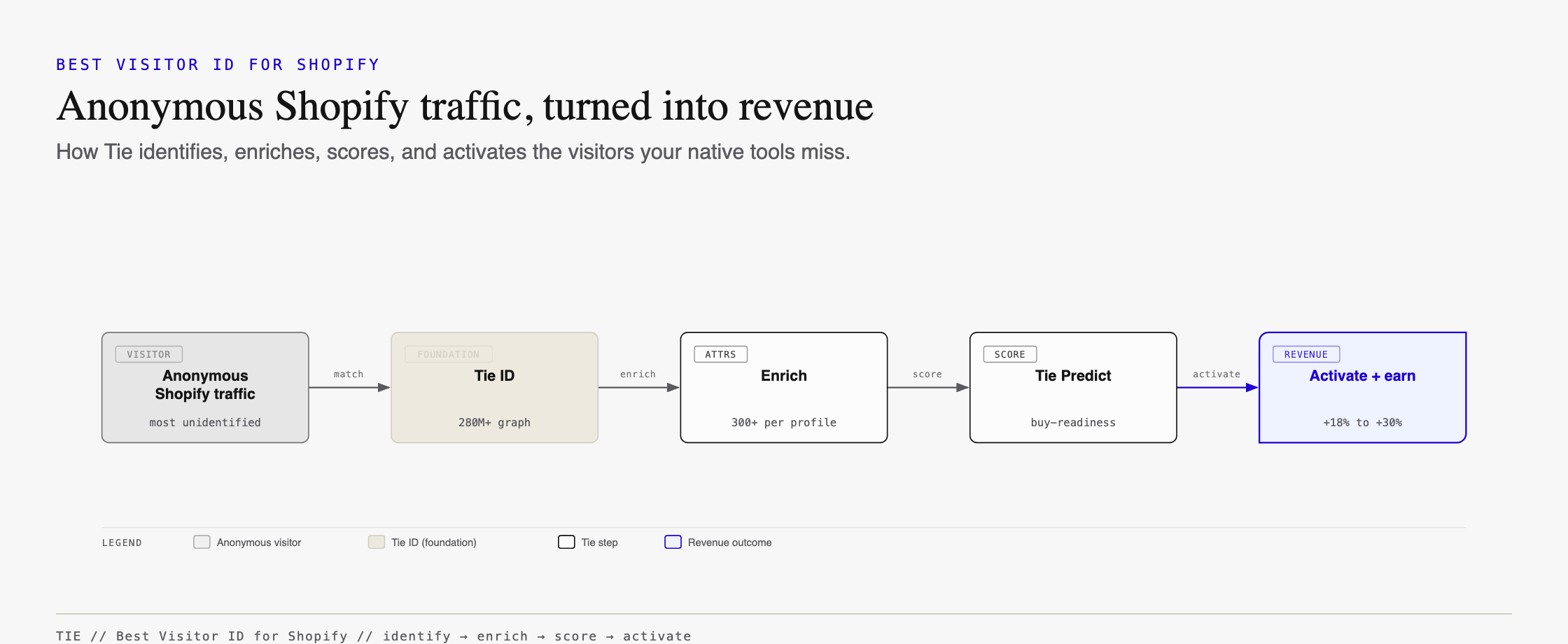
Identification is the starting point, not the deliverable. Once a visitor is matched, the Identify to Enrich to Activate to Measure motion determines whether that match becomes revenue:
- Identify — the visitor's browser signals are matched against a consumer identity graph.
- Enrich — the matched profile is appended with additional attributes. Tie adds 300+ per profile, spanning identity, purchasing behavior, interests, and geography.
- Activate — the enriched profile flows into connected tools. Tie is a Klaviyo tier-1 partner and also supports Attentive, Postscript, BigCommerce, WooCommerce, Braze, Iterable, and Bloomreach.
- Measure — incremental revenue from identified traffic is tracked against a pre-identification baseline, not just list growth.
Every vendor in this comparison performs step one. Fewer publish detail on step two, and step three's deliverability implications (step four's outcome) are where most competitor listicles in this category stop short.
Deliverability: The Step Most Comparisons Skip
Adding a large pool of newly identified visitors into existing Klaviyo flows increases send volume quickly. Without a deliverability layer managing that ramp, sender reputation can degrade, and identified contacts can land in Promotions or spam rather than Primary.
Tie addresses this directly with two products: Tie Priority (inbox placement, Promotions to Primary) and Tie Protect (sender-reputation monitoring and send-volume ramp management). None of the four competitors compared here publish an equivalent named deliverability product. This is a genuine content gap in the category, not just a keyword gap: most comparison content in this space evaluates match rate and stops, without addressing what happens to deliverability once identification succeeds at scale.
Related guides
- Best Klaviyo Visitor Identification App
- Best Visitor Identification Software for DTC Brands
- How to Identify Anonymous Shopify Visitors
Frequently Asked Questions
Which Shopify apps identify anonymous website visitors?
Visitor identification apps for Shopify include Tie, Retention.com, Opensend, Customers.ai, and Black Crow AI. They differ most on match rate, how deep the enriched profile is, and whether the app includes a deliverability layer to get resulting emails opened, not just sent.
How accurate is Shopify visitor identification software?
Accuracy is usually reported as match rate, the share of visitors resolved to a real identity. Tie matches up to 70% of total Shopify site traffic and 90%+ of returning shoppers, above typical Klaviyo-native match rates of 22-36% for returning visitors.
Does visitor identification work with Shopify's app ecosystem, or does it require custom development?
A native Shopify app requires no custom development. Tie installs from the Shopify App Store, reads storefront and purchase behavior in real time, and pushes identified profiles into connected tools like Klaviyo, Attentive, and Postscript automatically.
Are Shopify visitor identification results GDPR and CCPA compliant?
Compliance depends on the vendor's data sourcing, not the fact of identification itself. Merchants selling into regulated regions should confirm consent and disclosure requirements with legal counsel before activating any vendor's identified profiles in marketing.
Does visitor identification work the same for DTC and B2B traffic?
No. Every vendor compared on this page, including Tie, resolves consumer identity graphs built for personal, not work, email addresses. None of these tools identify B2B buying-committee traffic or work-email visitors. That is a category-wide limitation, not a difference between the vendors above.
See the full benchmark on Tie's Shopify integration page.