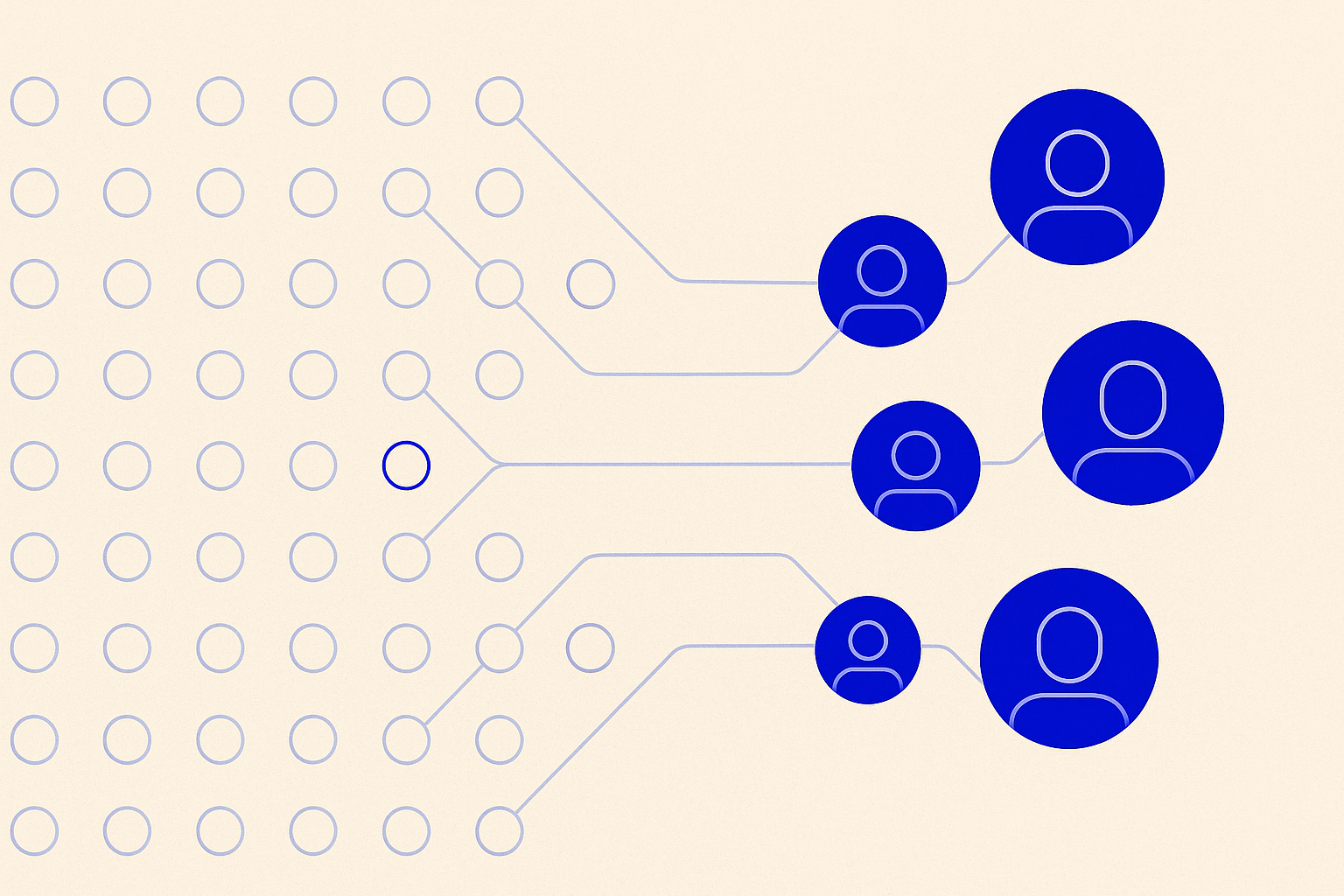

There is a number that explains why DTC email revenue per send is declining, and it is not your subject line. Fifty-four percent of mobile ad impressions now lack the identifiers that enable cross-session tracking (Comscore, 2026). Apple's Anti-Fingerprinting protections landed with iOS 26 and macOS 26, extending the identifier erosion that Mail Privacy Protection started in 2021. The signals that made engagement scoring work are degrading at the infrastructure level.
The brands that are still growing email revenue per send are not using better creative or better subject lines. They are using better signal.
What "Engagement Era" Marketing Looked Like
The logic of the engagement era was clean and it worked for a long time. Score your list by engagement. Send to the engaged segment. Suppress everyone else. Watch open rates go up. Watch revenue per send hold.
The model had one assumption built in: engagement history is a reliable proxy for purchase intent. Open it last month, likely to buy this month. Do not open for 90 days, suppress and move on.
That assumption is eroding. Not because marketers got worse at the craft, but because the inputs changed under the model.
Five Forces That Are Breaking the Model
1. Mobile identifier loss.
Fifty-four percent of mobile impressions lack identifiers (Comscore, 2026). Safari's anti-fingerprinting extension to iOS 26 and macOS 26 accelerates the gap between what a shopper does on mobile and what any engagement tracker can observe. When identity stitching fails, shoppers who are actively browsing your store appear dormant to engagement-based systems.
2. Rising acquisition costs with no relief in sight.
Meta ecommerce CPM hit $14.19 in 2025, up 20% year-over-year (Sovran.ai). CAC is rising across paid channels, which means the email list you already have is more strategically important than it has ever been. But the list is only valuable to the extent you can find the purchase-ready contacts inside it. Engagement history alone is no longer sufficient for that job.
3. The structure of your email list.
Sixty to 80 percent of your site visitors are anonymous, meaning they have never opted into your list. Every engagement-based scoring tool in the market, including Orita, Klaviyo K:AI, and Alfred, is invisible to that population. Your "active" segment is a subset of a subset. The high-intent shoppers in the anonymous majority are not being scored by any engagement tool on the market today.
4. Enterprise consolidation creating a mid-market window.
Insider's acquisition of Bluecore in May 2026 moved the enterprise end of the market. That consolidation creates a 12-to-18-month window where mid-market DTC brands can access the same identity-graph-backed scoring that enterprise has always had, before consolidation closes access or re-prices it. The window is now.
5. DTC is in survival mode.
Q1 2026 saw a 14% increase in DTC bankruptcy filings year-over-year (5W Research DTC Graveyard, May 2026). Brands that make it through 2026 will be the ones extracting maximum incremental revenue from the audiences they already have. The cost of getting email segmentation wrong in the next 12 months is higher than it has ever been.
The Intent Gap
Here is the structural problem with engagement-era segmentation illustrated plainly.
Your active segment is everyone who has opened or clicked in the last 90 days. Call it 30 percent of your total list. You send to that 30 percent. Your suppression list holds the other 70 percent.
Now add the dimension engagement scoring cannot see. Of the 70 percent in suppression, how many are browsing your site right now on a different device? Of the 60-to-80 percent anonymous site visitors, how many are on your best-selling product pages today?
That population, the shoppers expressing high purchase intent without appearing in your engaged segment, is what we call the intent gap. Every email program running on engagement scoring alone has one. It grows over time as engagement metrics erode and suppression lists expand. It represents high-intent, reachable audience that is being left unscored and unsent.
The brands that close the intent gap before BFCM will have a structural revenue advantage over the brands that do not.
How Identity-Backed Scoring Changes the Equation
The alternative to engagement-era scoring is not better engagement scoring. It is a different input set entirely.
Identity-backed purchase intent scoring draws on signals from outside the ESP:
- Anonymous site visitors matched to known identity profiles via an identity graph
- Cross-device behavior from suppression-list contacts who are active on a different device
- 55+ signals per shopper, refreshed daily, including demographic enrichment beyond what any brand can observe inside its own email program
The result is a complete intent picture: the opted-in list, the suppression list, and the anonymous visitors, scored by what they are about to do rather than what they did last month.
When that complete picture replaces engagement-history segmentation, the revenue outcomes change.
Caraway Home: +21% placed-order rate in a direct head-to-head against Orita's engagement-based scoring.
Sharper Image: 2x placed-order rate; +41% revenue per recipient; +36% CTR. Same list. Signal-led segmentation instead of engagement-led.
Portland Leather Goods: +18% incremental revenue per campaign from Predict-scored sends.
Three verticals. Three holdout-tested outcomes. The same directional result: when you score the full intent picture instead of the engagement slice, revenue per send moves upward.
The BFCM Math
DTC brands finalize MarTech stack in Q3. The window for a proof-of-concept that generates holdout-tested data before Black Friday closes in mid-September.
Here is the math on the cost of waiting. If your email program generates $2 million in Q4 revenue, a 20% improvement in revenue per send from better intent signal is worth $400,000 in incremental BFCM revenue. If you start a POC in October instead of July, you will not have the holdout data to inform your BFCM segmentation. You will run the same engagement-era playbook you ran last year.
The window is not theoretical. It closes on a specific date. Brands not in a proof-of-concept by mid-September miss the 2026 BFCM revenue window. Q1 2027 is the next available entry point.
What Replacing Engagement Scoring Does Not Mean
It does not mean sending more email. Sharper Image did not send more email. They sent to a more precisely scored audience and got 2x the placed-order rate. Volume was not the variable.
It does not mean abandoning Klaviyo. Intent scores sync to Klaviyo as profile properties. Your existing flows, templates, and creative strategy remain intact. The signal layer improves. The infrastructure stays.
It does not mean a technology overhaul. The tooling for identity-backed purchase intent scoring integrates with the Klaviyo stack most DTC brands already run. The lift is a proof-of-concept that proves or disproves the signal value with your own holdout-tested data.
The Category That Replaces Engagement Scoring
The category is identity-backed purchase intent scoring. It is currently uncontested in organic search as of June 2026. That will change.
The category will be won by the brands that embed it in their MarTech stack before BFCM 2026, prove it with their own data, and head into 2027 with holdout-tested evidence of incremental revenue from a signal set their competitors are still not using.
The engagement era produced reliable results for a long time. The five forces above are structural, not cyclical. The brands that adapt to identity-backed signal before those forces compound will not just outperform BFCM 2026. They will widen the gap on every send after that.
What to Do Before September
- Audit your current segmentation: is it built on engagement history or on forward-looking intent?
- Quantify your intent gap: how large is your suppression list relative to your active segment? What percentage of your site traffic is anonymous?
- Model the revenue impact: if your bottom-quartile sends shifted to signal-scored segments, what would the revenue per send look like?
- Start a proof-of-concept before mid-September. The holdout methodology means the proof is yours, not ours.
The engagement era is over. The identity-backed intent era has revenue proof across three verticals. The question is whether you enter it before or after BFCM.