Marketing Personalization in 2026: What’s Changed


If you manage retention or growth today, you’ve probably noticed the same pattern. You have personalization in place, but it doesn’t behave the way you expect:
- A shopper views a product three times, but your ESP doesn’t register the intent.
- Someone abandons a cart, but the journey fires late because the system treated them as a new visitor.
- Meta and Google both claim credit, while your onsite recommendations ignore what the shopper just browsed.
Your customers notice this. 81% of consumers ignore messages that aren’t relevant to them, and 1 in 4 are less likely to purchase after receiving a generic message.
Personalization has moved far beyond name tags and generic merge fields, and the impact shows up in your customer satisfaction.
Brands are now expected to respond to customer intent across email, SMS, paid, social media, and on-site channels—often within the same hour. At the same time, privacy changes, cookie loss, and fragmented identity signals make it harder to see the full customer journey. Without consistent identity, programs struggle to connect behavior across touchpoints.
The goal has stayed the same— understand what a real person is trying to do and help them take the next step. But what has changed is what it takes to do that well.
This article breaks down both sides: the shifts that matter, the fundamentals that still hold, and how to build a marketing strategy that isn’t derailed by missing data.
The state of marketing personalization in 2026
Personalization in 2026 is shaped by three pressures that hit your program at the right time:
- You capture less behavior that can be tied to real shoppers.
- Customers expect more relevance.
- Your stack carries more identity gaps than before.
61% of shoppers switch devices during a single customer journey, which breaks identity across your CRM, email marketing, and paid channels.
The shift isn’t about delivering more personalized experiences or having bigger personalized marketing setups. It’s about fixing the parts of your system that decide who you’re talking to and what you know about them. That’s what defines personalization this year.
From reactive to predictive personalization
For years, personalization meant reacting to a visible event. You triggered personalized messages whenever someone browsed, abandoned, or bought. That worked when signals were clean and sessions were predictable.
It doesn’t work in 2026 because now, you lose visibility before the trigger fires. A shopper jumps devices, browses anonymously, or returns through a channel that strips tracking. Your flow sees the action but not the identity behind it. So the message either fires at the wrong time or fires for the wrong person.
High-performing teams are moving to predictive personalized marketing strategies because they solve this timing gap. Instead of waiting for a clean trigger, you model:
- How fast intent usually builds for a category
- Which customer attributes (such as demographics, location, or purchase history) correlate with higher conversion likelihood
- How long a buyer typically waits before replenishment
- Which product sequences lead to a second order
- Who needs an incentive, and who converts without one
These come from an accurate identity stitched across sessions, something you can’t do with rules alone. That’s why the teams that run the most stable programs start by fixing identity and only then layer predictive logic on top of it.
The privacy-first reality
Most personalization issues trace back to privacy friction. Cookie loss, Apple’s link tracking protection, Meta’s API restrictions, stricter consent workflows; each one removes a part of the path you used to see.
Your shoppers are acting on these concerns. 64% now take steps to protect their privacy (they block tracking, limit app permissions, and opt out of cookies) while 71% still want brands to learn from their shopping habits when it improves relevance.
This means:
- Returning shoppers show up as new because device-level IDs reset.
- Attribution breaks, so your models misread what caused intent.
- Browse and cart flows underperform because the profile isn’t verified.
- Email and SMS systems hold contradictory versions of the same customer.
This is why personalization now depends on how much of your customer data you can prove as accurate, not how much data you can collect. The brands that adapt the quickest don’t try to replace the lost tracking.
Instead, they rebuild the identity layer so every session, channel, and action maps back to a single profile. Once that stabilizes, the consent wall becomes predictable, and personalization becomes reliable again.
The consolidation of martech stacks
Marketing stacks with six or seven disconnected tools no longer work. Every disconnected system holds a different slice of customer behavior, a different set of IDs, and a different logic for determining who the customer is. This spreads identity across too many places and breaks personalization at the profile level.
Teams are consolidating their data to reduce identity drift. When enrichment, consent, browsing behavior, purchase data, and lifecycle events are within one identity graph, you see three positive outcomes:
- Segments stop contradicting each other.
- Triggered journeys fire at the right moments.
- Predictive models stop overfitting to incomplete profiles.
A unified identity graph like Tie solves the root problem: fragmentation. Once the identity is stable, every downstream layer (flows, incentives, personalized recommendations, and timing) performs more consistently.
What’s changed in how personalization works
Ecommerce teams still rely on the same mix of quizzes, pop-ups, and basic onsite behavior, but the rules have changed. You now have tighter consent standards, fragmented sessions, and fewer reliable identifiers.
This forces you to rethink how you source data, model intent, and deliver moments that match what the shopper is actually doing. Here's where the biggest changes show up:
Data ownership and consent take center stage
You don’t control the data pipes you once did. Due to privacy rules, cookie loss, and tracking gaps, your best signals now come directly from your shoppers. That puts zero-party and first-party data at the core of your data-capturing methods:
- Zero-party data: What a shopper tells you through quizzes, preference settings, or post-purchase inputs.
- First-party data: What you collect through on-site behavior, such as views, past purchases, add-to-cart events, and session depth.
Both are valuable, but both have limits. Quizzes and forms don’t capture intent every time, and first-party signals alone won’t fill gaps when shoppers browse across devices or bounce before signing up.
This is where marketing automation changes the equation. Tools like Tie add a real-time enrichment layer that fills the blind spots with verified identity data, demographics, session behavior, and engagement depth, all sourced through consented, privacy-safe signals. You get a complete profile without relying on third-party cookies or guesswork.
AI-driven audience modeling
Predictive tools only work when the data feeding them is accurate. Most ecommerce teams feed their models with inconsistent data like duplicate profiles, disconnected browsing events, and incomplete purchase histories. When identity is off, every prediction is off, and your personalized content lands at the wrong moment.
Once you work with verified profiles, predictive modeling becomes practical. With Tie, you’re not guessing who performed an action. You’re working with a unified customer record that includes:
- Demographic signals
- Session patterns
- Engagement depth, like dwell time and number of visits.
- Purchase behavior
With that structure in place, the algorithms behind your artificial intelligence and machine learning systems can recommend the next step with far more precision: who is likely to buy again, who is close to dropping off, who is discount-sensitive, and who isn’t. You make decisions based on reliable patterns instead of broad averages.
Contextual and real-time personalization
Personalization is no longer about pre-built rules that run once a day. What matters now is how quickly you respond to intent.
Shoppers move between channels, devices, and sessions with almost no continuity. If your system reacts hours later, you miss the window where intent is highest.
Real-time personalization fixes that. You adjust the customer experience based on what the shopper is doing right now:
- A restock prompt appears when someone hits their typical repurchase window.
- A tailored on-site layout or personalized product recommendations when browsing patterns show strong category interest.
- A shift from cart recovery → upsell → loyalty program once a shopper completes each step.
- A different incentive when repeat visits signal high intent without a purchase.
Tools like Tie make this possible because every profile updates live. When a visitor takes an action, the enrichment changes instantly. Your flows, your dynamic blocks, and your segments respond in the same moment, and not one campaign later.
What hasn’t changed and still drives results
Even with new privacy rules and new tech, the core mechanics of personalization haven’t shifted. You still win when the message matches intent, when your data reflects reality, and when the experience feels respectful instead of intrusive.
These principles held up before cookies disappeared, and they still decide whether your program converts today:
Relevance and timing still win
Every successful lifecycle program still runs on the same principle: the message works only when it lands at the moment the shopper cares.
You see this across the entire journey: Awareness → Conversion → Retention → Loyalty. Move too early, and the shopper ignores you. Similarly, move too late, and the intent disappears.
Nothing about that has changed. What has changed is how you detect the right moment. You no longer get clean, predictable triggers from cookies or device IDs. You rely on verified identity and real intent signals, like repeat views, increasing session depth, return visits, and product-level interest.
When those signals align across different touchpoints, timing becomes predictable again, and your customer loyalty improves because the message feels timely instead of forced.
Data accuracy is everything
Most underperforming programs fail because the data behind them is fragmented or outdated. The shopper looks like a new visitor on the website, a returning customer in email, and an uninterested user in Meta. This is because each system holds a different version of the same person.
But when the data is right, customer relationships strengthen because the messaging reflects the customer’s needs. 66% say they stay loyal to brands that remember their preferences, and 52% value brands that recall past interactions across channels.
Tie solves this by unifying your web, email, and ad data under one verified profile. The profile updates in real time, not hours later. Every session, view, click, and purchase connects back to the same identity. This accuracy changes how you work:
- Segments reflect what the shopper is doing now.
- Triggered journeys fire off fresh data, not stale snapshots.
- Paid audiences stay aligned because the identity doesn’t drift.
Personalization does not mean intrusion
The line between helpful and intrusive has stayed the same. Personalization works when it supports the shopper’s goal. It fails when it exposes data they didn’t knowingly share or when it pushes past their comfort level.
Creepy retargeting, hyper-specific assumptions, or surprise ads that reveal unknown browsing history still break trust. Shoppers haven’t become more tolerant, but more aware. They reward transparent personalization efforts, like clear opt-ins, relevant content, and tailored experiences they can control, without feeling watched.
What works now is clarity. People want to understand why they’re seeing something and how their data is used. Compliant opt-ins, clear customer preference centers, and predictable data collection build that trust. When shoppers see transparency, they stay subscribed longer, click more often, and buy with less hesitation.
Framework for privacy-safe personalization in 2026
Personalization only works when you can see who is behind a session, understand what they’re trying to do, and act on it without crossing any privacy lines.
This four-step framework keeps those three requirements intact:
Step 1: Identify visitors early
You can’t personalize a session you can’t recognize. Most visitors leave before they sign up, and most tracking tools lose them between visits. That’s where the biggest revenue gap sits.
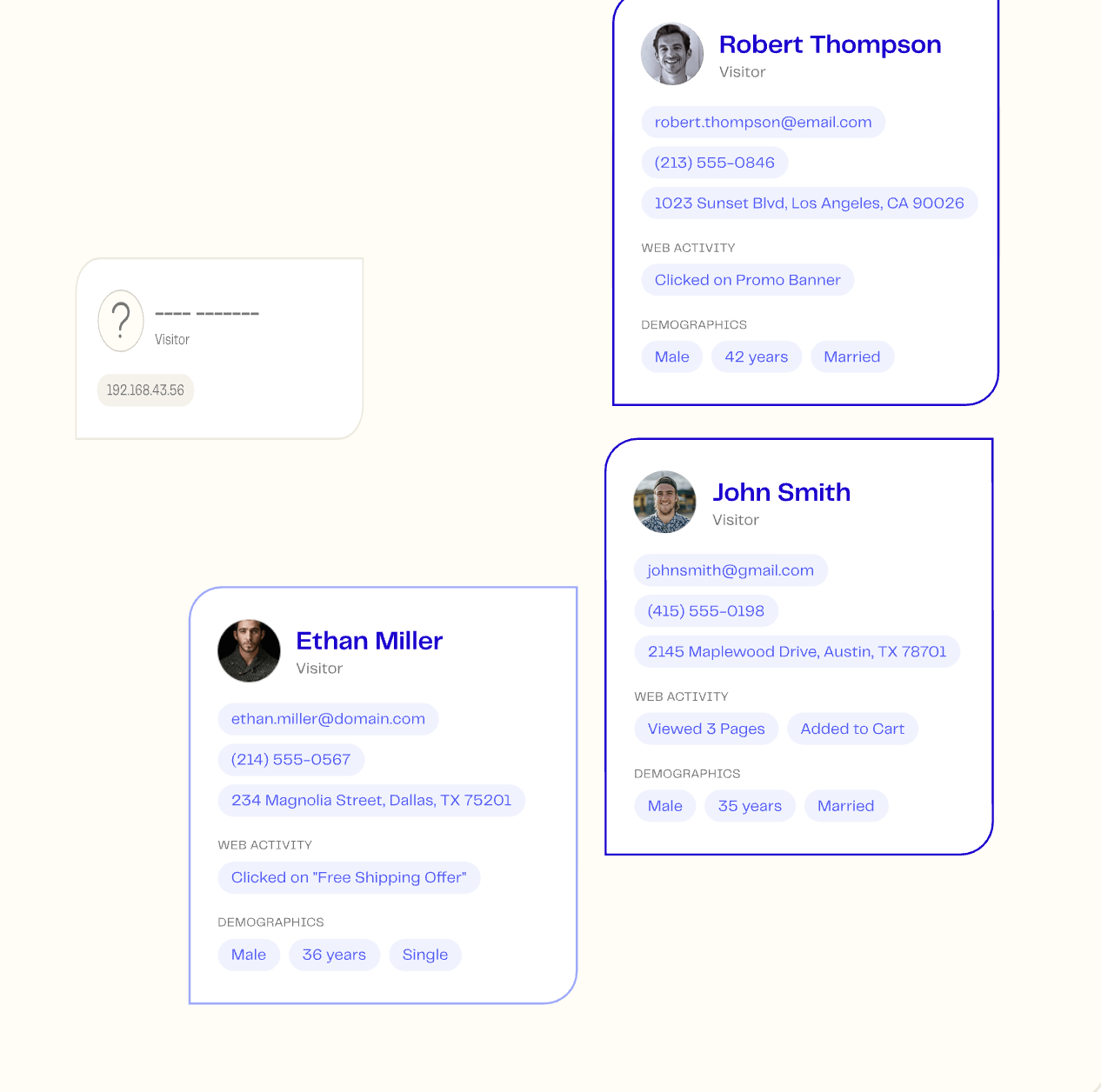
Early identification solves this. Tools like Tie recognize up to 90% of anonymous visitors through consented signals and map those sessions to real customer profiles. You see who is returning, what they looked at, and how their intent changes long before they buy or subscribe.
This gives you a reliable starting point for personalization. You aren’t waiting for a form fill to understand the visitor. You start with identity, not the order confirmation.
Step 2: Enrich profiles with meaningful context
A profile becomes more useful when it carries context, not just contact information. You need to gather three core inputs:
- Session data: depth, repeat visits, recency
- Intent signals: add-to-cart, category exploration, return patterns
- Product affinity: which items attract attention and how interest builds
Tie adds this in real time. This context lets you build segments that respond to current behavior rather than static rules. A shopper moving from casual browsing to high intent can shift segments in the same session. This level of accuracy is what makes predictive timing and tailored journeys possible.
Step 3: Activate personalization across channels
Once identity and context are enabled, you can run relevant omnichannel messages across email, SMS, and paid media without stepping over any privacy boundaries.
Setting up personalized interactions is simple:
- Personalized email and SMS: Dynamic journeys triggered from real-time session behavior.
- Paid channels: Audience set syncs based on verified identity built with privacy-safe data.
- On-site: Adaptive blocks that adjust as intent changes.
For example, with verified identity, you can recover the same abandoner through Klaviyo and Meta without relying on deprecated cookies or gray-area tracking. The message aligns across both channels because the identity powering it is the same.
Step 4: Measure accurately
Most attribution issues come from one problem: your data sources don’t align. That breaks your ability to measure lift.
Fix this by measuring what you can prove:
- Whether the message drove customer engagement
- Whether intent increased
- Whether the journey is shortened
- Whether incremental revenue went up
These metrics connect directly to behavior that you can link to a verified identity. Tie’s attribution model does this by using consented, identity-backed signals instead of cookies or last-click hacks. You see the real impact of your flows, your journeys, and your ads because every action is mapped to the same profile.
Personalize smarter to drive higher conversions and stronger trust
Most marketing campaigns fail because the system can’t clearly see the customer to make a good decision. That’s the real problem that this entire framework solves. When your system knows who is behind a session, what they’re trying to do, and how their intent shifts, you can create journeys that feel timely without crossing any privacy lines.
The shift away from third-party data is a permanent change in how data enters your stack. The brands that adapt are the ones grounding every decision in consented identity, real behavior, and context that updates fast enough to matter.
If you want personalization that holds up in 2026, this is the only path that scales: clean identity → real-time enrichment → channel-safe activation → measurement you can defend.
Want to see how real-time identity resolution and enrichment help you build compliant, conversion-focused personalization flows? Book a demo with Tie.