

← All articles

Retention Marketing

·

6

min read

Marketing Strategy vs. Plan vs. Tactics

Learn the real difference between marketing strategy, plans, tactics, and campaigns. Build clearer direction, better execution, and stronger performance.

John Levis

John Levis

Director of Product Marketing

, Tie ·

November 13, 2026

Marketing Strategy vs. Plan vs. Tactics

If you’ve ever planned a quarter of marketing, you’ve seen the confusion happen in real time. Strategy decks turn into channel menus. Plans become wishlists. Tactics float around with no guardrails. 

Suddenly, you’re shipping campaigns with no angle, watching ROAS dip, or posting content because “it’s on the calendar.”

Getting it right matters because each layer plays a different role:

  • Your strategy defines the advantage you’re betting on.
  • Your plan turns that advantage into a sequence across the marketing mix that you can actually sustain.
  • Your tactics express the plan, not the other way around.

In this guide, we break each piece down and show how they fit together.

What is a marketing strategy?

A marketing strategy is the high-level blueprint for how a brand wins in the market. It defines the advantage you’re trying to create, who you’re trying to win, and how you plan to compete over time. It’s the logic behind every decision you take after.

If you can replace your brand’s name with a competitor’s and the statement still holds, you don’t have a strategy; you have a plan with no point of view.

Many teams also blend brand and marketing strategy, leading to vague thinking. Brand shapes how you show up, what you stand for, and the feeling you want to create. Marketing strategy goes several layers deeper, including the market positioning you commit to. It covers:

  • Which market you’re choosing to serve, backed by real market research instead of assumptions.
  • How you position your offer against substitutes.
  • The economics you’re betting on.
  • The constraints you’ll operate within.
  • The competitive angle you will commit to, even if others copy your tactics.

These decisions keep your team aligned and stop you from chasing short-term brand awareness spikes that don’t support the strategy.

Why this matters when you run lifecycle or retention programs

Lifecycle plans fall apart when you don’t know who is on your site. You can’t build cohorts, model repeat rates, or segment beyond basic demographics if half your traffic stays anonymous across visits and devices.

Your strategy might call for replenishment, VIP nurture, or predictive winbacks, but none of that works when identity breaks.

What is a marketing plan?

A marketing plan is the actionable roadmap that turns your strategy into reality. Where strategy sets the direction, the marketing plan maps out what you’re going to do, when, where, and with what resources.

A marketing plan answers:

  • What initiatives will we run this quarter or year? (Campaigns, channel programs, launches, experiments.)
  • Where will these initiatives happen? (Email, SMS, paid social, SEO, social media, partnerships, onsite, etc.)
  • Who is responsible? (Owners, collaborators, timelines.)
  • What resources do we need? (Budget, tools, creative assets, tech, people.)
  • How will we measure success? (KPIs, milestones, reporting cadence.)

It includes quarterly goals and KPIs, channel plans (email, paid, content, SEO, partnerships, etc.), campaign calendar, audience segments and targeting, creative requirements, budget allocation, measurement framework, and owners and deadlines.

You also list risks, fallback paths, and stop rules so you can cut losses early instead of dragging failing work across the quarter.

If your “plan” is just a content calendar, rough monthly budgets, and a list of ideas, it isn’t a plan but a campaign schedule. A real plan only exists when every action ties back to a single, clear strategy statement. If a task doesn’t support that strategy or help you measure success meaningfully, it doesn’t belong in the plan.

Why this matters when you expect growth from email or ads

When your plan depends on revenue from email or ads, you have to call out three dependencies upfront: email deliverability, identity, and enrichment. These are not technical details. They decide whether the plan even has a chance to work.

  • If inbox placement drops, your lifecycle flows can’t hit volume targets.
  • If you can’t identify visitors across sessions, your retargeting and cohorts collapse.
  • If data enrichment signals are weak, your segments stay generic and your CPA rises.

This is why your plan needs go/no-go checks before execution. You confirm minimum thresholds for inbox placement, identity coverage, and enrichment depth. If any baseline fails, pause the plan, fix the dependency, and only then release the budget.

What is a marketing tactic?

A marketing tactic is a specific action you take to execute your marketing plan and support your broader strategy.

If strategy is why you’re doing something, and your plan is what you’ll do and when, then tactics are the how — the individual moves that make progress happen.

A marketing tactic is a single execution step, short-term and adaptable, channel-specific, measurable at a granular level, and easy to test, tweak, or replace

Marketing strategy vs marketing plan

A marketing strategy defines why you’ll win. It clarifies the segment you’re targeting, the comparison you want customers to make, and the advantage you’re betting on.

A marketing plan is about how you’ll execute that strategy. It turns the strategic direction into owners, budgets, timelines, and cross-team dependencies. Plans are time-boxed and reversible. They lay out the sequence of steps you’ll take, the resources required, and the risks or assumptions tied to execution.

Marketing tactics, finally, are the individual actions you take day-to-day, like sending a replenishment reminder, launching a referral prompt, testing a new creative, or building a segment.

Basis Marketing strategy Marketing plan Marketing tactics
Core question Why will you win? How will you execute the choices you made? What exactly will you do today or this week to move the plan forward?
Focus Choice of segment, advantage, and constraints. Tasks, sequencing, owners, and budgets. Channel-level actions like emails, posts, ads, tests, or creative variations.
Nature Non-easily-copied advantage. Reversible actions that express the advantage. Highly interchangeable, swappable executions that can be repeated or discarded.
Stability Survives channel changes. Logic stays intact. Adjusts when channels change, but shouldn't collapse. Changes frequently; optimized through testing and short cycles.
Structure One sentence that sets direction. A time-boxed, resourced set of steps. Individual actions (e.g., "Send 3-part winback flow," "Launch TikTok UGC test").
Dependency Your moat: data, supply, brand, or structural constraint. Operational inputs: deliverability, identity, enrichment, reach. Depends only on tools and execution bandwidth.
Scope Needs only 3-5 tactic families to stay coherent. Lists assumptions, risks, and stop rules tied to execution. Dozens of small actions under each tactic family; easy to launch, adjust, pause.

‍Marketing strategy vs plan vs tactic example

Below is a complete example that shows how a real strategy is built and how the companion plan translates those choices into budgets, owners, and risks.

Strategy

  • Diagnosis: Visitors hesitate because product clarity is weak.
  • Guiding policy: Win through clarity and fit, not discounts.
  • Coherent actions: Improve identity coverage, enrich by habits, rebuild early journeys around clarity.

Plan

  • Budgets: Paid media, creative, lifecycle.
  • Owners: Growth, CRM, analyst, creative.
  • Timeline: Baseline → launch clarity journeys → retarget.
  • Assumptions: Match rates, inbox placement, enrichment stability.
  • Risks: If assumptions break → pause, fix, resume.

Tactics

  • Launch new PDP modules showing fit, materials, and comparisons.
  • Run a 3-part “first-visit clarity” flow in email/SMS.
  • Deploy UGC-led retargeting ads focused on fit and use cases.
  • Add habit-based cross-sell prompts to early lifecycle flows.
  • Test short-form clarity videos for top-performing SKUs.

Marketing strategy vs tactics

A tactic is a reversible action. You can swap it without changing the underlying logic of how you win.

Your strategy sits on something a competitor can’t copy tomorrow. It could be a data moat, a supply advantage, or a brand position that has developed over time.

Some core differences between a marketing strategy and a marketing tactic are:

Basis Marketing strategy Tactics
Core question Why will you win? What actions will you take to express that advantage?
Nature Non-easily-copied advantage + constraints (data, supply, brand). Reversible actions you can swap without changing the logic.
Stability Stays intact even if channels change. Should change often based on performance.
Copyability Competitors can't replicate it quickly. Competitors can copy it tomorrow.
Role Sets the direction and limits. Executes within those limits.
Structure One sentence that defines your edge. 3-5 tactic families that ladder up to the strategy.
Sniff test If a competitor can adopt your "strategy" overnight, it's not a strategy. If removing one action breaks everything, it wasn't a tactic; it was doing the strategy's job.
Governance need Clear constraints you won't break. Controlled with guardrails (frequency, deliverability, attribution).

A quick sniff test keeps you grounded: write your strategy in one sentence. Then list 3–5 tactic families that support it. If you need 20+ tactics to explain how you’ll win, the strategy isn’t clear. Strong strategy simplifies, not expands.

Examples of strategies vs tactics in marketing (definition and litmus tests)

You can separate strategy from tactics by checking two things:

  1. Replaceability: If the action can be swapped tomorrow without breaking the logic of how you win, it’s a tactic.
  2. Constraint: If the competitive advantage comes from something other brands can’t copy, that’s a strategy.

Most confusion happens when a channel choice is mistaken for a strategy. Use the table below to test your thinking and see exactly where each layer belongs.

Strategy (why you win) Tactic (how you act) How to tell the difference
"Win by giving shoppers the strongest ingredient clarity in the category." Use creator videos to explain ingredient quality. Remove the creator videos. The strategy still holds. You replace the channel, not the logic.
"Win by using proprietary run-pattern data to match runners to the right shoe." Send product-match emails based on gait signals. Competitors can copy the email flow. They cannot copy your data. Your edge sits in the constraint.
"Win by validating micro-trends earlier than competitors." Creator sampling, fast-turn UGC, micro-trend tests. If the platform changes, the strategy stays intact. Only the tactic family changes.
"Win by offering next-day delivery through an owned logistics network." Offer free shipping for 72 hours. Competitors can copy the offer instantly. They can't copy the logistics network. The advantage remains untouched.

Marketing plan vs tactics

A marketing plan sets the limits first (people hours, cash, and risk), then selects a small set of tactics that fit those limits in a clear sequence. A backlog has no order, no risk budget, and no shared definitions, which is why teams overload themselves and wreck performance.

When you build a plan, you also add operational guardrails, like a no-send calendar and a weekly volume ceiling, so last-minute promos don’t erode deliverability or distort quarter-end attribution.

Here’s how marketing plans and tactics differ and how each one works:

Basis Marketing plan Tactics
Purpose Execute work within fixed constraints. Express the strategy through specific actions.
Nature Sequenced, resourced, and limited. Reversible and interchangeable.
Starting point Constraints: hours, cash, risk budget. Ideas or actions you could run.
Structure Clear order of specific steps, owners, timeframe, and ceilings. Standalone actions with no dependency view.
Guardrails No-send calendar, weekly volume ceiling, frequency caps. None unless imposed by the plan.
Risk control Sets limits before execution to prevent bursts from breaking deliverability or attribution. Can overload systems if run without a plan.

‍

Brand strategy vs marketing strategy

Brand strategy sets the promise you stand on and the distinctive codes that signal who you are. Effective marketing strategy, on the other hand, decides where you compete, how you position yourself, and the economics and channels you use to turn that promise into revenue.

Some key differences between a brand strategy and a marketing strategy:

Basis Brand strategy Marketing strategy
Core role Sets the brand promise and distinctive codes. Chooses the market, position, economics, and channels to deliver on the promise.
Output A constraint on what you will always do and what you will never do. A set of choices about where you'll win and why.
Tradeoffs Forces consistent boundaries across teams. Turns those boundaries into competitive moves.
Stability Long-term, slow to change. Medium-term, shaped by target market conditions.
Copyability Hard to copy if the color codes and the promise are consistent. Easier to copy unless anchored in a deeper advantage.
Measurement Lagging, cross-channel outcomes. Leading indicators tied to segment, reach, and economics.

‍

What is a marketing plan vs strategy vs campaign

Your strategy sets the logic for why you win. Your plan turns that logic into a sequenced, resourced path you can execute. A campaign is a time-boxed set of specific tactics that serve one marketing objective within that plan.

Here are some ways the three differ from each other:

Basis Marketing strategy Marketing plan Campaign
Core question Why will you win? How will you execute the choices you made? What set of tactics will deliver one plan objective?
Nature Long-term direction anchored in a non-easily-copied advantage. Sequenced, resourced path with constraints. Time-boxed cluster of tactics.
Role Sets markets, positioning, constraints, and the edge you commit to. Owns the calendar, budgets, people hours, and risk limits. Executes one marketing goal within the plan.
Stability Should not change often. Adjusts based on resources and inputs. Begins and ends within a defined window.
Dependency Must stay intact across all campaigns. Must define kill criteria and guardrails. Must follow the strategy and fit inside the plan.
Failure mode If it shifts per campaign, it's not a strategy. If it becomes a backlog, it loses sequencing and limits. If it runs with a different strategy, you create incoherence.

‍Strategy vs tactics vs campaign

You can keep your execution aligned when you separate the three layers clearly.

  • Your marketing strategy defines why you win and the constraints you operate under.
  • Your tactics are the reversible actions you use to express that strategy.
  • Your campaigns are time-boxed clusters of those tactics built to deliver a single plan objective.

If a campaign runs on different logic than the strategy, or if tactics start driving direction, you lose coherence and drift into noise.

Digital marketing strategy vs digital marketing plan

If your digital strategy only lists platforms, budgets, and content buckets, it’s not a strategy. It’s a business plan. A real digital strategy answers where you’ll win online: which segments you’ll focus on, what content or data moats you’re building, and which digital constraints you will operate within.

The digital marketing plan follows next. It sequences the work, sets guardrails, and shows how each workstream moves the strategy forward without breaking deliverability, attribution, or targeting inputs.

Before you execute any digital marketing activities, run a simple pre-flight checklist to confirm you’re not pushing campaigns into a broken system:

  1. Identity coverage %: Confirm the minimum identity match rate needed for audience building and retargeting.
  2. Enrichment: Verify the attributes and intent signals you need to support segmentation, and that those attributes and signals are stable.
  3. Email domain health: Check inbox placement, spam rate, and warming status before running high-volume flows.
  4. Paid channel audience overlap: Review overlap between Meta, Google, TikTok, and CRM audiences to avoid wasted spend.
  5. Deliverability constraints: Align send ceilings and frequency caps so you don’t burn your domain during a push.
  6. Attribution readiness: Confirm tracking, UTMs, and claimed identity signals are clean before scaling spend.

Content marketing vs strategy vs plan

Your content only stays coherent when you separate direction, execution, and ideas. If you mix them, you end up with scattered posts, inconsistent positioning, and a workload your team can’t support.

  • You need a content strategy that sets the logic for why you create content and the moat you’re building.
  • You need a plan that translates that logic into realistic workflows.
  • Finally, you need to make sure you can distribute what you create.

Here’s how the three layers differ and why failing to separate them weakens everything downstream:

Basis Content strategy Content plan Content ideas
Core role Define why you create content, who it serves, and the moat that makes your content hard to imitate. Sequence formats, resources, and timing so the strategy is doable. Scraps of potential topics with no strategic filter.
What it forces Positioning and constraints: what you say, what you avoid, and what you want to own. Calendar, capacity checks, and process control. None, ideas change without consequence.
Dependency Needs a clear POV and a segment you commit to. Needs validated distribution capacity (newsletter growth, outreach bandwidth, creator slots). Needs a strategy and plan to matter.
Failure mode Becomes generic messaging if the moat is weak. Over-promises when capacity is unverified. Pretends to be a plan when teams dump them into a backlog.

‍Marketing concept vs plan vs strategy

Marketing teams often confuse theoretical frameworks with real strategic choices.

Concepts like production, product, selling, marketing, and societal help you diagnose a company’s mindset, but they do not tell you where to win or how to execute.

If you treat a concept as your strategy, you get abstract direction with no competitive angle. If you treat it as your plan, you end up with a document that has no sequencing, no constraints, and no link to measurable outcomes.

You need to keep these three layers separate so your strategy sets the path and your plan converts that path into action.

Basis Marketing concept Marketing strategy Marketing plan
Core role Diagnose how the organization thinks, not what it should do. Decide where you'll win and why you'll win. Convert those choices into sequenced, resourced execution.
Nature Theoretical orientation that doesn't guide real tradeoffs. Competitive logic anchored in constraints competitors can't copy. Operational steps with owners, budgets, and timing.
Practical use Helps you understand bias (e.g. product-first vs market-first). Forces prioritization of segments, messages, and edges. Controls capacity, sequencing, risks, and measurement.
Failure mode When treated as a strategy, it gives vague direction with no edge. When ignored, the organization drifts into tactic-chasing. When mistaken for strategy, it becomes a random backlog of tasks.

‍Market adoption strategy vs tactic

When you think about adoption, you’re thinking about how people start using your product and keep using it. That happens because you make deliberate choices about where you enter the market, how easy your products are to pick up, and whether it’s low risk to try.

A tactic sits lower in the stack. It helps a new customer move through one step faster, but it doesn’t change how the market adopts your product.

While you need both, you need to stop calling tactics your “adoption strategy” because this hides the bigger decisions you need to make. It keeps your team busy without shifting the trajectory of adoption.

Examples

It’s easier to understand strategy, plan, and tactics when you see them in real situations. Below are a few examples that use simple one-line strategies, show the plan in a clear sequence, and list tactic families to help you grasp the concepts better:

Examples and counter-examples: strategy vs tactics

Here are some examples that will help you spot the difference between strategy, plans, and tactics:

Apparel ecommerce

  • Strategy (one line): Win high-intent shoppers by removing uncertainty around fit.
  • Plan (sequence):
    • Build identity coverage so you can connect repeat browsing behavior.
    • Enrich visitors by size and style intent.
    • Route shoppers into fit-focused product paths.
    • Retarget enriched segments with specific fit cues.
    • Shift paid spend toward clear fit-intent signals.
  • Tactic families:
    • Fit quizzes
    • Creator fit demos
    • SKU-level retargeting
    • Size-clarity landing pages
    • Fit-focused abandonment flows

Food & beverage

  • Strategy (one line): Win first-time buyers by reducing friction in product selection.
  • Plan (sequence):
    • Identify high-intent visitors early in the session.
    • Enrich visitors with dietary goals.
    • Route them to matching landing paths.
    • Use retargeting to push “starter pack” decisions.
    • Close the gap with short-cycle SMS nudges.
  • Tactic families
    • Diet-matched bundles
    • Ingredient-filter landing pages
    • Micro-timed SMS nudges
    • Short “choose your pack” guides
    • Diet-specific onboarding emails

Content-led beauty brand

  • Strategy (one line): Win trust by becoming the most credible source of ingredient clarity.
  • Plan (sequence):
    • Validate distribution capacity (newsletter growth, outreach bandwidth, creator slots).
    • Build a content moat around ingredient explainers.
    • Segment visitors based on data around skin concerns.
    • Retarget segments with personalized content paths.
    • Deliver routines and recommendations through email.
  • Tactic families:
    • Ingredient breakdown content
    • Creator reactions
    • Skin-concern retargeting
    • Clarity newsletters
    • Comparison charts

Example: Coke marketing strategy vs tactics

Coca-Cola is a great example because you can see the difference from the outside without internal data.

Strategy (what stays constant)

  • Distribution: Be physically and mentally available everywhere.
  • Brand codes: Red, the ribbon, the bottle silhouette, the tone of optimism.
  • Portfolio: Cover every occasion across sugar, zero-sugar, and flavors.

These are strategic because they compound for decades and are difficult to copy.

Tactics (what changes constantly)

  • Seasonal promotions
  • Limited editions
  • Creator partnerships
  • Holiday moments
  • Varying channel mixes

These change based on attention cycles and market dynamics. They express the strategy but they don’t define it.
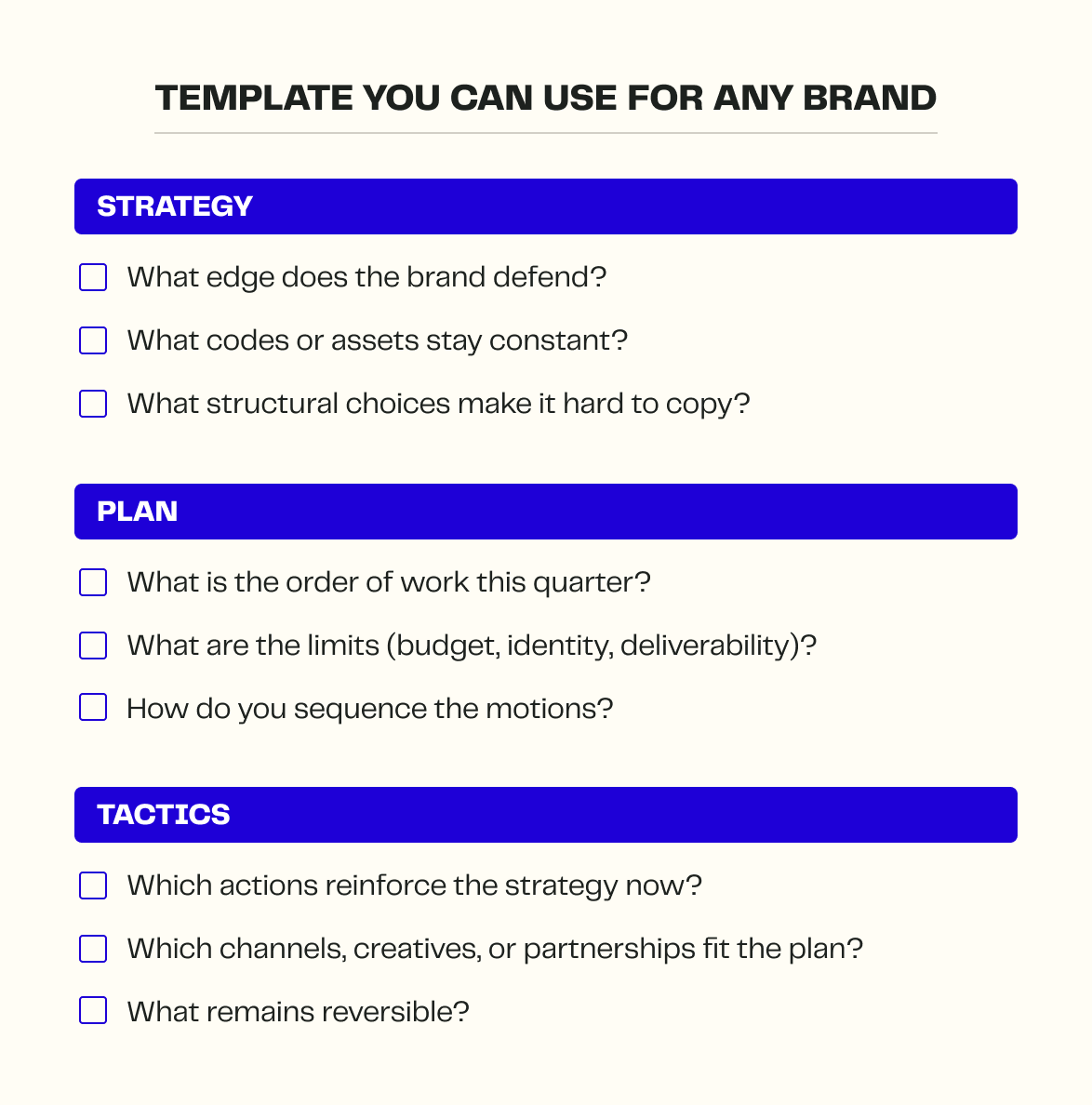
Template for brands to use for creating a strategy, plan, and tactics

Common failure modes: plan vs strategy

When your strategy and plan drift apart, your execution becomes noisy and unpredictable. You see teams chasing every persona, shipping campaigns that don’t ladder to any edge, and optimizing for numbers that don’t move revenue.

At the same time, tactics run without guardrails and end up damaging deliverability, attribution, and identity quality, all the systems your plan depends on.

Below are the three failure modes you’ll see most often and the direct fixes that pull your execution back into alignment.

1. Strategy by wishlist

You try to serve every persona and show up on every channel. Nothing gets cut. No tradeoffs are made. Your strategy becomes a list of intentions instead of a choice. You move in too many directions at once, so nothing compounds over time.

How to fix it: Write your non-business goals first. State the target audience you won’t cater to, which channels you won’t chase this quarter, and which objectives you’re not solving right now. This gives your strategy more focus. Once you define the “no,” the “yes” becomes sharper and easier to execute.

2. Plans built on vanity metrics

Your plan can look productive while delivering almost nothing. You might see higher open rates, more followers, and a spike in impressions, but none of it shifts revenue, improves reach, or strengthens your data foundation. 

It’s activity without impact. The work moves, but the business doesn’t.

Conversion rates stay flat, revenue per recipient doesn’t improve, and LTV to CAC remains unchanged. The plan looks active, but the wrong metrics are driving it. Teams ship more campaigns, but none of them map back to behavior that actually moves the business.

How to fix it: Define quality key performance indicators (KPIs) before you plan anything. Anchor execution to behavioral signals like clicks, conversion paths, revenue per recipient, and the economics that tell you if growth is compounding.

When you fix definitions up front, you stop relying on vanity targets and focus every action plan on measurable outcomes.

3. Tactics run without guardrails

Teams execute marketing campaigns without frequency limits or domain protection. Deliverability drops, identity gaps widen, and attribution becomes unreliable. Short bursts of activity damage the systems that your plan relies on, and the fixes get treated as creative problems instead of system failures.

How to fix it: Set shared guardrails: weekly send ceilings, no-send windows, domain health checks, and identity plumbing. Protect the infrastructure first. Once the inputs are stable, your tactics stop degrading the system and start compounding the strategy.

Go-to-market strategy vs marketing strategy

A go-to-market (GTM) strategy is about launching something new: a product, a geography, or a segment. It answers: How do we enter? How do we create momentum fast? What sequence of channels and motions gets us early traction?

Your marketing strategy is broader and more durable. It guides how you win across cycles, launches, and market shifts. It sets your position, your segments, and the constraints you operate under. You don’t rewrite your marketing strategy every time you launch something. You use it to shape the GTM.

Basis Go-to-market strategy Marketing strategy
Scope Built for launches; tied to one entry motion. Built for durability; guides every cycle.
Purpose Create fast traction for a new product, segment, or geography. Set a long-term goal and logic for where and why you win.
Time horizon Short window; high resource concentration. Medium-term; stable across launches.
Focus Activation sequence, launch channels, early signals. Positioning, segments, economics, constraints.
Dependency Must follow the marketing strategy. Should not shift with each GTM.
Failure mode When it tries to become the long-term strategy. When teams rebuild it every launch.

When the two align, resource planning becomes simple. You know which channels stay stable, which ones flex for the launch, and how your teams should posture toward short-term GTM pushes without damaging long-term brand, deliverability, or segmentation work.

Want to make your strategy, plan, and tactics actually work together?

When you separate strategy, plan, and tactics, your marketing stops feeling chaotic. Strategy gives you the reason you win. The plan converts that logic into an order you can sustain. Tactics become sharper because they serve a direction instead of replacing it.

But none of these marketing efforts work if your inputs are broken. You can’t run a real plan on anonymous traffic, weak enrichment, or poor deliverability.

Tie solves that gap. You get clean identity coverage, richer enrichment, and a stable email domain, three conditions that your strategy and plan rely on.

With Tie, you can:

  • Turn anonymous visitors into verified profiles you can reach and enrich.
  • Push those profiles straight into Klaviyo or your CRM in real time.
  • Keep your domain healthy by blocking bad, invalid, or duplicated emails before they hit your ESP.
  • Recover high-intent sessions with cart flows tied to actual identity, not guesswork.
  • Run win-back, replenishment, and cross-sell journeys on a unified customer profile, and not fragmented data.

If you want to see how much of your traffic you’re missing, and how much lift comes from fixing the data layer your strategy relies on, book a demo.


Written by

John Levis

Director of Product Marketing

, Tie

John leads product marketing at Tie, where he focuses on positioning, messaging, and helping ecommerce brands make better use of customer identity and behavioral data.

Maya K. identified · score 9Jordan R. synced to KlaviyoSana P. landed in PrimaryDani N. ready to buy

See what Tie finds on your site.

A 20-minute walkthrough on your own traffic — positive ROI within 30 days.

Book a demoSee pricing
November 13, 2026

Marketing Strategy vs. Plan vs. Tactics

Written by
John Levis
Director of Product Marketing
John leads product marketing at Tie, where he focuses on positioning, messaging, and helping ecommerce brands make better use of customer identity and behavioral data.

If you’ve ever planned a quarter of marketing, you’ve seen the confusion happen in real time. Strategy decks turn into channel menus. Plans become wishlists. Tactics float around with no guardrails. 

Suddenly, you’re shipping campaigns with no angle, watching ROAS dip, or posting content because “it’s on the calendar.”

Getting it right matters because each layer plays a different role:

  • Your strategy defines the advantage you’re betting on.
  • Your plan turns that advantage into a sequence across the marketing mix that you can actually sustain.
  • Your tactics express the plan, not the other way around.

In this guide, we break each piece down and show how they fit together.

What is a marketing strategy?

A marketing strategy is the high-level blueprint for how a brand wins in the market. It defines the advantage you’re trying to create, who you’re trying to win, and how you plan to compete over time. It’s the logic behind every decision you take after.

If you can replace your brand’s name with a competitor’s and the statement still holds, you don’t have a strategy; you have a plan with no point of view.

Many teams also blend brand and marketing strategy, leading to vague thinking. Brand shapes how you show up, what you stand for, and the feeling you want to create. Marketing strategy goes several layers deeper, including the market positioning you commit to. It covers:

  • Which market you’re choosing to serve, backed by real market research instead of assumptions.
  • How you position your offer against substitutes.
  • The economics you’re betting on.
  • The constraints you’ll operate within.
  • The competitive angle you will commit to, even if others copy your tactics.

These decisions keep your team aligned and stop you from chasing short-term brand awareness spikes that don’t support the strategy.

Why this matters when you run lifecycle or retention programs

Lifecycle plans fall apart when you don’t know who is on your site. You can’t build cohorts, model repeat rates, or segment beyond basic demographics if half your traffic stays anonymous across visits and devices.

Your strategy might call for replenishment, VIP nurture, or predictive winbacks, but none of that works when identity breaks.

What is a marketing plan?

A marketing plan is the actionable roadmap that turns your strategy into reality. Where strategy sets the direction, the marketing plan maps out what you’re going to do, when, where, and with what resources.

A marketing plan answers:

  • What initiatives will we run this quarter or year? (Campaigns, channel programs, launches, experiments.)
  • Where will these initiatives happen? (Email, SMS, paid social, SEO, social media, partnerships, onsite, etc.)
  • Who is responsible? (Owners, collaborators, timelines.)
  • What resources do we need? (Budget, tools, creative assets, tech, people.)
  • How will we measure success? (KPIs, milestones, reporting cadence.)

It includes quarterly goals and KPIs, channel plans (email, paid, content, SEO, partnerships, etc.), campaign calendar, audience segments and targeting, creative requirements, budget allocation, measurement framework, and owners and deadlines.

You also list risks, fallback paths, and stop rules so you can cut losses early instead of dragging failing work across the quarter.

If your “plan” is just a content calendar, rough monthly budgets, and a list of ideas, it isn’t a plan but a campaign schedule. A real plan only exists when every action ties back to a single, clear strategy statement. If a task doesn’t support that strategy or help you measure success meaningfully, it doesn’t belong in the plan.

Why this matters when you expect growth from email or ads

When your plan depends on revenue from email or ads, you have to call out three dependencies upfront: email deliverability, identity, and enrichment. These are not technical details. They decide whether the plan even has a chance to work.

  • If inbox placement drops, your lifecycle flows can’t hit volume targets.
  • If you can’t identify visitors across sessions, your retargeting and cohorts collapse.
  • If data enrichment signals are weak, your segments stay generic and your CPA rises.

This is why your plan needs go/no-go checks before execution. You confirm minimum thresholds for inbox placement, identity coverage, and enrichment depth. If any baseline fails, pause the plan, fix the dependency, and only then release the budget.

What is a marketing tactic?

A marketing tactic is a specific action you take to execute your marketing plan and support your broader strategy.

If strategy is why you’re doing something, and your plan is what you’ll do and when, then tactics are the how — the individual moves that make progress happen.

A marketing tactic is a single execution step, short-term and adaptable, channel-specific, measurable at a granular level, and easy to test, tweak, or replace

Marketing strategy vs marketing plan

A marketing strategy defines why you’ll win. It clarifies the segment you’re targeting, the comparison you want customers to make, and the advantage you’re betting on.

A marketing plan is about how you’ll execute that strategy. It turns the strategic direction into owners, budgets, timelines, and cross-team dependencies. Plans are time-boxed and reversible. They lay out the sequence of steps you’ll take, the resources required, and the risks or assumptions tied to execution.

Marketing tactics, finally, are the individual actions you take day-to-day, like sending a replenishment reminder, launching a referral prompt, testing a new creative, or building a segment.

Basis Marketing strategy Marketing plan Marketing tactics
Core question Why will you win? How will you execute the choices you made? What exactly will you do today or this week to move the plan forward?
Focus Choice of segment, advantage, and constraints. Tasks, sequencing, owners, and budgets. Channel-level actions like emails, posts, ads, tests, or creative variations.
Nature Non-easily-copied advantage. Reversible actions that express the advantage. Highly interchangeable, swappable executions that can be repeated or discarded.
Stability Survives channel changes. Logic stays intact. Adjusts when channels change, but shouldn't collapse. Changes frequently; optimized through testing and short cycles.
Structure One sentence that sets direction. A time-boxed, resourced set of steps. Individual actions (e.g., "Send 3-part winback flow," "Launch TikTok UGC test").
Dependency Your moat: data, supply, brand, or structural constraint. Operational inputs: deliverability, identity, enrichment, reach. Depends only on tools and execution bandwidth.
Scope Needs only 3-5 tactic families to stay coherent. Lists assumptions, risks, and stop rules tied to execution. Dozens of small actions under each tactic family; easy to launch, adjust, pause.

‍Marketing strategy vs plan vs tactic example

Below is a complete example that shows how a real strategy is built and how the companion plan translates those choices into budgets, owners, and risks.

Strategy

  • Diagnosis: Visitors hesitate because product clarity is weak.
  • Guiding policy: Win through clarity and fit, not discounts.
  • Coherent actions: Improve identity coverage, enrich by habits, rebuild early journeys around clarity.

Plan

  • Budgets: Paid media, creative, lifecycle.
  • Owners: Growth, CRM, analyst, creative.
  • Timeline: Baseline → launch clarity journeys → retarget.
  • Assumptions: Match rates, inbox placement, enrichment stability.
  • Risks: If assumptions break → pause, fix, resume.

Tactics

  • Launch new PDP modules showing fit, materials, and comparisons.
  • Run a 3-part “first-visit clarity” flow in email/SMS.
  • Deploy UGC-led retargeting ads focused on fit and use cases.
  • Add habit-based cross-sell prompts to early lifecycle flows.
  • Test short-form clarity videos for top-performing SKUs.

Marketing strategy vs tactics

A tactic is a reversible action. You can swap it without changing the underlying logic of how you win.

Your strategy sits on something a competitor can’t copy tomorrow. It could be a data moat, a supply advantage, or a brand position that has developed over time.

Some core differences between a marketing strategy and a marketing tactic are:

Basis Marketing strategy Tactics
Core question Why will you win? What actions will you take to express that advantage?
Nature Non-easily-copied advantage + constraints (data, supply, brand). Reversible actions you can swap without changing the logic.
Stability Stays intact even if channels change. Should change often based on performance.
Copyability Competitors can't replicate it quickly. Competitors can copy it tomorrow.
Role Sets the direction and limits. Executes within those limits.
Structure One sentence that defines your edge. 3-5 tactic families that ladder up to the strategy.
Sniff test If a competitor can adopt your "strategy" overnight, it's not a strategy. If removing one action breaks everything, it wasn't a tactic; it was doing the strategy's job.
Governance need Clear constraints you won't break. Controlled with guardrails (frequency, deliverability, attribution).

A quick sniff test keeps you grounded: write your strategy in one sentence. Then list 3–5 tactic families that support it. If you need 20+ tactics to explain how you’ll win, the strategy isn’t clear. Strong strategy simplifies, not expands.

Examples of strategies vs tactics in marketing (definition and litmus tests)

You can separate strategy from tactics by checking two things:

  1. Replaceability: If the action can be swapped tomorrow without breaking the logic of how you win, it’s a tactic.
  2. Constraint: If the competitive advantage comes from something other brands can’t copy, that’s a strategy.

Most confusion happens when a channel choice is mistaken for a strategy. Use the table below to test your thinking and see exactly where each layer belongs.

Strategy (why you win) Tactic (how you act) How to tell the difference
"Win by giving shoppers the strongest ingredient clarity in the category." Use creator videos to explain ingredient quality. Remove the creator videos. The strategy still holds. You replace the channel, not the logic.
"Win by using proprietary run-pattern data to match runners to the right shoe." Send product-match emails based on gait signals. Competitors can copy the email flow. They cannot copy your data. Your edge sits in the constraint.
"Win by validating micro-trends earlier than competitors." Creator sampling, fast-turn UGC, micro-trend tests. If the platform changes, the strategy stays intact. Only the tactic family changes.
"Win by offering next-day delivery through an owned logistics network." Offer free shipping for 72 hours. Competitors can copy the offer instantly. They can't copy the logistics network. The advantage remains untouched.

Marketing plan vs tactics

A marketing plan sets the limits first (people hours, cash, and risk), then selects a small set of tactics that fit those limits in a clear sequence. A backlog has no order, no risk budget, and no shared definitions, which is why teams overload themselves and wreck performance.

When you build a plan, you also add operational guardrails, like a no-send calendar and a weekly volume ceiling, so last-minute promos don’t erode deliverability or distort quarter-end attribution.

Here’s how marketing plans and tactics differ and how each one works:

Basis Marketing plan Tactics
Purpose Execute work within fixed constraints. Express the strategy through specific actions.
Nature Sequenced, resourced, and limited. Reversible and interchangeable.
Starting point Constraints: hours, cash, risk budget. Ideas or actions you could run.
Structure Clear order of specific steps, owners, timeframe, and ceilings. Standalone actions with no dependency view.
Guardrails No-send calendar, weekly volume ceiling, frequency caps. None unless imposed by the plan.
Risk control Sets limits before execution to prevent bursts from breaking deliverability or attribution. Can overload systems if run without a plan.

‍

Brand strategy vs marketing strategy

Brand strategy sets the promise you stand on and the distinctive codes that signal who you are. Effective marketing strategy, on the other hand, decides where you compete, how you position yourself, and the economics and channels you use to turn that promise into revenue.

Some key differences between a brand strategy and a marketing strategy:

Basis Brand strategy Marketing strategy
Core role Sets the brand promise and distinctive codes. Chooses the market, position, economics, and channels to deliver on the promise.
Output A constraint on what you will always do and what you will never do. A set of choices about where you'll win and why.
Tradeoffs Forces consistent boundaries across teams. Turns those boundaries into competitive moves.
Stability Long-term, slow to change. Medium-term, shaped by target market conditions.
Copyability Hard to copy if the color codes and the promise are consistent. Easier to copy unless anchored in a deeper advantage.
Measurement Lagging, cross-channel outcomes. Leading indicators tied to segment, reach, and economics.

‍

What is a marketing plan vs strategy vs campaign

Your strategy sets the logic for why you win. Your plan turns that logic into a sequenced, resourced path you can execute. A campaign is a time-boxed set of specific tactics that serve one marketing objective within that plan.

Here are some ways the three differ from each other:

Basis Marketing strategy Marketing plan Campaign
Core question Why will you win? How will you execute the choices you made? What set of tactics will deliver one plan objective?
Nature Long-term direction anchored in a non-easily-copied advantage. Sequenced, resourced path with constraints. Time-boxed cluster of tactics.
Role Sets markets, positioning, constraints, and the edge you commit to. Owns the calendar, budgets, people hours, and risk limits. Executes one marketing goal within the plan.
Stability Should not change often. Adjusts based on resources and inputs. Begins and ends within a defined window.
Dependency Must stay intact across all campaigns. Must define kill criteria and guardrails. Must follow the strategy and fit inside the plan.
Failure mode If it shifts per campaign, it's not a strategy. If it becomes a backlog, it loses sequencing and limits. If it runs with a different strategy, you create incoherence.

‍Strategy vs tactics vs campaign

You can keep your execution aligned when you separate the three layers clearly.

  • Your marketing strategy defines why you win and the constraints you operate under.
  • Your tactics are the reversible actions you use to express that strategy.
  • Your campaigns are time-boxed clusters of those tactics built to deliver a single plan objective.

If a campaign runs on different logic than the strategy, or if tactics start driving direction, you lose coherence and drift into noise.

Digital marketing strategy vs digital marketing plan

If your digital strategy only lists platforms, budgets, and content buckets, it’s not a strategy. It’s a business plan. A real digital strategy answers where you’ll win online: which segments you’ll focus on, what content or data moats you’re building, and which digital constraints you will operate within.

The digital marketing plan follows next. It sequences the work, sets guardrails, and shows how each workstream moves the strategy forward without breaking deliverability, attribution, or targeting inputs.

Before you execute any digital marketing activities, run a simple pre-flight checklist to confirm you’re not pushing campaigns into a broken system:

  1. Identity coverage %: Confirm the minimum identity match rate needed for audience building and retargeting.
  2. Enrichment: Verify the attributes and intent signals you need to support segmentation, and that those attributes and signals are stable.
  3. Email domain health: Check inbox placement, spam rate, and warming status before running high-volume flows.
  4. Paid channel audience overlap: Review overlap between Meta, Google, TikTok, and CRM audiences to avoid wasted spend.
  5. Deliverability constraints: Align send ceilings and frequency caps so you don’t burn your domain during a push.
  6. Attribution readiness: Confirm tracking, UTMs, and claimed identity signals are clean before scaling spend.

Content marketing vs strategy vs plan

Your content only stays coherent when you separate direction, execution, and ideas. If you mix them, you end up with scattered posts, inconsistent positioning, and a workload your team can’t support.

  • You need a content strategy that sets the logic for why you create content and the moat you’re building.
  • You need a plan that translates that logic into realistic workflows.
  • Finally, you need to make sure you can distribute what you create.

Here’s how the three layers differ and why failing to separate them weakens everything downstream:

Basis Content strategy Content plan Content ideas
Core role Define why you create content, who it serves, and the moat that makes your content hard to imitate. Sequence formats, resources, and timing so the strategy is doable. Scraps of potential topics with no strategic filter.
What it forces Positioning and constraints: what you say, what you avoid, and what you want to own. Calendar, capacity checks, and process control. None, ideas change without consequence.
Dependency Needs a clear POV and a segment you commit to. Needs validated distribution capacity (newsletter growth, outreach bandwidth, creator slots). Needs a strategy and plan to matter.
Failure mode Becomes generic messaging if the moat is weak. Over-promises when capacity is unverified. Pretends to be a plan when teams dump them into a backlog.

‍Marketing concept vs plan vs strategy

Marketing teams often confuse theoretical frameworks with real strategic choices.

Concepts like production, product, selling, marketing, and societal help you diagnose a company’s mindset, but they do not tell you where to win or how to execute.

If you treat a concept as your strategy, you get abstract direction with no competitive angle. If you treat it as your plan, you end up with a document that has no sequencing, no constraints, and no link to measurable outcomes.

You need to keep these three layers separate so your strategy sets the path and your plan converts that path into action.

Basis Marketing concept Marketing strategy Marketing plan
Core role Diagnose how the organization thinks, not what it should do. Decide where you'll win and why you'll win. Convert those choices into sequenced, resourced execution.
Nature Theoretical orientation that doesn't guide real tradeoffs. Competitive logic anchored in constraints competitors can't copy. Operational steps with owners, budgets, and timing.
Practical use Helps you understand bias (e.g. product-first vs market-first). Forces prioritization of segments, messages, and edges. Controls capacity, sequencing, risks, and measurement.
Failure mode When treated as a strategy, it gives vague direction with no edge. When ignored, the organization drifts into tactic-chasing. When mistaken for strategy, it becomes a random backlog of tasks.

‍Market adoption strategy vs tactic

When you think about adoption, you’re thinking about how people start using your product and keep using it. That happens because you make deliberate choices about where you enter the market, how easy your products are to pick up, and whether it’s low risk to try.

A tactic sits lower in the stack. It helps a new customer move through one step faster, but it doesn’t change how the market adopts your product.

While you need both, you need to stop calling tactics your “adoption strategy” because this hides the bigger decisions you need to make. It keeps your team busy without shifting the trajectory of adoption.

Examples

It’s easier to understand strategy, plan, and tactics when you see them in real situations. Below are a few examples that use simple one-line strategies, show the plan in a clear sequence, and list tactic families to help you grasp the concepts better:

Examples and counter-examples: strategy vs tactics

Here are some examples that will help you spot the difference between strategy, plans, and tactics:

Apparel ecommerce

  • Strategy (one line): Win high-intent shoppers by removing uncertainty around fit.
  • Plan (sequence):
    • Build identity coverage so you can connect repeat browsing behavior.
    • Enrich visitors by size and style intent.
    • Route shoppers into fit-focused product paths.
    • Retarget enriched segments with specific fit cues.
    • Shift paid spend toward clear fit-intent signals.
  • Tactic families:
    • Fit quizzes
    • Creator fit demos
    • SKU-level retargeting
    • Size-clarity landing pages
    • Fit-focused abandonment flows

Food & beverage

  • Strategy (one line): Win first-time buyers by reducing friction in product selection.
  • Plan (sequence):
    • Identify high-intent visitors early in the session.
    • Enrich visitors with dietary goals.
    • Route them to matching landing paths.
    • Use retargeting to push “starter pack” decisions.
    • Close the gap with short-cycle SMS nudges.
  • Tactic families
    • Diet-matched bundles
    • Ingredient-filter landing pages
    • Micro-timed SMS nudges
    • Short “choose your pack” guides
    • Diet-specific onboarding emails

Content-led beauty brand

  • Strategy (one line): Win trust by becoming the most credible source of ingredient clarity.
  • Plan (sequence):
    • Validate distribution capacity (newsletter growth, outreach bandwidth, creator slots).
    • Build a content moat around ingredient explainers.
    • Segment visitors based on data around skin concerns.
    • Retarget segments with personalized content paths.
    • Deliver routines and recommendations through email.
  • Tactic families:
    • Ingredient breakdown content
    • Creator reactions
    • Skin-concern retargeting
    • Clarity newsletters
    • Comparison charts

Example: Coke marketing strategy vs tactics

Coca-Cola is a great example because you can see the difference from the outside without internal data.

Strategy (what stays constant)

  • Distribution: Be physically and mentally available everywhere.
  • Brand codes: Red, the ribbon, the bottle silhouette, the tone of optimism.
  • Portfolio: Cover every occasion across sugar, zero-sugar, and flavors.

These are strategic because they compound for decades and are difficult to copy.

Tactics (what changes constantly)

  • Seasonal promotions
  • Limited editions
  • Creator partnerships
  • Holiday moments
  • Varying channel mixes

These change based on attention cycles and market dynamics. They express the strategy but they don’t define it.

Template for brands to use for creating a strategy, plan, and tactics

Common failure modes: plan vs strategy

When your strategy and plan drift apart, your execution becomes noisy and unpredictable. You see teams chasing every persona, shipping campaigns that don’t ladder to any edge, and optimizing for numbers that don’t move revenue.

At the same time, tactics run without guardrails and end up damaging deliverability, attribution, and identity quality, all the systems your plan depends on.

Below are the three failure modes you’ll see most often and the direct fixes that pull your execution back into alignment.

1. Strategy by wishlist

You try to serve every persona and show up on every channel. Nothing gets cut. No tradeoffs are made. Your strategy becomes a list of intentions instead of a choice. You move in too many directions at once, so nothing compounds over time.

How to fix it: Write your non-business goals first. State the target audience you won’t cater to, which channels you won’t chase this quarter, and which objectives you’re not solving right now. This gives your strategy more focus. Once you define the “no,” the “yes” becomes sharper and easier to execute.

2. Plans built on vanity metrics

Your plan can look productive while delivering almost nothing. You might see higher open rates, more followers, and a spike in impressions, but none of it shifts revenue, improves reach, or strengthens your data foundation. 

It’s activity without impact. The work moves, but the business doesn’t.

Conversion rates stay flat, revenue per recipient doesn’t improve, and LTV to CAC remains unchanged. The plan looks active, but the wrong metrics are driving it. Teams ship more campaigns, but none of them map back to behavior that actually moves the business.

How to fix it: Define quality key performance indicators (KPIs) before you plan anything. Anchor execution to behavioral signals like clicks, conversion paths, revenue per recipient, and the economics that tell you if growth is compounding.

When you fix definitions up front, you stop relying on vanity targets and focus every action plan on measurable outcomes.

3. Tactics run without guardrails

Teams execute marketing campaigns without frequency limits or domain protection. Deliverability drops, identity gaps widen, and attribution becomes unreliable. Short bursts of activity damage the systems that your plan relies on, and the fixes get treated as creative problems instead of system failures.

How to fix it: Set shared guardrails: weekly send ceilings, no-send windows, domain health checks, and identity plumbing. Protect the infrastructure first. Once the inputs are stable, your tactics stop degrading the system and start compounding the strategy.

Go-to-market strategy vs marketing strategy

A go-to-market (GTM) strategy is about launching something new: a product, a geography, or a segment. It answers: How do we enter? How do we create momentum fast? What sequence of channels and motions gets us early traction?

Your marketing strategy is broader and more durable. It guides how you win across cycles, launches, and market shifts. It sets your position, your segments, and the constraints you operate under. You don’t rewrite your marketing strategy every time you launch something. You use it to shape the GTM.

Basis Go-to-market strategy Marketing strategy
Scope Built for launches; tied to one entry motion. Built for durability; guides every cycle.
Purpose Create fast traction for a new product, segment, or geography. Set a long-term goal and logic for where and why you win.
Time horizon Short window; high resource concentration. Medium-term; stable across launches.
Focus Activation sequence, launch channels, early signals. Positioning, segments, economics, constraints.
Dependency Must follow the marketing strategy. Should not shift with each GTM.
Failure mode When it tries to become the long-term strategy. When teams rebuild it every launch.

When the two align, resource planning becomes simple. You know which channels stay stable, which ones flex for the launch, and how your teams should posture toward short-term GTM pushes without damaging long-term brand, deliverability, or segmentation work.

Want to make your strategy, plan, and tactics actually work together?

When you separate strategy, plan, and tactics, your marketing stops feeling chaotic. Strategy gives you the reason you win. The plan converts that logic into an order you can sustain. Tactics become sharper because they serve a direction instead of replacing it.

But none of these marketing efforts work if your inputs are broken. You can’t run a real plan on anonymous traffic, weak enrichment, or poor deliverability.

Tie solves that gap. You get clean identity coverage, richer enrichment, and a stable email domain, three conditions that your strategy and plan rely on.

With Tie, you can:

  • Turn anonymous visitors into verified profiles you can reach and enrich.
  • Push those profiles straight into Klaviyo or your CRM in real time.
  • Keep your domain healthy by blocking bad, invalid, or duplicated emails before they hit your ESP.
  • Recover high-intent sessions with cart flows tied to actual identity, not guesswork.
  • Run win-back, replenishment, and cross-sell journeys on a unified customer profile, and not fragmented data.

If you want to see how much of your traffic you’re missing, and how much lift comes from fixing the data layer your strategy relies on, book a demo.

On this page
Stay Connected to the Latest
New articles delivered to your inbox—no strings attached.