What Brands Miss When They Only Look at Transactional Customer Data


Brands have more customer data than ever before. Yet many still struggle to explain why their best customers stay, leave, or come back.
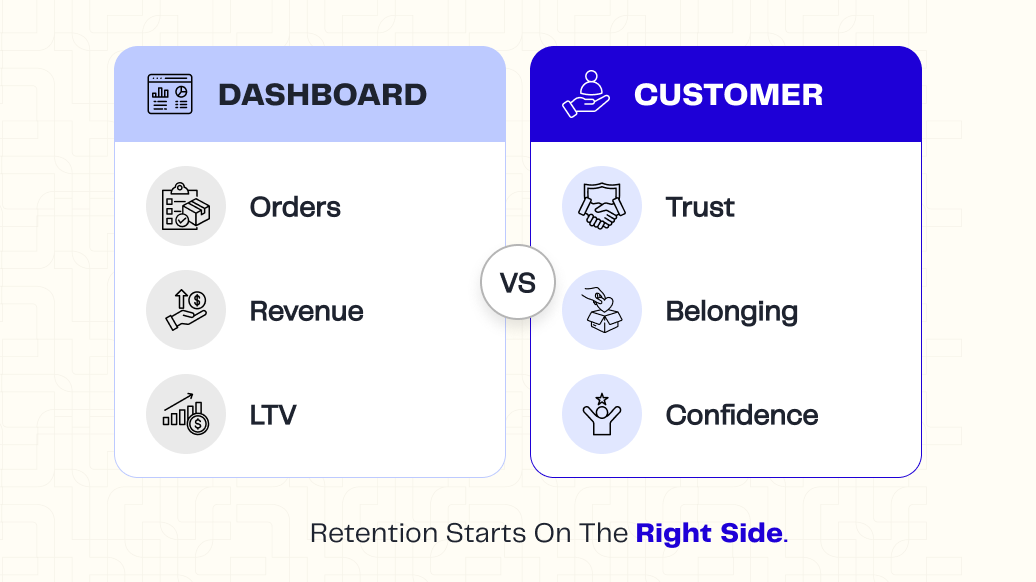
The problem is that most data shows what customers did, not why they did it.
Brands track purchases, clicks, unsubscribes, and customer lifetime value. But by the time a dashboard shows that a customer has lapsed, the decision often happened weeks earlier. The signals were already there. They just weren't showing up in the reports that teams were watching.
Nicole Harvey has seen this pattern throughout her career.
Before founding HER In Focus, a global community for women in retail and ecommerce, she spent more than a decade working with brands through companies like Wayfair and Recharge. Across industries, customer segments, and stages of growth, she saw the same challenge emerge: brands measuring customer behavior without fully understanding customer motivation.
In this article, Harvey shares the signals brands miss when they rely too heavily on transactional data, why community often reveals more than a dashboard, and how brands can build customer relationships that last beyond the next purchase.
Transactional data tells you what happened, not why it happened
A purchase can tell you that someone converted. It can't tell you what convinced them to trust your brand in the first place.
That's the limitation of most ecommerce reporting. Brands can see who bought, when they bought, how much they spent, and whether they returned. What often remains invisible is the motivation behind those actions.
Transactional data can tell you:
- What someone bought
- When they purchased
- How often they return
- When they stopped engaging
It can't tell you:
- What built trust
- What nearly stopped them from buying
- What keeps them connected between purchases
- Why they choose to come back
"Transactional data tells you the what, never the why. And the why is where retention actually lives."
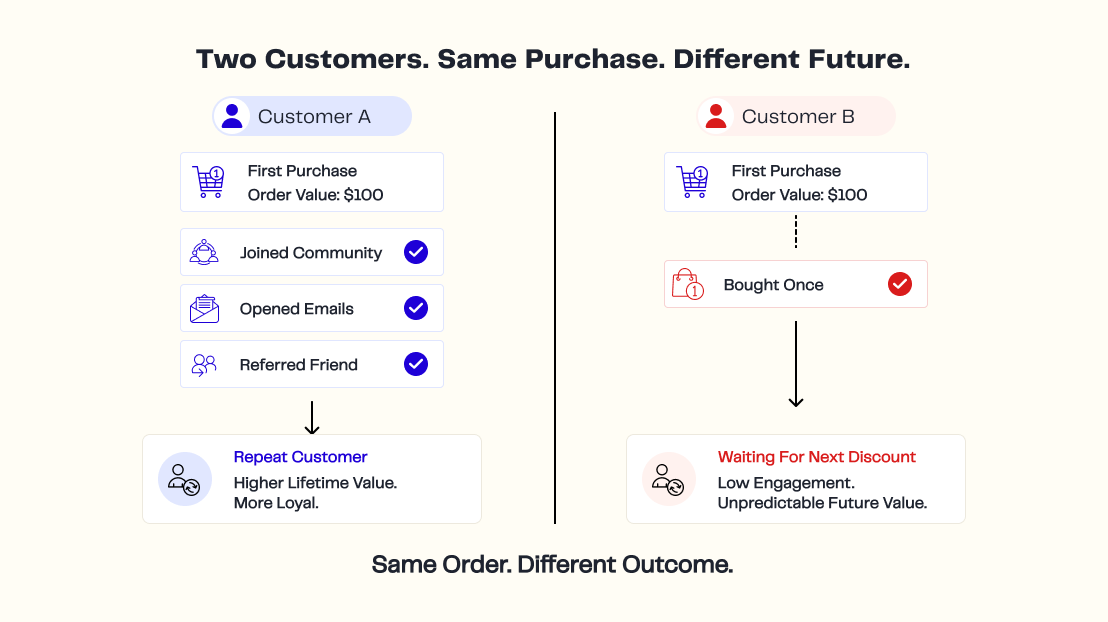
Two customers can generate identical purchase data while representing completely different opportunities for a brand.
Why retention signals appear earlier than revenue signals
Consider two customers who make the same purchase.
One arrived through a discount, bought once, and is waiting for the next promotion. The other engages with your content, participates in your community, and is gradually building a relationship with your brand.
In a dashboard, those customers can look almost identical. In reality, they're moving in completely different directions.
The challenge is that most brands only investigate customer behavior after something goes wrong. A customer unsubscribes, purchase frequency drops, revenue declines, and churn becomes visible.
By that point, the decision has often already been made.
"The data didn't lie to them, they just weren't asking it the right questions.”
Long before someone stops buying, they often stop engaging. They stop opening emails, participating in the community, referring friends, or interacting with content.
Those behaviors rarely appear in revenue reports, but they can reveal more about future retention than a transaction ever could. That's where many retention marketing strategies begin to break down.
Brands optimize around purchases since they are easy to measure. But loyalty is harder to quantify, even though it often determines future revenue. It develops through conversations, repeated engagement, shared identity, referrals, and emotional connection.
The strongest retention marketing strategies don't rely on transactional data alone. They combine it with the signals that reveal how customers feel, engage, and connect with the brand over time.
The goal isn't simply understanding what customers bought. It's understanding what made them come back.
The strongest customer signals rarely appear inside dashboards
Once you start looking beyond transactions, a different set of customer signals begins to emerge.
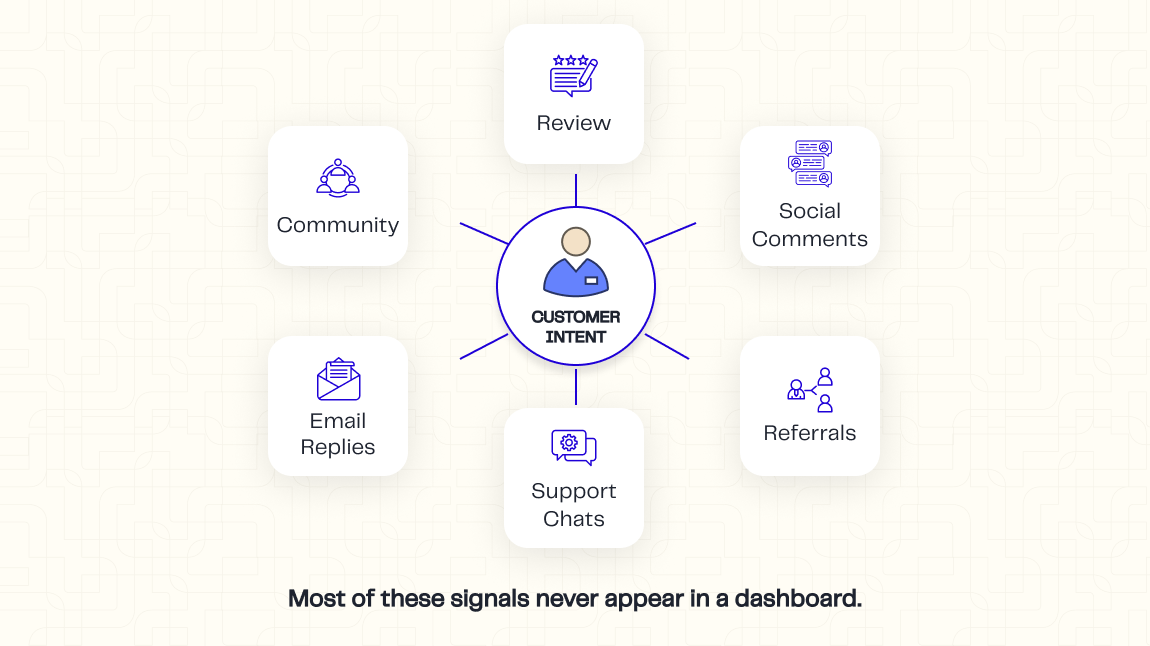
They rarely appear in consumer attribution reports or retention dashboards. Instead, they show up in places most brands overlook, like community discussions, email replies, support conversations, product reviews, and social interactions.
"The richest signals are usually hiding in plain sight, a comment in a Reddit group, a reply to an email, a question that keeps coming up in a community forum."
A shopper asking, "Does this work for someone like me?" before making a purchase is already revealing hesitation, intent, and expectations. So is a customer who posts about your product without being asked.
These interactions provide context around the decision itself, something purchase data rarely captures. For brands trying to understand loyalty, those conversations often contain the missing pieces. They reveal what customers care about, what they're struggling with, and what keeps them engaged long after a transaction is complete.
"Brands that have an active community are sitting on a goldmine of unsolicited, unfiltered feedback. That's hard to replicate with a survey."
Repeat engagement matters more than brands realize
Not every valuable customer signal leads directly to a purchase.
Some customers open every email. Others regularly engage with content, revisit product pages, participate in community discussions, or follow the brand closely for months before placing another order.
Most dashboards classify these customers as inactive because no revenue event has occurred. The purchase hasn't happened yet, but the relationship is still active.
"Someone who opens every email, watches your content, shares your posts, that's a customer telling you they haven't left, they're just not ready yet."
One of the strongest early indicators of loyalty is what a customer does after their first purchase.
"Do they follow you? Join the community? Reply to an email? That second touchpoint, whatever it is, is a strong early indicator that someone is becoming a brand person, not just a buyer."
That's why leading brands pay attention to engagement between orders, not just the orders themselves. They want to know who continues showing up, who keeps interacting, and who remains connected to the brand when there isn't an immediate reason to buy.
Those behaviors often reveal future loyalty long before it appears through revenue.
Referrals reveal trust better than purchases do
Referral behavior is another signal that traditional ecommerce reporting often undervalues. A purchase requires confidence in a product, but a referral requires confidence in the brand itself.
Most customers will buy something they like. Far fewer will recommend it to someone else, especially without an incentive.
"When a member recommends your product to someone else in the community unprompted, that's a conversion moment your analytics will never capture. But it's one of the most powerful ones that exists."
When customers recommend a brand unprompted, they're doing more than expressing satisfaction. They're putting their own reputation behind it.
That's why some of the most valuable customers aren't always the biggest spenders. They're the ones advocating for the brand, participating in the community, and bringing new people into it.
Why community gives brands context that data alone cannot
Most customer data is collected after a decision has already been made.
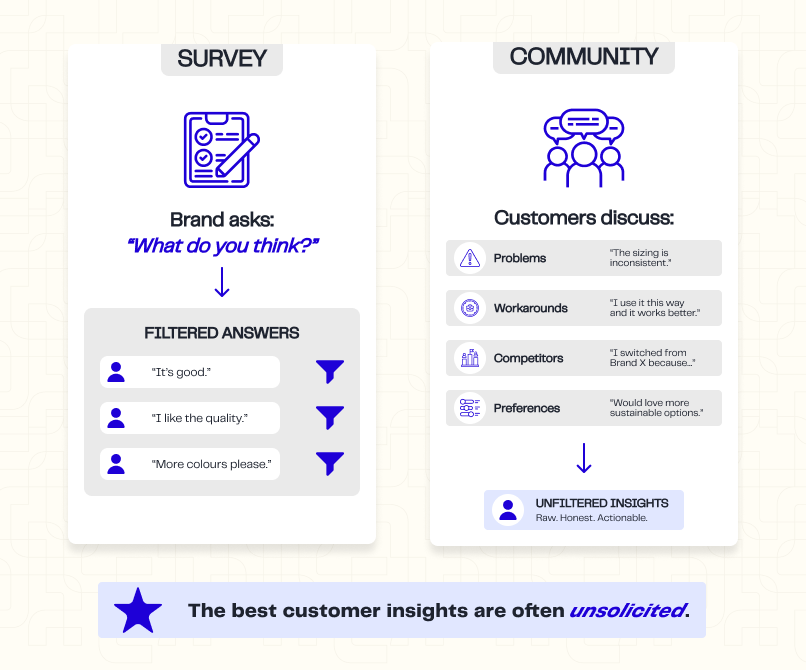
A purchase tells you someone bought. A survey tells you what they chose to share. Neither gives you much visibility into the conversations, questions, and considerations that shaped the decision in the first place.
That's where community becomes valuable.
When customers talk to each other, they explain problems in their own words. They share frustrations, compare alternatives, ask questions, and discuss what matters to them. You start seeing the factors influencing decisions before they show up in conversion reports.
"Community is where customers tell you what they'd never put in a survey. The frustrations, the workarounds they've figured out, the comparisons they're making to competitors — it's all there if you're paying attention."
That's difficult to replicate through traditional feedback channels because most surveys are structured around questions the brand wants answered. Communities often surface questions brands never thought to ask.
Those conversations surface blind spots quickly.
You might assume customers buy because of price, only to realize they're unsure how your product fits into their routine. You might believe a specific feature drives purchases, while customers are actually focused on something else entirely.
Community gives you access to that missing context.
Customers stay closer to brands they help shape
The strongest communities don't just generate feedback. They also create participation.
Harvey points to brands like Gorgie, which regularly involve customers in decisions around flavors, packaging, and product development.
When customers contribute ideas and see those ideas reflected in the final product, the relationship changes. They stop feeling like buyers on the outside looking in. They become invested in the brand's success.
"When customers feel like they helped build something, they don't just buy it, they protect it, promote it, and bring others into it. That level of involvement creates something transactional data can never manufacture: ownership."
You can see the difference in how customers talk about the brand. The conversation shifts from what they purchased to what they're part of.
That kind of involvement is hard for competitors to recreate because it’s built on participation, not just transactions. Discounts can be matched. Products can be copied. A sense of ownership is much harder to replicate.
Identity drives behavior
This is where many brands get stuck.
They build customer profiles around transactions, demographics, and engagement metrics. Useful information, but incomplete.
Two customers can buy the same product and spend the same amount of money for entirely different reasons. One may simply like the product. The other may identify with the community, values, or people behind the brand.
Over time, those customers behave very differently.
"The brands that struggle to grow beyond a certain point are usually the ones still defining their customer by what they bought last. The ones that break through have figured out that identity drives behavior, not the other way around."
Community helps you reveal that identity. It shows what customers care about, how they see themselves, and what keeps them connected between purchases.
Once you understand those motivations, retention becomes much easier to predict than when you're relying on purchase history alone.
The hidden cost of optimizing only for ROAS and conversion
Ecommerce and DTC brands would agree that customer loyalty matters. But many still evaluate marketing performance through metrics that stop at the point of purchase.
A campaign drives conversions, ROAS looks healthy, customer acquisition costs stay within target, and the budget increases.
The problem isn't that these metrics are wrong. It's that they only capture part of the story.
"ROAS tells you what worked. It doesn't tell you why, or whether it'll work again. When teams build their entire strategy around hitting a number, they tend to optimize for the short game and quietly erode the long one."
High-converting customers aren’t always high-value customers
One of the easiest mistakes to make is assuming that every conversion carries the same long-term value.
Imagine two customers acquired through the same campaign. Both place an order, generate similar revenue, and improve the campaign's performance metrics. From a dashboard's perspective, they look identical.
Over the following months, their behavior tells a different story:
Customer A
- Follows product launches and opens every email
- Participates in community discussions
- Returns without needing a promotion
Customer B
- Goes quiet after the first order
- Only reappears when an offer lands in their inbox
- Converts again, but only on discount
"One of them is loyal. One of them is waiting for your next sale."
The challenge is that acquisition metrics rarely show that difference. They tell you who converted, but not what kind of customer you acquired.
Discounts can hide underlying retention problems
Harvey sees this pattern frequently.
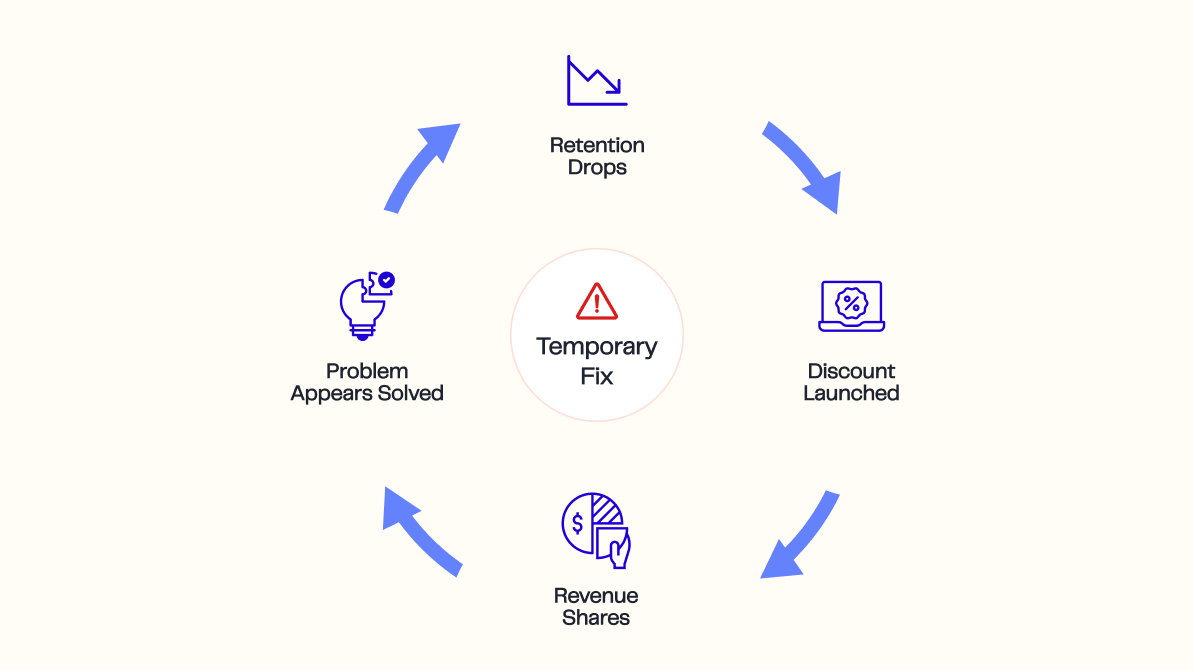
A brand notices repeat purchase rates starting to decline and responds with another discount. Revenue lifts, customers come back, and the campaign gets marked as a success.
The problem is that the discount answers the wrong question.
Instead of understanding why customers were disengaging, the brand learns that customers respond to discounts. Those aren't the same thing.
"A customer who converts because of a discount isn't the same as a customer who converts because they finally trusted you enough to try. Those two look identical in a performance dashboard, but they behave completely differently over the next 12 months."
The promotion brings customers back, but it doesn't clarify why they left in the first place. That's what makes discounts such a tempting shortcut. They can boost results without deepening your understanding of the customer.
Over time, this creates a blind spot. Every dip in engagement gets treated as a pricing problem when the real cause may have nothing to do with price.
The brands that retain customers successfully spend as much time understanding the reasons behind repeat purchases as they do measuring the purchases themselves.
A customer who returns because they genuinely value the product behaves very differently from one who returns only because the offer was compelling. In a dashboard, those purchases appear identical. In reality, the relationships behind them are fundamentally different.
Some of the most important growth signals never appear in ROAS reporting
ROAS can tell you which campaign generated a sale.
It can't tell you whether customers are developing trust in the brand, recommending products to friends, participating in the community, or becoming advocates who influence future purchases.
"The other signal that gets buried is organic momentum, word of mouth, community growth, unprompted mentions. These are compounding assets that performance marketing can't buy directly, but a brand obsessed with paid metrics rarely has the bandwidth to notice them building, or to notice when they start to stall."
Those behaviors tend to emerge gradually, which makes them harder to measure and easier to overlook.
Yet they're often what separates brands with durable customer relationships from brands that rely on a constant stream of new customer acquisition.
The strongest operators don't stop measuring conversion metrics. They simply recognize their limitations.
A successful transaction tells you revenue was generated. Sustainable growth depends on understanding why customers continue showing up after that transaction is complete.
What a more complete customer understanding actually looks like
Most brands already have enough customer data to make better decisions.
The challenge is that the information lives in different places. Marketing teams review campaign performance, CX teams analyze support conversations, community managers track engagement, and product teams collect feedback.
Each team sees part of the customer, and very few see the whole picture.
"Your customer is the same person whether they're in your email flow, your Instagram comments, your community platform, or standing in front of your product at retail. The brands that win treat them that way."
A customer might stop opening emails but become more active in the community. Another might purchase less frequently while continuing to leave reviews and refer friends.
If you're only looking at one channel or one metric, those behaviors can seem disconnected. Together, they tell a much clearer story about the health of the relationship.
"The goal isn't just a unified data profile, it's a unified relationship."
Start treating customer conversations as business intelligence
Most brands review revenue reports every week. Far fewer review customer conversations with the same discipline.
That's a missed opportunity.
Customers regularly explain what they're struggling with, what they're excited about, and what’s influencing their decisions.
Pay attention to:
- Questions that come up repeatedly
- Objections customers mention before purchasing
- Topics that generate the most community discussion
- Reasons customers recommend the brand to others
- Language customers use when describing the product
When the same themes surface across multiple conversations, patterns begin to emerge. Those patterns often explain what's driving purchases and what's preventing them.
Look for behavior that happens between purchases
Many retention strategies focus almost entirely on transactions.
The problem is that customers spend far more time not purchasing than purchasing.
"The gap between order one and order two is where loyalty is either built or abandoned. A brand with no community infrastructure has nothing to fill that space with except another promotional email."
That's why Harvey encourages brands to pay attention to what happens between orders. Are customers engaging with content, participating in discussions, responding to product launches, referring friends, or staying connected even when they aren't actively shopping?
Those behaviors often reveal more about future retention than purchase history alone. A customer who hasn't bought in 60 days but still engages with the brand may be in a much stronger position than one who purchased recently and disappeared immediately afterward.
Connect identity, behavior, and transactions
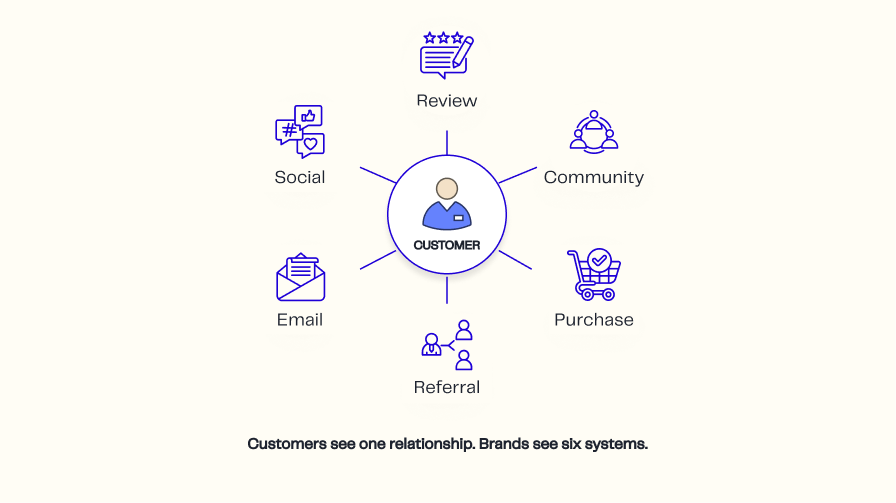
Customers experience your brand as one continuous relationship. Most systems don't.
Someone might discover your brand through social media, join the community, visit your website multiple times, subscribe to emails, make a purchase, leave a review, and recommend the brand to a friend.
When those interactions live in separate systems, it's difficult to understand what actually influenced the outcome.
The strongest brands connect those signals instead of analyzing them in isolation. They look at transactions alongside engagement, community participation, customer feedback, and behavioral trends.
"Your community tells you who your customer really is. Your data tells you how they behave. Identity is what ties it together across every touchpoint."
Retention isn't built through a single purchase. It's built through hundreds of small interactions that shape how customers feel about your brand over time.
The brands that understand those interactions are usually the ones that keep customers around the longest.
Turn customer insights into better decisions
If there's one takeaway from this conversation, it's that transactions only tell part of the story.
The brands that build stronger retention don't just track purchases. They pay attention to the signals around those purchases: customer conversations, community participation, engagement patterns, referrals, and the behaviors that reveal why people stay.
The challenge is connecting those signals.
Customers interact with your brand across dozens of touchpoints before and after they buy. When those interactions live in different tools, it's difficult to understand what actually drives loyalty, retention, and long-term growth.
Tie helps ecommerce brands connect customer identity, behavior, and transaction data into a more complete view of the customer relationship. By bringing together signals across channels, brands can better understand who their customers are, what keeps them engaged, and which behaviors are most likely to drive future value.
Want a better understanding of the people behind the purchases on your store? Book a demo and see how Tie helps you connect the dots.