What Scalable Automation Really Looks Like for Ecommerce


Automation tends to get more complicated than it needs to be.
It usually starts simple with welcome flows, abandoned cart, and post-purchase messaging. As the brand grows, more segments are introduced, new flows are added, and additional tools layer into the stack for loyalty, reviews, referrals, and personalization.
None of these changes feels unusual as they’re a part of scaling the lifecycle program.
But over time, the system becomes harder to operate. Flows overlap, tools trigger messages at the same time, and small changes in one area ripple across the entire program. Teams spend more time managing automation than improving it.
Sammy Tran sees this pattern frequently. As the founder of BMO Media, a lifecycle marketing agency, he works with fast-growing ecommerce brands whose email and SMS systems have quietly become complex.
In most cases, nothing is technically broken. The automation system has simply expanded without a clear structure guiding how it should scale. That’s where many lifecycle programs begin to strain.
In this piece, Tran breaks down how automation systems evolve, where they become overengineered, and what scalable lifecycle architecture actually looks like as brands grow.
The difference between basic and scalable automation
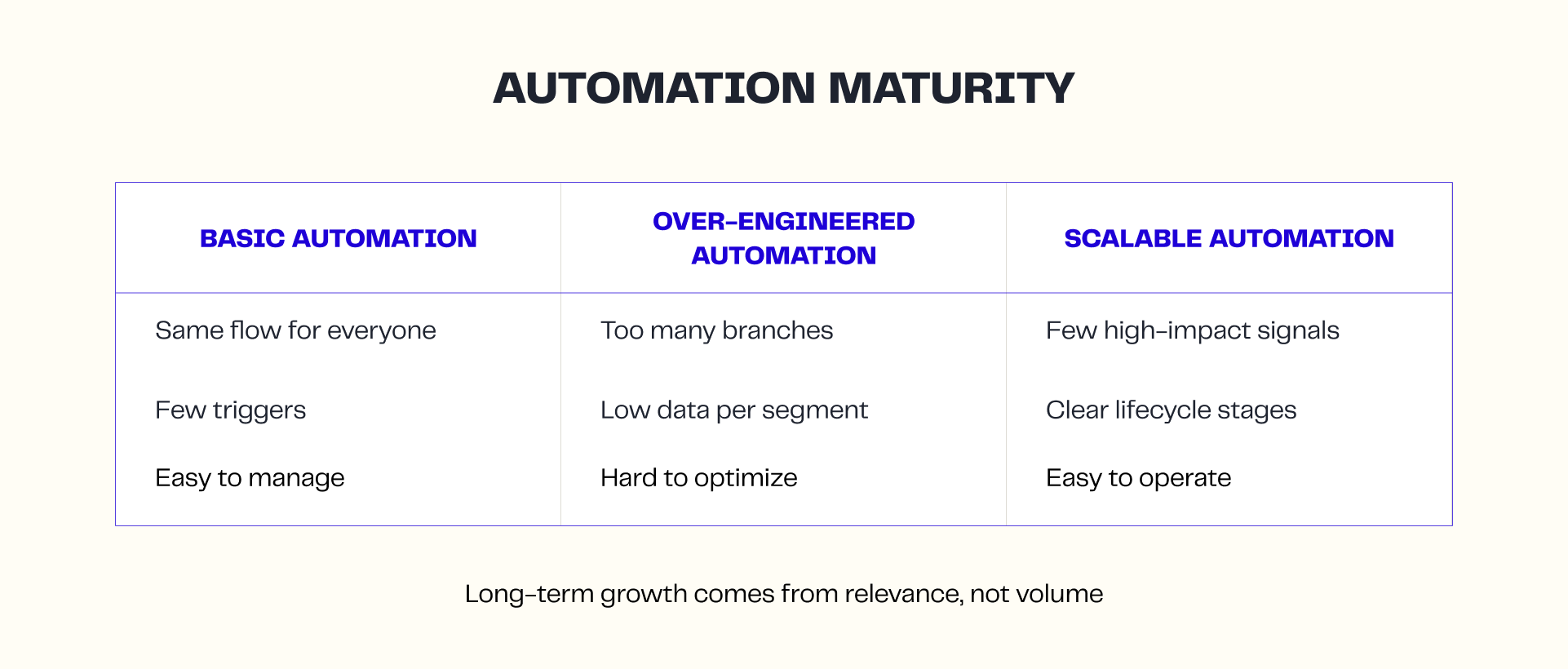
Tran describes automation maturity as a progression in how much decision logic exists within the system.
Most ecommerce brands start with basic automation: a welcome flow introduces the brand, abandoned cart emails recover incomplete checkouts, and post-purchase messages confirm the order and follow up after delivery. Every subscriber enters the same sequence and receives the same set of messages.
As the program matures, the brand starts adding branches based on customer state. Flows begin to change depending on who the person is:
- Prospect vs existing customer
- First-time buyer vs repeat buyer
- Purchase recency or frequency
This shift creates a more responsive system because messaging reflects where the customer actually is in the lifecycle.
“Splitting by prospect versus customer usually improves results. Splitting again by purchase count can still work. But when every flow has five or six variables, the incremental lift becomes very small.”
The structure works as long as the data volume supports it. Automation becomes scalable when each branch has enough traffic to generate meaningful results and when lifecycle teams can still understand how flows interact with each other.
When automation becomes overcomplicated
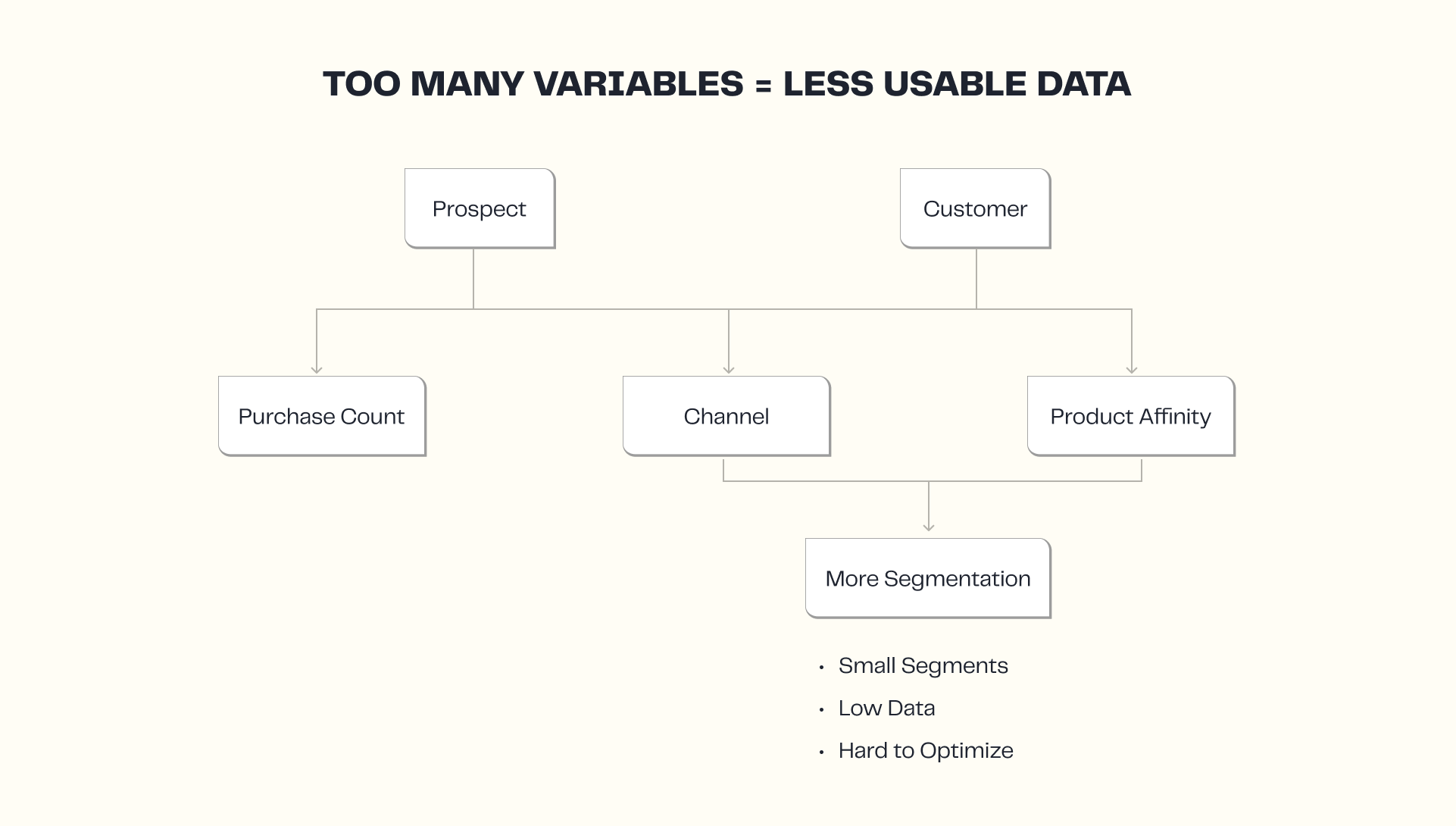
Complexity grows when brands keep adding variables to the same flows.
Tran often reviews automation systems that branch across multiple signals at once, including product affinity, acquisition channel, geography, predicted lifetime value, and multiple identity tools feeding the same flow.
Each variable creates additional branches, and each branch receives less traffic.
“Complexity doesn't necessarily mean stronger revenue. It doesn't necessarily mean it's worth the resources or it drives an ROI at scale."
Low-volume segments make optimization difficult. Smaller branches rarely reach statistical significance, which slows testing and makes results unreliable.
Operational complexity increases at the same time. More branches create more dependencies across flows, increasing the chances of overlapping triggers and conflicting messages.
Automation systems that scale well usually stay focused on a few high-impact signals, like prospect vs customer, first-time buyer vs repeat buyer, and purchase recency. Those decisions guide messaging clearly while keeping the lifecycle structure manageable as the business grows.
Why sending more emails stops working
Once automation begins branching across several segments, many teams try to push performance by increasing send volume. More flows go live, campaign calendars become more active, and lifecycle programs begin delivering significantly more emails than they did a year earlier.
Early results often look promising because more sends create more chances for clicks and orders. Over time, the pattern changes.
Higher frequency spreads similar messaging across larger portions of the list. Engagement begins to weaken. Revenue gradually depends on how many emails are sent instead of how well each message fits the customer.
Sammy Tran sees this tradeoff often when reviewing lifecycle programs.
“Sending twice as many emails rarely doubles revenue. You might see a short lift, but long-term performance comes from relevance.”
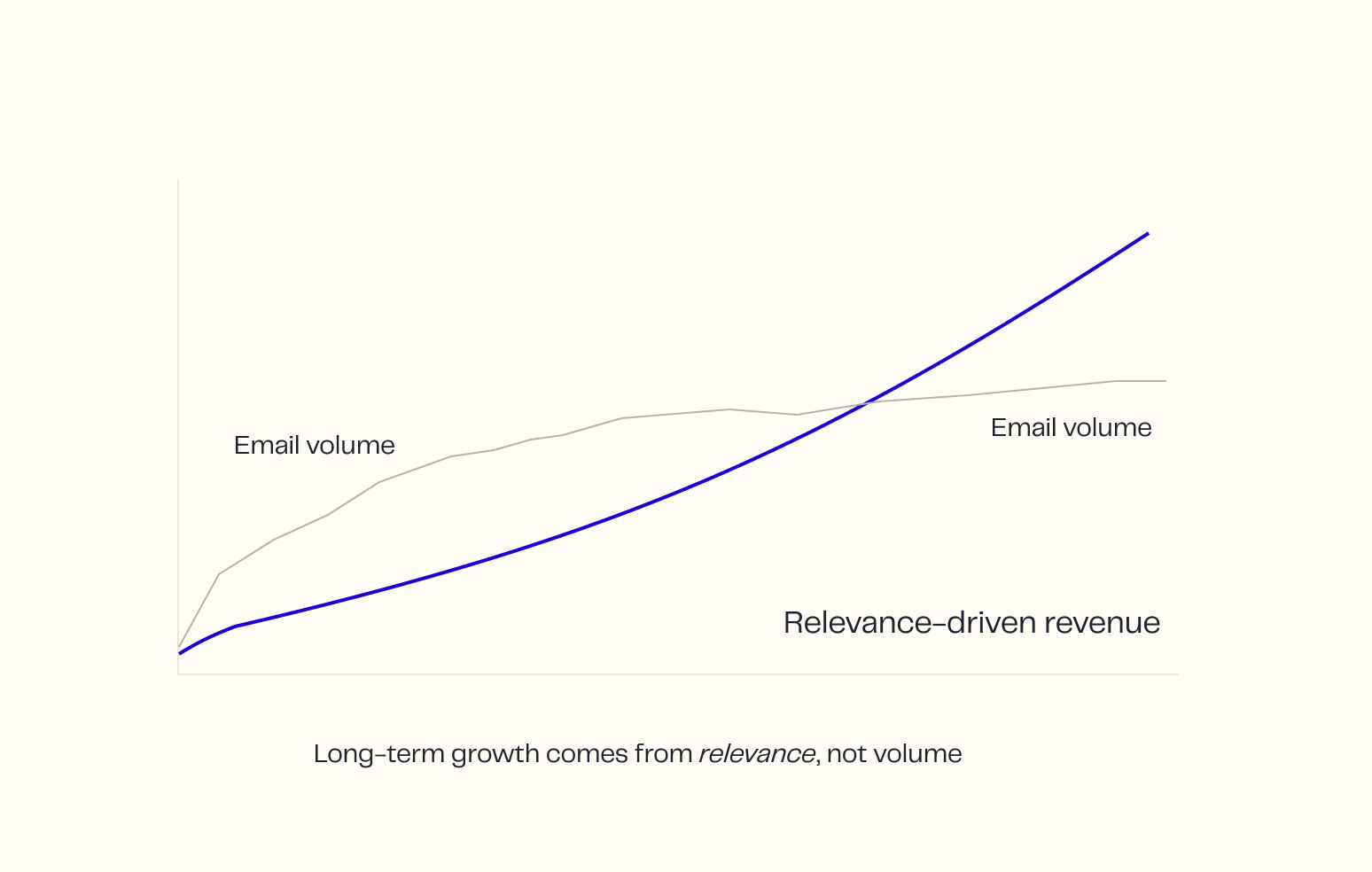
Lifecycle teams usually discover that stronger segmentation produces more durable results than higher volume.
Personalization should focus on customer state
Segmentation only improves performance when messaging actually reflects where the customer is in the journey. Many brands treat personalization as a creative change within the email: first-name tokens, dynamic product blocks, or slightly different images.
Tran approaches it from a lifecycle perspective. Messaging should match the customer’s situation. For example:
- A prospect still deciding whether to buy often needs reassurance, reviews, or a clear incentive.
- A first-time buyer benefits more from product education and post-purchase support.
- Repeat customers usually respond to product discovery, launches, or loyalty incentives.
“Personalization works when the message reflects the customer’s state.”
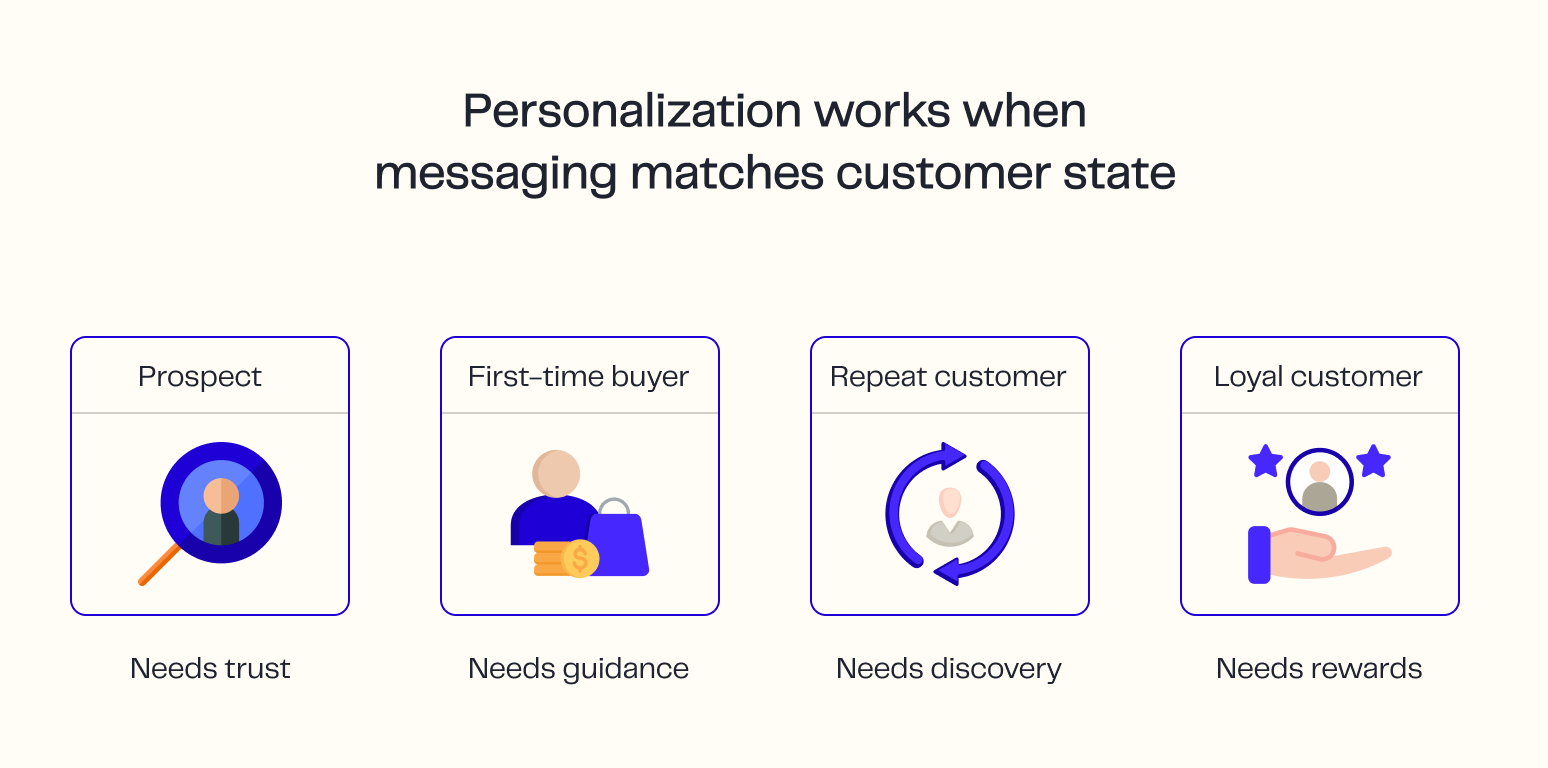
Marketing automation tools scale more smoothly when flows are built around those lifecycle transitions. Messaging becomes easier to maintain, and each email has a clear role in moving the customer toward the next purchase.
Why brands build the wrong flows first
Once lifecycle marketing teams start thinking about personalization and customer state, the next question becomes: where should that logic live in the funnel?
Many brands answer that question incorrectly.
Tran often sees teams invest heavily in retention flows early in the lifecycle program. Post-purchase sequences, loyalty messaging, and winback campaigns receive detailed segmentation and creative attention while acquisition flows remain basic.
The assumption is that email and SMS are primarily retention marketing channels. In reality, early lifecycle revenue usually comes from converting new visitors into customers.
Welcome flows, abandoned cart recovery, and browse abandonment interact with shoppers who already show purchase intent. Improvements in these flows often produce immediate revenue because they shorten the path to the first order.
“When a brand is still building its customer base, the biggest leverage usually sits at the top of the funnel.”
Lifecycle programs become more effective once early conversion flows perform well and the brand has a growing base of customers to retain.
What a strong post-purchase flow actually does
Post-purchase automation becomes more valuable once the brand has a steady stream of first-time buyers entering the lifecycle. At that point, the goal shifts from conversion to confidence.
Tran often sees brands treat post-purchase emails as another sales channel. Cross-sells and promotions appear quickly after the order is confirmed. That approach misses the moment when customer perception is still forming.
Strong post-purchase flows focus on reinforcing the decision the customer just made. Messages often guide the customer through the experience that follows the purchase:
- Setting expectations around delivery
- Explaining how to use or care for the product
- Introducing the brand story
- Helping the customer get the most value from the order
“After someone buys, the goal is to make them feel good about the decision they just made.”
Customers who understand the product and feel confident in the purchase tend to return naturally. Post-purchase automation builds that foundation, which makes repeat purchases and long-term retention easier to sustain.
Why automation breaks when too many tools are involved
Automation usually starts within the ESP, where flows are easy to see, triggers are predictable, and teams understand how messages connect across the lifecycle. As the stack grows, the messaging logic begins to spread across multiple platforms.
For example, a loyalty tool sends reward notifications, a reviews platform triggers feedback requests, referral apps invite customers to share links, and subscription platforms send renewal reminders.
Each system introduces its own triggers and timing, and the lifecycle program gradually loses a single point of control. Sammy Tran has seen automation systems where several tools trigger messages independently. Teams can no longer see the full communication sequence a customer receives.
“When different platforms start sending emails on their own schedules, the system becomes difficult to manage.”
Three operational problems usually appear:
- Message collisions: Two tools trigger emails at the same time.
- Broken sequencing: Lifecycle flows lose their intended order.
- Frequency problems: Customers receive more messages than planned.
Automation becomes manageable again when messaging decisions remain centralized. External tools can still send events or data, but the ESP should control when messages are sent and how flows interact.
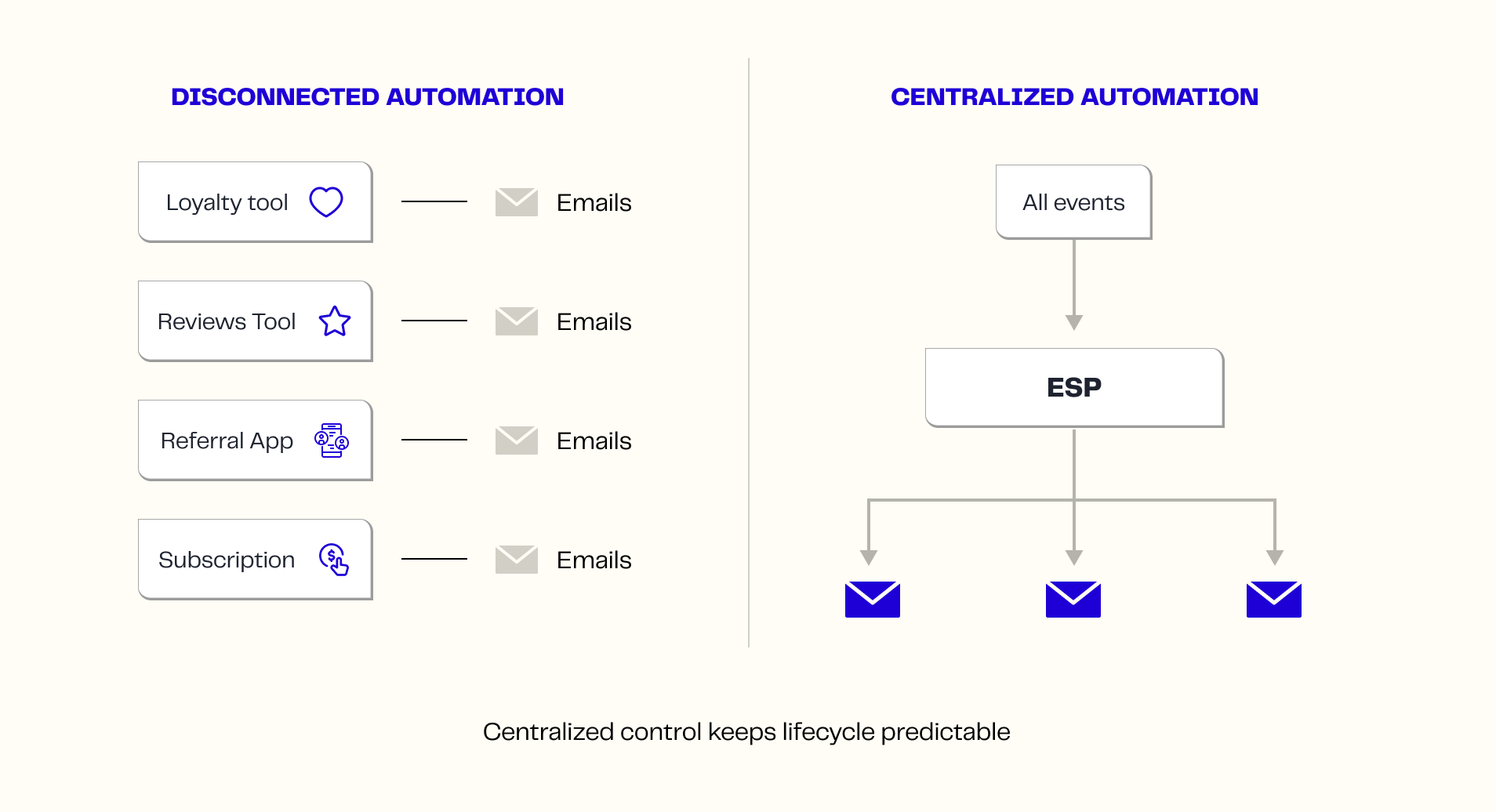
That structure keeps lifecycle communication readable and predictable as the stack grows.
Automation depends on reliable identity signals
As segmentation and branching increase, automation starts relying heavily on identity accuracy. Flows depend on knowing who triggered an event, whether the person has purchased before, and how they have interacted with the brand across previous sessions.
When those signals become inconsistent, automation begins making the wrong decisions.
Tran frequently sees returning customers enter prospect flows or existing subscribers treated as new visitors. Activity across devices often appears as separate profiles, which breaks lifecycle continuity.
Those gaps create subtle problems within automations:
- The wrong messaging path fires.
- Duplicate emails appear.
- Lifecycle timing becomes inconsistent.
Segmentation logic may look sophisticated on paper, but inaccurate identity data prevents the system from functioning correctly.
Strong automation architecture depends on reliable identity signals. Every lifecycle decision depends on accurate identification. Who receives the message, when it is sent, and what content appears all require knowing exactly who the customer is at that moment.
What a clean automation system feels like
Lifecycle teams should be able to open the ESP and immediately understand how the system works. Each flow should have a defined role in the customer journey, and the trigger behind every message should be obvious.
Tran often uses a simple test when reviewing automation systems. A new operator should be able to enter the account and quickly answer three questions:
- Why does this flow exist?
- When does it trigger?
- Who receives it?
With these questions answered, flows remain focused on a single purpose, triggers connect clearly to customer actions, and segments stay large enough to support testing and optimization. The system grows without becoming harder to understand.
According to Tran, the strongest lifecycle programs feel simple even when they manage large volumes of traffic and customers. Operators can trace the path from a customer action to the message they receive. Changes can be made confidently because teams understand how each part of the system interacts with the rest.
Ready to build automation that scales with your ecommerce growth?
Lifecycle automation starts working when the structure stays simple and the signals behind it stay accurate.
Sammy Tran’s advice through our conversation comes down to a few clear principles. Build flows around meaningful lifecycle stages, prioritize the parts of the funnel that drive the first purchase, and keep automation logic simple enough to manage as traffic and orders increase.
That level of control depends on reliable identity signals. Your automation system needs to recognize returning visitors, understand purchase history, and connect behavior across sessions.
Tie helps provide that intelligence. Tie Predict helps brands understand which shoppers are most likely to engage, while Tie ID connects behavior across sessions and devices to create a more complete customer view. Together, they give lifecycle teams the signals needed to build smarter segments, trigger more relevant automations, and keep messaging aligned with real customer intent as the business grows.
Book a demo to see how Tie helps ecommerce teams build automation systems that scale cleanly as the business grows.