The Retention Levers Most Brands Underestimate & How They Impact Revenue Over Time


When brands first set up retention strategies, they seem to drive steady growth. Welcome flows are live, post-purchase emails are scheduled, abandonment sequences are active, and campaigns go out every week.
But, unless it’s adapted to how customers actually behave over time, these post-purchase flows and loyalty offers start to stall.
An effective retention strategy evolves with the customer. It recognizes the difference between someone who just placed their first order, someone who purchases every 30 days, and someone who hasn’t engaged in months. It changes cadence, messaging, and incentives accordingly.
We spoke with Nikki Tooman, co-founder of Sticky Digital, to understand what separates retention programs that compound from those that quietly plateau. Across the brands she works with, a consistent pattern emerges: teams optimize for immediate revenue signals, and in the process, weaken long-term performance.
In this editorial, Nikki breaks down the retention levers brands consistently underestimate, where the real compounding happens, and what needs to change before a retention program can truly hold over time.
TL;DR: What most retention programs get wrong
- Retention is not something you set up once. Every email, incentive, and flow either increases the chance of a repeat purchase or pushes it further away.
- Post-purchase communication is the most underestimated retention lever. Sending too much too soon after purchase drives unsubscribes and delays the second order
- High-performing teams analyze performance by cohort, like first-time buyers, repeat buyers, and high-frequency customers, instead of treating the entire list the same.
- Overloading customers with post-purchase emails increases unsubscribes and weakens repeat purchase behavior. Timing and content matter more than volume.
- Even if you don’t use first-party data immediately, collecting accurate customer data early determines how well you can segment and personalize later.
- Increasing campaign volume does not automatically increase revenue. In many cases, it accelerates list fatigue and churn.
- The highest-impact structural fix is simple: branch your flows by customer type. Returning customers and net-new buyers should not receive the same messaging, cadence, or incentives.
- Identity resolution enables precise segmentation that protects margins and improves conversion efficiency over time
Why most retention programs plateau
Retention marketing weakens when you treat your stack as something you installed rather than something you actively manage. You set up core email and SMS flows, launch a few campaigns, and assume the system will keep driving repeat purchases. It won’t.
As Tooman explains:
“Most brands think that once the core functions of email and SMS are live, customers will just keep purchasing. But every decision should be evaluated against one question: does this increase the likelihood of a repeat purchase?”
That question changes how you operate. Instead of asking, “Will this campaign drive revenue this week?”, you ask, “How will this affect the next order?”
If you don’t evaluate retention this way, you create friction without noticing it. A discount-heavy campaign increases first-time conversions but makes customers expect to wait for offers. A high-volume promo calendar drives short-term revenue but raises unsubscribe rates. A cross-sell flow ignores purchase context and erodes trust.
Individually, each tactic looks reasonable. Together, they weaken repeat behavior. Retention compounds only when every new flow, tool, or campaign strengthens the customer’s likelihood to buy again. If it doesn’t, it works against you.
Post-purchase communication: The retention lever most brands overlook
When asked which lever brands consistently underestimate, Tooman doesn’t hesitate: post-purchase communication.
Ecommerce teams usually increase communication immediately after a purchase to stay visible and secure the next order quickly. So they layer in promotions, cross-sells, loyalty nudges, and additional campaigns.
The assumption is that more touchpoints equal faster repeat purchases, but that’s rarely the case.
“Sending a lot of comms after someone purchases isn’t going to get them to purchase immediately again. It’s actually going to do the opposite.”
Right after checkout, your customer is evaluating whether they made the right decision. They’re looking for signals (like order confirmation and expected delivery) that they can trust your brand.
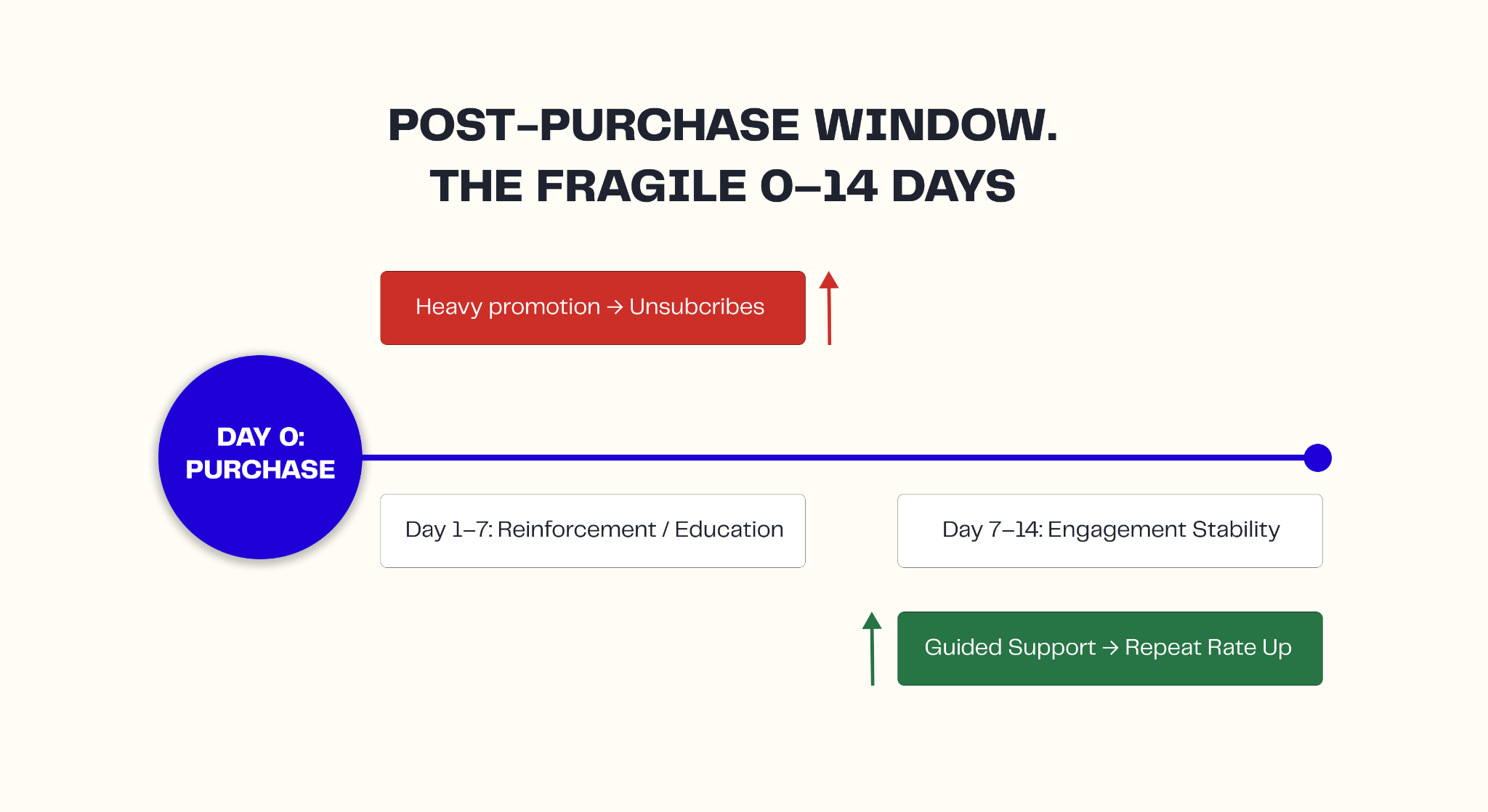
If you switch back to heavy promotion immediately, you interrupt that process. This results in higher unsubscribe rates within the first 7–14 days, lower engagement in upcoming campaigns, and a longer gap before the second purchase.
Simply sending fewer emails doesn’t solve the problem. What matters is whether your content and timing match the customer’s stage. Before you send anything post-purchase, pressure-test it:
- Does this message reinforce the purchase they just made?
- Does it help them use, enjoy, or understand the product?
- Is the timing based on product lifecycle or on your campaign calendar?
When you align post-purchase communication with how customers naturally move toward a second order, repeat purchase rates improve without increasing send volume.
How strong retention teams think about the customer journey
Teams driving high retention focus on where the system is breaking. As Tooman explains:
“We look for the parts of the retention program that aren’t converting or are causing churn. We’re not evaluating from an immediate revenue angle. We’re looking at how communication flows and whether it actually brings customers back.”
That perspective changes how retention teams work.
Instead of adding more flows, strong teams analyze where momentum breaks. They study first-time buyers who don’t convert into a second order, repeat customers whose purchase intervals start widening, and the exact points where unsubscribe rates increase or revenue per recipient weakens.
The main objective is to stop treating retention as output (campaigns sent) and start treating it as leakage control.
This also changes how performance gets measured. Click-through and open rates show surface engagement. They do not reveal whether the retention engine is strengthening over time.
Teams that think long term track churn by cohort, time between purchases, and revenue per recipient across lifecycle stages. If these metrics improve, your system is strengthening. If they decline, adding more volume will only accelerate the problem.
Where channel-by-channel thinking breaks retention
Retention weakens when each team optimizes its own channel without shared visibility.
If your email marketing team reports revenue from flows, your SMS team reports campaign revenue, and your acquisition team reports lead volume, you might think performance looks healthy. But none of those numbers explain what the customer is actually experiencing.
Tooman gives a clear example:
“If acquisition drives traffic into a quiz before someone can give their email, and conversion drops, you can’t isolate the problem by looking at one channel. Is the friction in the quiz? The landing page? The follow-up flow? You have to examine the entire path.”
When acquisition decisions introduce friction, retention feels the impact later. Lower-quality leads enter the lifecycle. Engagement declines. The retention team adjusts subject lines or offers, unaware that the real constraint started earlier in the journey.
Without a unified view, teams solve the wrong problem.
Strong retention programs map the full path from first touch to repeat purchase. They evaluate how traffic enters, how data is captured, how the first 14 days are structured, and where engagement shifts.
Looking at the journey as a whole reveals the actual bottleneck and prevents teams from optimizing symptoms instead of causes.
The most important retention lever: first-party data
When asked which lever has the greatest long-term impact, Tooman is clear:
“First-party data collection is the most important lever. Even if you can’t act on it right away, you need to be collecting it. Otherwise, you won’t be able to market properly later.”
Retention breaks when visibility is weak.
Many brands focus on creative and offers early on, but delay structured data capture. Later, when they try to scale lifecycle marketing, they realize they lack basic clarity: who these customers are, how they entered the funnel, what they’ve browsed, and how often they purchase.
Without that foundation, segmentation stays shallow, messaging stays broad, and incentives become the default lever.
The discipline starts earlier than most teams think. A change as simple as adjusting pop-up timing can impact list growth quality. If a form appears after meaningful engagement rather than immediately upon arrival, conversion rates often improve.
Over months, that small timing shift adds thousands of better-qualified contacts into the system. At the time, it feels incremental. Over a year, it changes the ceiling of your retention program.
How small improvements compound into long-term revenue
Retention rarely delivers dramatic spikes; instead, it delivers steady structural gains. Tooman sees this often:
“If you adjust a segment or a flow and revenue doesn’t jump immediately, but click-through rate improves, revenue per recipient increases, and unsubscribes decrease, many brands assume it didn’t work.”
That reaction is what slows retention down.
When a change doesn’t produce an immediate revenue lift, teams assume it failed. In reality, structural improvements appear first in engagement and churn metrics. Revenue usually follows later because stronger cohorts buy more consistently over time.
For example, when unsubscribe rates decrease, the size of the reachable audience stabilizes. When revenue per recipient increases, each send generates more value without increasing volume. When churn declines, the gap between purchases shortens.
The difficulty is resisting the urge to override those gains with short-term fixes. Under revenue pressure, teams often increase campaign volume or lean harder on discounts. That move may create a temporary lift, but it frequently erodes the improvements that were starting to take hold.
Customer retention increases when teams stay focused on cohort health even before revenue reflects it. Tracking churn, revenue per recipient, and engagement consistency provides an early signal that the system is improving. Over time, that discipline produces steadier LTV growth than reactive campaign pushes.
Why running more campaigns almost always works against you
One of the clearest differences that Tooman sees between strong and weak retention programs is how they handle campaign volume.
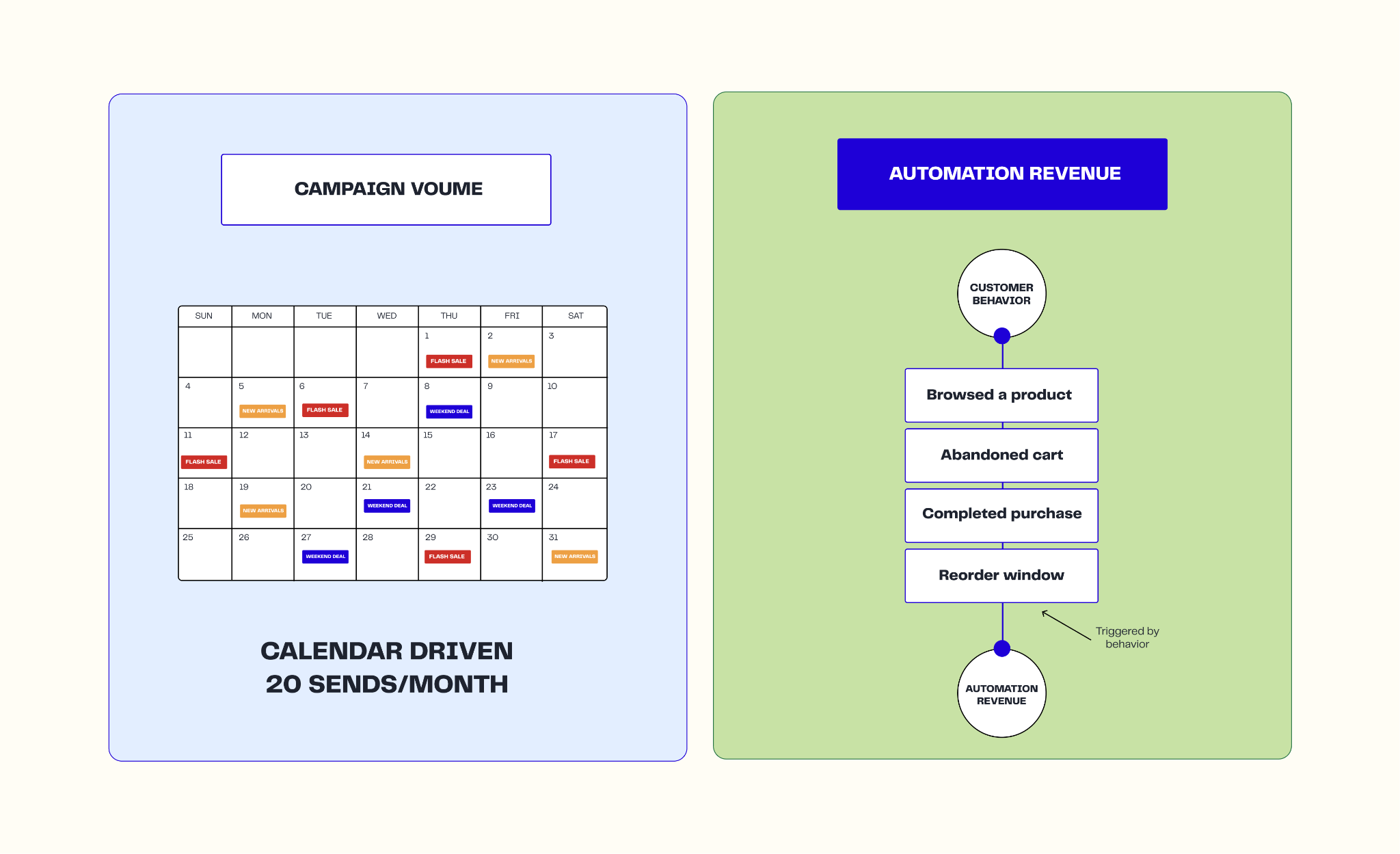
“Most brands chasing short-term revenue end up sending 20+ campaigns a month. It feels productive, but it usually works against them. Scaling back campaigns and strengthening automations tends to drive better results.”
When revenue dips, the instinct is to send more, since more campaigns increase your chances of capturing new revenue.
But it’s still the same audience receiving all of those sends. Frequency rises, moderately engaged customers start ignoring emails or opting out, and overall responsiveness begins to drop. Over time, the list simply stops reacting the way it used to.
Automations work differently because they respond to behavior. They send a message after someone browses a product, abandons a cart, completes a purchase, or reaches a natural reorder window.
That context changes how the message is received. A replenishment reminder aligned with real usage feels helpful. A post-purchase sequence that guides someone through the product strengthens the experience. A browse follow-up reconnects with existing interest.
Campaigns push messages based on a schedule. Automations send messages when behavior signals readiness. When a larger share of revenue comes from behavior-triggered flows, performance holds steadier because communication happens at moments that make sense.
How to diagnose where to start
Retention marketing teams don’t try to fix everything at once. They start by identifying the largest leak. Tooman’s framework is simple:
“Separate first-time customers from returning customers. See which group is leaking more. Start there. Each group needs something different.”
This distinction creates clarity. If first-time buyers aren’t placing a second order, the issue may sit in post-purchase timing, onboarding content, or product experience. If returning customers are slowing down or churning, the issue may be cadence, over-discounting, or incentive fatigue.
By isolating the leakiest segment first, teams avoid spreading effort thin across the entire lifecycle.
The correct starting point depends on the business model. A consumable product with a 30-day cycle requires different retention marketing tactics than a high-ticket product purchased twice a year. Purchase frequency, margin structure, and RFM (recency, frequency, monetary) distribution shape what should be prioritized.
Strong retention marketing teams don’t copy playbooks. They build around the specific purchase behavior of their customers and fix the highest-impact leak first.
What becomes possible with better identity resolution
Once the retention structure is clear, identity determines how precise it can become. As Tooman explains:
“By knowing who the customer is, you can personalize properly. Even when someone isn’t cookied by your ESP, Tie can match identities and help you segment and target them more accurately. The more you understand who is shopping, the higher your likelihood of converting them.”
Retention decisions improve when identity is reliable.
Without identity resolution, flows treat too many customers the same. A returning customer who has purchased three times can enter the same abandonment sequence as someone brand new. Incentives are distributed broadly because the system can’t distinguish intent or familiarity.
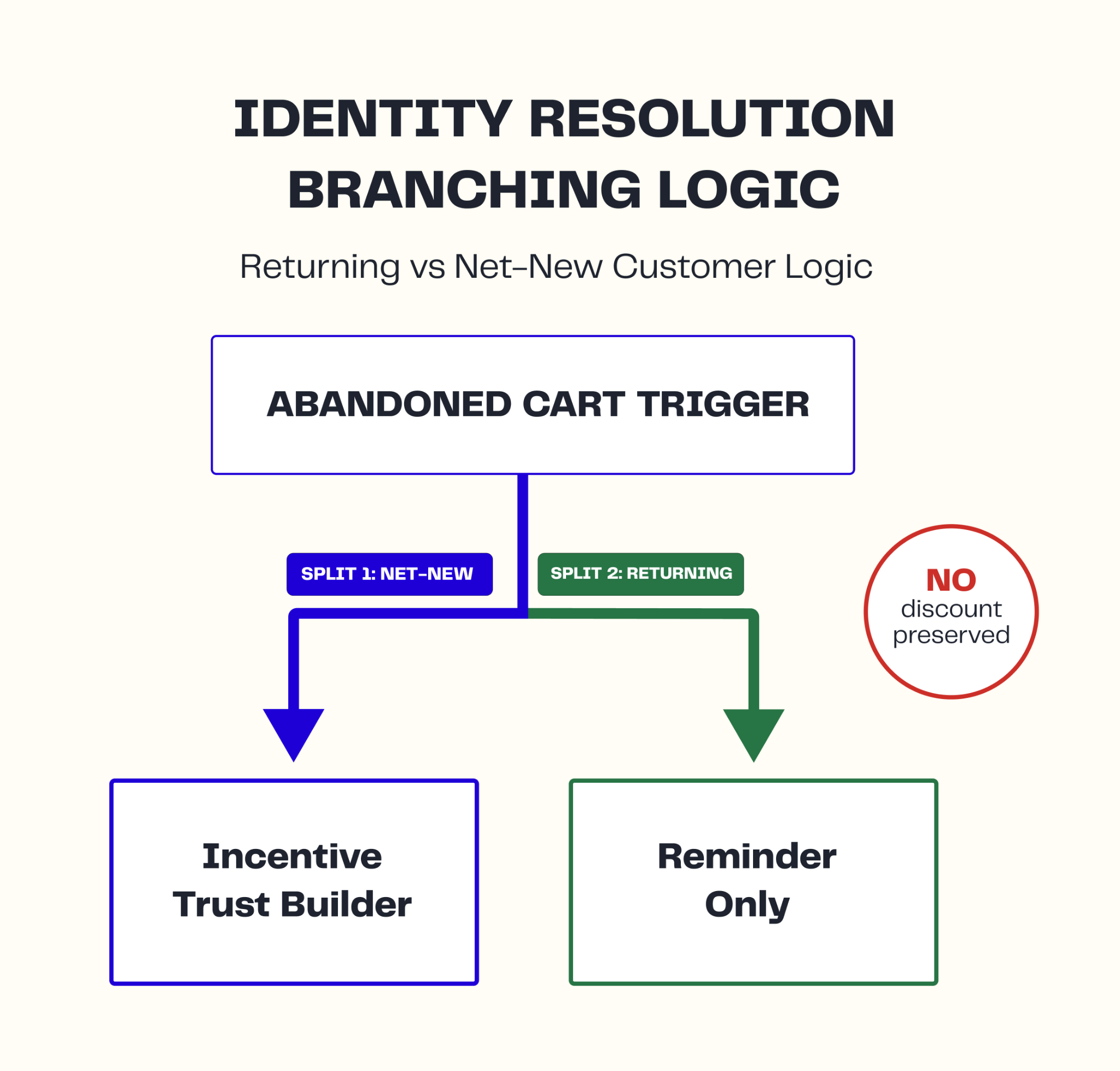
A common example is discounting for abandonment. Many brands automatically send a coupon to anyone who leaves a cart. That includes returning customers who were likely to complete the purchase anyway. For these shoppers, the discount isn’t required to nudge that sale and instead reduces margins.
“If you offer abandonment codes, segment returning and new customers. You shouldn’t constantly give discounts to people who are already buying from you. Identity resolution makes that separation possible.”
With identity resolution solutions, you get insights into their intent strength. This lets you differentiate between new, returning, and frequent customers. Net-new customers may require reassurance or an incentive, returning customers may only need a reminder, and high-frequency buyers may not need either.
Separating different types of customers is one of the most consistent structural changes Tooman recommends. It influences messaging, incentive logic, cadence, and overall margin control.
Unlike campaign spikes, this kind of adjustment doesn’t generate a one-week lift. It improves conversion efficiency and protects profitability over time.
Tactical checklist to improve retention
Post-purchase communication
- Pull unsubscribe rates and engagement data for the first 7–14 days after purchase.
- Reduce send volume in the post-purchase window if unsubscribes or disengagement are elevated.
- Replace promotional content in that window with order confirmation, delivery expectations, and product guidance.
- Before every post-purchase send, confirm: Does this reinforce the purchase? Does it help them use the product? Is timing based on product lifecycle, not campaign calendar?
Retention metrics
- Replace open and click-through rates as primary KPIs.
- Track churn by cohort, time between purchases, and revenue per recipient across lifecycle stages.
- Monitor whether these metrics are improving or declining before adding send volume.
If the answer to any of these is no, revise before sending.
Customer journey mapping
- Map the full path from first touch to repeat purchase across all channels.
- Identify where engagement drops and treat that as the real bottleneck.
Data capture
- Audit when your pop-up or sign-up form triggers.
- Test delaying the form until after meaningful on-site engagement.
- Track list quality over 60–90 days to measure impact of the change.
Customer identity
- Audit whether your ESP or retention stack can distinguish between new, returning, and high-frequency customers.
- Identify flows where all customer types are currently treated the same and flag them for segmentation.
- Evaluate identity resolution tools if cookieless gaps are limiting your ability to match and segment accurately
Customer segmentation
- Separate first-time and returning customers across all flows and campaigns.
- Identify which group has the higher leak rate and prioritize that segment first.
- Build distinct messaging, cadence, and incentive logic for each group.
Automation vs. campaign balance
- Calculate what percentage of your retention revenue currently comes from automations vs. campaigns.
- Set a target to shift a greater share toward behavior-triggered flows over the next 90 days.
Incentive audit
- Review all active flows and campaigns for over-reliance on discounts.
- Identify segments that are converting without discounts and remove incentives from those sequences.
- Monitor margin impact alongside conversion rate when adjusting incentive logic.
Abandonment flows
- Audit current abandonment flows for blanket discount logic.
- Remove discount incentives for returning and high-frequency customers.
- Replace with a reminder-only send for returning customers and monitor conversion before reintroducing offers.
Campaign volume
- Identify low-engagement sends and cut or consolidate them if volume exceeds 15–20 per month.
- Reinvest that effort into behavior-triggered automations— post-purchase sequences, replenishment reminders, browse follow-ups.
- Track revenue per recipient across campaign and automation sends over 60 days
Ready to build a retention program that actually compounds?
Brands that sustain long-term LTV stop relying on campaign frequency as the primary growth lever. They segment by cohort, branch flows based on customer type, control incentive logic, and track churn and revenue per recipient instead of chasing short-term spikes.
That level of control depends on visibility. Acquisition context needs to carry through checkout, and lifecycle programs need to recognize returning customers, high-frequency buyers, and new prospects differently.
That is where Tie comes in. As the Shopper Intelligence Platform, Tie ID helps brands understand who their shoppers are, when they're ready to engage, and how to reach them more effectively. From identifying anonymous visitors and enriching customer profiles to improving segmentation, engagement, and deliverability, Tie gives retention teams the intelligence needed to build stronger customer relationships over time.
If retention is a priority this quarter, start by fixing what it runs on. Book a demo to see how Tie helps teams build retention programs that compound over time.