How to Audit and Fix Email Deliverability at Scale


Email deliverability has a direct impact on how reliably a retention program produces revenue. When inbox placement remains stable, campaigns and flows perform consistently. When it changes, performance across the entire email channel begins to shift.
For ecommerce brands sending hundreds of thousands or millions of emails, deliverability becomes a daily operational concern. Inbox providers constantly evaluate engagement patterns, list quality, and sending behaviour to determine where messages land.
Xiaohui "X" Wang has spent years helping brands investigate and correct these shifts.
As the founder of Essence of Email, a boutique email and SMS marketing agency that has worked with more than 450 ecommerce brands, he regularly guides teams through deliverability audits and recovery processes across large sending programs.
We spoke with X to understand how experienced teams investigate deliverability issues, what they prioritise during an audit, and how they stabilise inbox placement once performance begins to change.
Open rate is only a starting signal
Open rate is usually the first metric teams look into when they suspect deliverability issues. It provides a quick directional signal, especially when performance changes across major mailbox providers.
X explains that open rates help identify early warning signs, but they cannot diagnose deliverability on their own.
“If you just look at open rates, that’s not sufficient. You want to look at inbox placement metrics, negative engagement signals, and sender reputation across both domain and IP.”
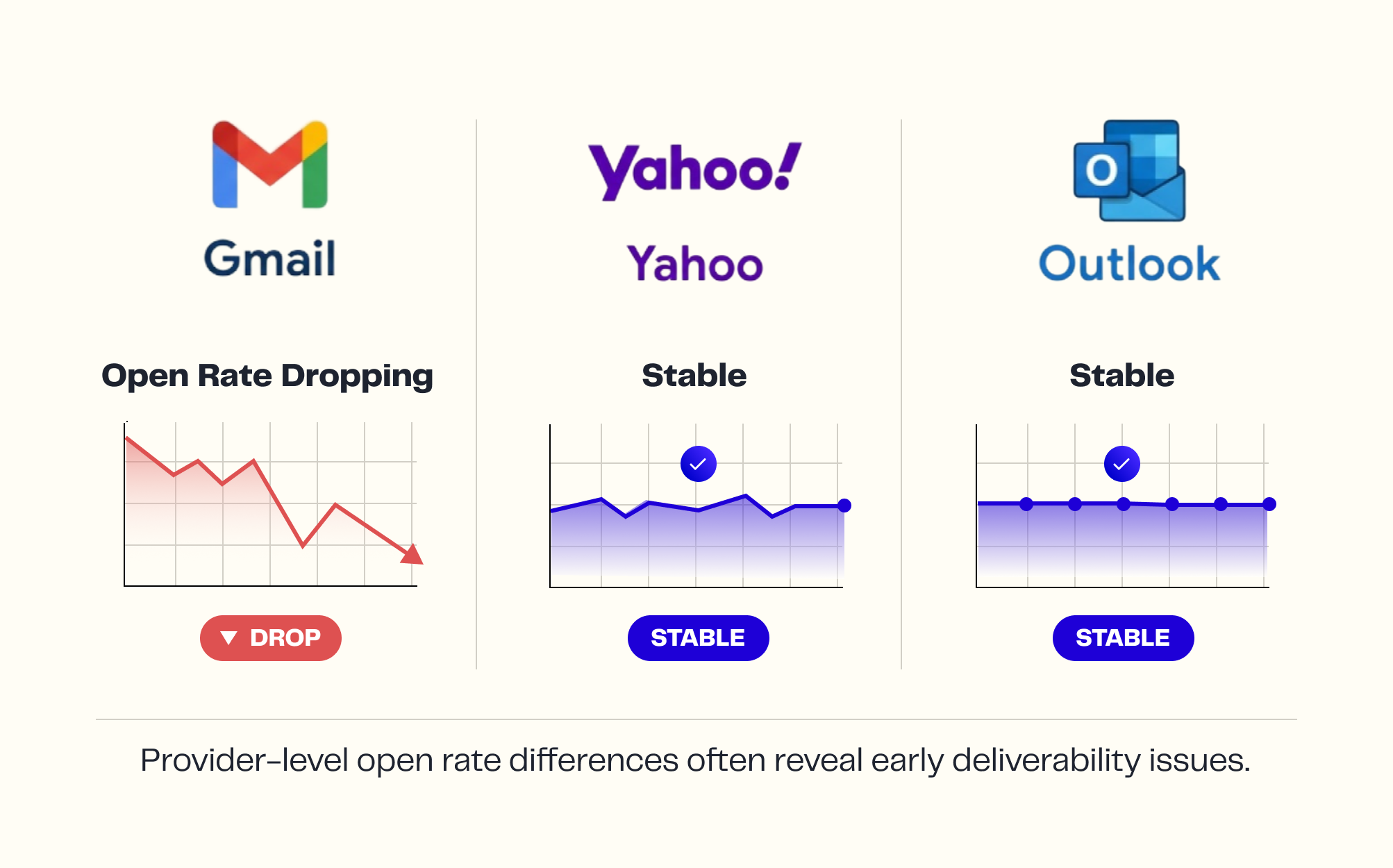
A useful practice is to review open rates by provider. Gmail, Yahoo, and Outlook evaluate senders differently, so performance shifts often appear unevenly across them. A drop in Gmail opens while Yahoo and Outlook remain stable can signal inbox placement issues tied specifically to Gmail’s filtering.
Evaluated this way, open rate becomes an early signal that prompts deeper investigation rather than a metric that explains the problem on its own.
Distinguishing temporary deliverability fluctuations from structural problems
Short dips in performance happen in most sending programs. A campaign might trigger filtering because of a subject line, a sudden spike in volume, or a brief reputation fluctuation in a shared sending pool. Engagement may dip for a send or two and recover once the next campaigns go out.
Structural email deliverability problems behave differently. Performance stays poor across multiple campaigns and providers, and reputation signals begin to appear in diagnostic tools.
X often sees these situations show up in technical indicators such as hard bounce responses tied to sender reputation, consistently low reputation scores in Google Postmaster Tools, or repeated filtering by specific mailbox providers. Authentication issues involving SPF, DKIM, or DMARC can also contribute to these longer-term problems.
Recovering from structural issues takes a measured approach. Teams usually tighten engagement segments, stabilise sending patterns, and rebuild sender reputation gradually as inbox placement improves.
The core areas to review in a deliverability audit
An email deliverability audit works best when it follows a clear order. X’s team begins by examining the underlying signals that mailbox providers use to evaluate senders. The goal is to understand how the sending program behaves across infrastructure, reputation, and engagement.
Several areas usually reveal the source of the issue, but, according to X, the following checks provide a strong baseline:
Sending infrastructure
Start with the technical foundation of the sending setup. Authentication records such as SPF, DKIM, and DMARC should be correctly configured and aligned with the sending domain. Infrastructure changes, such as switching platforms, changing domains, or moving IP environments, can also influence deliverability if warming and configuration are handled poorly.
X often begins email campaign audits here because infrastructure issues can quietly affect inbox placement.
“We usually start by checking authentication and infrastructure. If those pieces aren’t configured correctly, the rest of the program struggles to perform.”
Domain and IP reputation
Mailbox providers maintain reputation scores tied to both the sending domain and the IP address. These scores reflect how recipients interact with the emails over time.
Tools like Google Postmaster Tools help identify reputation trends and reveal when inbox providers begin to treat a sender differently.
Engagement signals
Engagement plays a central role in deliverability decisions. Inbox providers observe whether recipients open emails, click links, move messages to folders, or mark them as spam. Declining engagement across large segments of the list gradually weakens the sender's reputation.
X stresses that these signals carry more weight than many teams realise.
“Mailbox providers care about how people interact with your emails. If engagement drops across the list, that signal feeds directly into reputation.”
List hygiene and suppression logic
Healthy sending programs remove disengaged subscribers before engagement ratios deteriorate. Reviewing suppression rules, inactivity windows, and re-engagement practices often reveals whether inactive contacts remain in the active sending pool longer than they should.
Spam trap exposure
Older email lists or poorly managed acquisition sources can introduce spam trap addresses. These addresses exist specifically to detect senders who continue emailing abandoned or scraped lists. Even a small number of traps can quickly affect reputation signals.
Blocklist status
The final step involves checking whether the sending domain or IP appears on public blocklists such as Spamhaus. Listings can directly affect inbox placement and usually require remediation before reputation stabilises.
How engagement signals shape inbox placement
Once the technical setup and reputation signals are reviewed, the next step in an email deliverability checklist is understanding engagement.
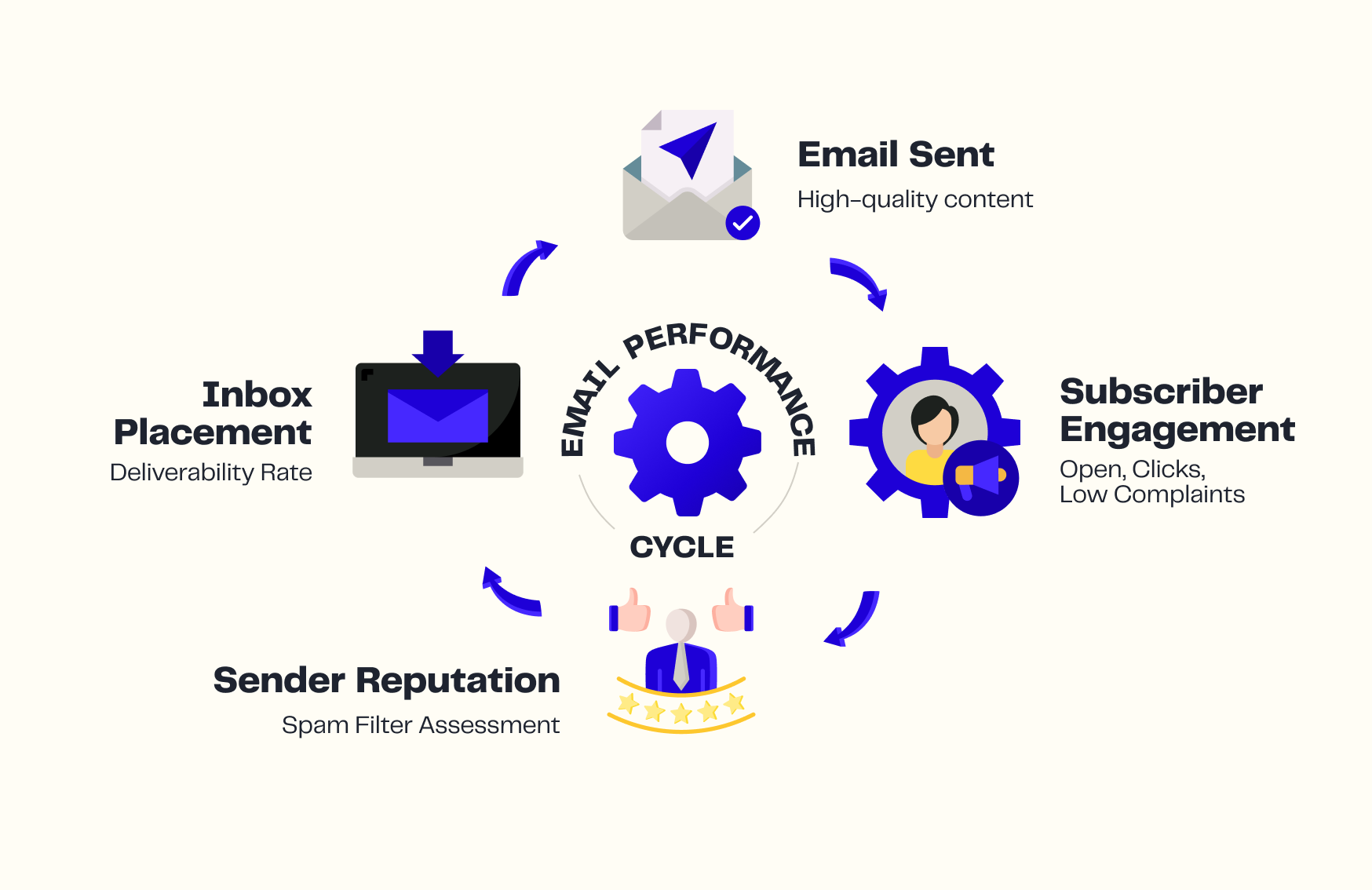
Mailbox providers rely heavily on engagement when deciding where emails land. They observe how recipients interact with messages over time and adjust sender reputation accordingly.
Xiaohui “X” Wang notes that multiple signals feed into this evaluation.
“Mailbox providers are constantly evaluating how people react to your emails. Opens, clicks, replies, spam complaints; all of those signals feed into reputation.”
For most email programs, recent engagement matters most. X often recommends using a 30-day engagement window as a practical benchmark.
Subscribers who have opened or clicked within the past 30 days usually represent the healthiest portion of the list. Sending consistently to this segment keeps engagement ratios strong and reinforces positive reputation signals.
Subscribers outside that window should be moved to re-engagement flows or reduced sending segments before they begin weakening overall engagement.
Using a clear engagement window helps maintain a smaller, more engaged sending pool, which ultimately supports stable inbox placement.
Sending patterns that gradually damage the sender's reputation
Engagement doesn’t decline without a reason. Most of the time, it reflects how the sending program has been operating over time.
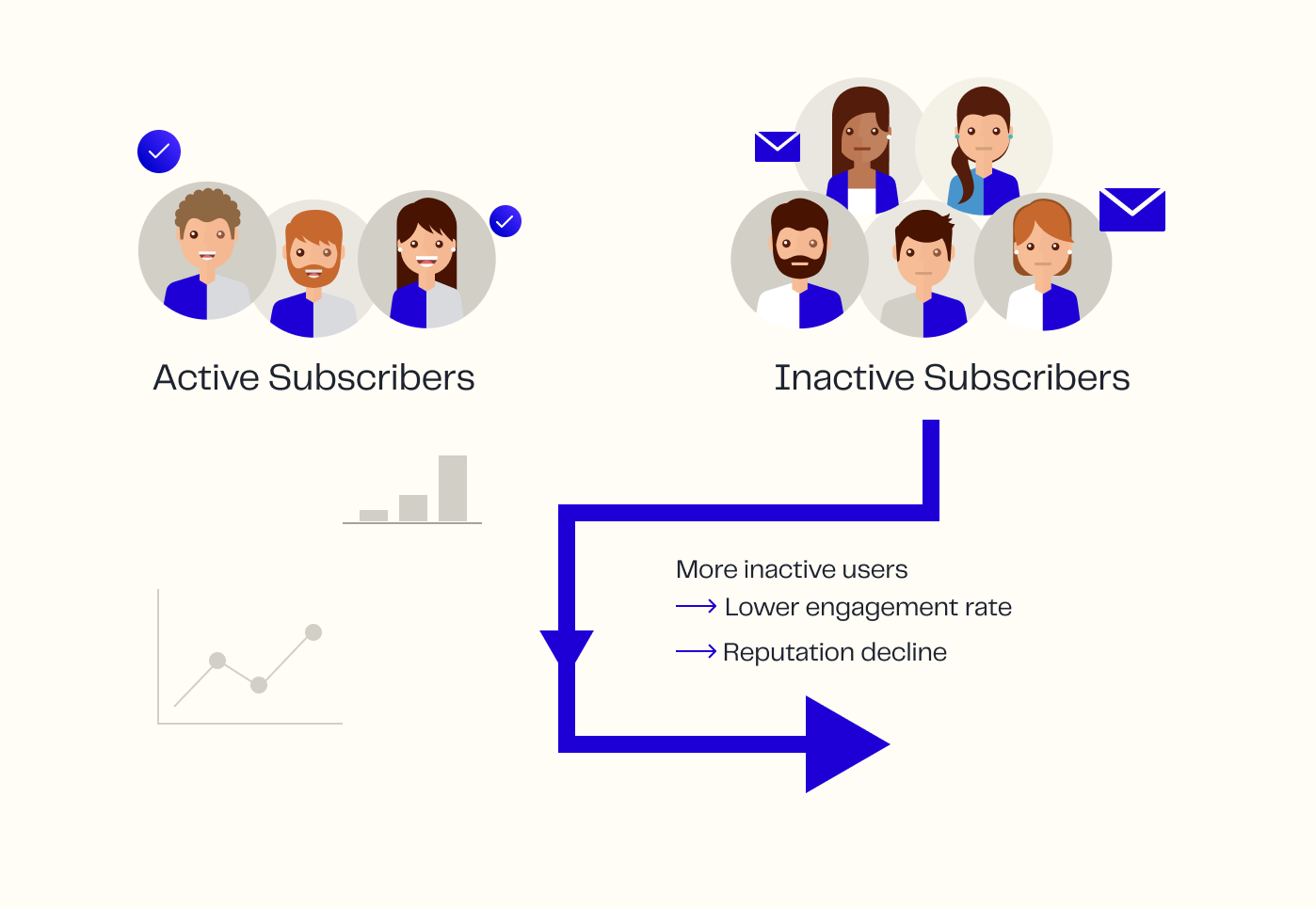
One common pattern involves continuing to send campaigns to large groups of inactive subscribers. As more disengaged contacts remain in the active list, overall engagement ratios begin to fall.
X sees this frequently when brands prioritise list size over engagement quality.
“If a large portion of your list isn’t interacting with your emails, that signal eventually starts working against you.”
Sending behaviour can also influence how inbox providers interpret reputation. Large spikes in volume, inconsistent sending schedules, or sudden increases in campaign frequency often trigger closer filtering.
None of these patterns cause immediate deliverability failure. Instead, the impact builds gradually. Engagement weakens, reputation signals shift, and inbox placement slowly becomes less reliable.
Maintaining deliverability, therefore, depends on consistent sending patterns and regular list management that keeps engagement signals healthy.
The suppression mistakes that hurt deliverability
How inactive subscribers are handled directly affects deliverability. Mailbox providers evaluate engagement across the entire sending list, so inactive contacts that remain in regular campaign sends gradually weaken those signals.
Over time, those recipients stop opening emails, clicking links, or interacting with campaigns. As their share of the list grows, overall engagement ratios begin to fall.
X sees this frequently when auditing email programs.
“If you continue sending to people who haven’t engaged in a long time, the mailbox providers start reading that as a negative signal.”
Many brands delay suppression because they want to preserve list size. In practice, continuing to send to disengaged subscribers gradually lowers engagement across the entire program.
A common re-engagement flow mistake
Re-engagement flows are meant to solve this problem, but a small configuration mistake often keeps inactive contacts in circulation.
When a subscriber finishes the re-engagement sequence, many setups simply apply a tag like “unengaged” instead of suppressing the contact. Those subscribers remain eligible for campaigns and continue receiving emails despite showing no interaction.
X sees this configuration gap often in Klaviyo accounts.
“A lot of brands run a re-engagement flow, but when someone finishes it, they just get tagged. They don’t actually get suppressed.”
The operational fix
The solution is straightforward: connect the end of the re-engagement flow to automatic suppression. In some Klaviyo setups, X’s team implements this by triggering a webhook or automation that removes the contact from active sending segments once the flow finishes.
When suppression is automatic, inactive subscribers stop circulating within the campaign pool. Engagement ratios stabilise, and sender reputation becomes easier to maintain as the list grows.
When to sunset inactive subscribers
Re-engagement flows also create a natural decision point. Once subscribers complete the sequence, teams need to decide whether they remain in the active database.
X treats re-engagement performance as a clear signal.
“Single-digit re-engagement rates are normal. If you’re seeing around 10%, that’s actually a good result.”
Most contacts who enter a re-engagement sequence will not return to active engagement. Continuing to send campaigns to those subscribers keeps inactive contacts circulating inside the sending pool.
Healthy programs treat the end of the re-engagement flow as a sunset decision point. Subscribers who do not re-engage move into suppression rather than returning to regular campaigns.
That discipline keeps the active sending pool focused on subscribers who still interact with emails.
Infrastructure and warming practices that teams often overlook
Infrastructure changes offer another common deliverability risk. Sending domains, IP environments, and email platforms all contribute to how mailbox providers evaluate a sender.
Whenever these components change, reputation signals need time to stabilise. X often encounters situations where brands migrate platforms or introduce new sending domains without adjusting their sending patterns.
“Whenever you change infrastructure, like a new domain, new IP, or new platform, mailbox providers need to see consistent sending again before they trust it.”
Warming helps rebuild that trust. Sending usually begins with smaller groups of highly engaged subscribers, then expands gradually as reputation stabilises.
Skipping this step often leads to filtering shortly after the migration, even when the rest of the email program remains unchanged.
Why small authentication changes can cause large deliverability issues
Infrastructure changes require careful handling because mailbox providers rely heavily on authentication and domain configuration.
X also sees another common issue. Teams make partial changes to DNS or authentication records without fully understanding the implications.
“Sometimes the most dangerous situation is when a team knows just enough about deliverability to start changing DNS records.”
SPF, DKIM, and DMARC settings control how inbox providers verify sending domains. Small configuration mistakes can break authentication or weaken reputation signals without being immediately visible in campaign metrics.
For that reason, infrastructure changes are best handled deliberately and tested carefully. Incorrect authentication settings can create deliverability problems that take much longer to diagnose and resolve.
Deliverability challenges change as sending volume scales
Deliverability behaves differently as sending volume grows. A program sending 50,000 emails a week operates under very different conditions than one sending five million.
At lower volumes, many brands send through shared IP environments provided by their ESP. Engagement data is limited, and reputation signals can shift quickly depending on a few campaigns.
Large sending programs operate under tighter scrutiny.
At scale, teams typically move to dedicated IP infrastructure, where sender reputation is tied directly to their own sending behavior. Inbox providers also evaluate engagement across a much larger dataset, which makes list quality and segmentation far more important.
X notes that scale also introduces new operational risks.
“Once you’re sending millions of emails, even small issues can have a big impact on your reputation.”
High-volume programs often require tighter engagement segmentation, stricter suppression rules, and closer monitoring of reputation signals.
Bot traffic and automated signups can also become a larger issue at scale. When those contacts enter the email list without real engagement, they dilute engagement signals and increase filtering risk.
As sending volume increases, performance shifts gradually. Engagement declines across segments, email deliverability scores begin to drift, and inbox placement slowly becomes less stable.
Why deliverability recovery must be gradual
When inbox placement begins to decline, the instinct is often to correct it immediately by changing campaigns or increasing sending to re-engage the list.
Deliverability systems do not respond to sudden changes. Mailbox providers rebuild trust by observing consistent engagement patterns over time.
X typically approaches recovery by tightening the sending audience first.
“You want to show mailbox providers consistent engagement again. That usually means starting with the most engaged segments and rebuilding from there.”
A typical recovery process follows a controlled progression:
- Begin with the most engaged subscribers.
- Stabilise engagement signals across several campaigns.
- Gradually expand sending to broader segments.
Each step allows mailbox providers to observe improved audience behaviour before additional volume is introduced.
Typical timelines for deliverability recovery
Improving deliverability is rarely immediate. Inbox providers rely on historical engagement patterns, which means reputation improves only after they observe consistent behaviour over multiple sends.
The timeline usually depends on how severe the reputation damage is and how large the sending program has become. X explains that most recovery processes follow a gradual progression rather than a sudden improvement.
“Mailbox providers want to see consistent positive engagement again. That takes time because they’re evaluating behaviour across multiple campaigns.”
In many cases, early signals begin to improve within the first few weeks once sending patterns stabilize and highly engaged segments drive stronger interaction.
For larger sending programs, full reputation recovery can take longer because mailbox providers evaluate behaviour across a much larger data set. Programs sending millions of emails often need to sustainably improve engagement across several campaign cycles before inbox placement stabilises.
Due to this, recovery depends less on quick fixes and more on maintaining consistent engagement signals across the sending program. Over time, stable audience interaction gradually restores the sender's reputation and improves inbox placement.
Want to fix the data behind your deliverability signals?
Inbox providers increasingly rely on engagement signals to decide where emails land, making audience visibility critical. Retention teams need to know exactly which subscribers are active, which ones are drifting, and how behaviour changes across the lifecycle.
When identity data is fragmented, those signals become unreliable. The same customer may appear as multiple profiles across devices or sessions, which distorts engagement metrics and weakens segmentation.
Tie helps solve that visibility problem. Tie ID identifies anonymous visitors, enriching customer profiles, and connecting behaviour across channels. With a clearer view of who is actually engaging, retention teams can build healthier audiences, improve segmentation, and maintain stronger engagement signals over time.
But visibility alone isn't enough to maintain strong deliverability at scale.
Tie Priority helps emails reach Gmail's Primary inbox, while Tie Protect continuously monitors reputation signals and adjusts audience eligibility when deliverability begins to slip. Together, they help brands protect sender reputation and improve inbox placement as sending volume grows.
If deliverability is a priority this quarter, start by fixing the data that powers it. Book a demo to see how Tie helps teams build healthier email programs with stronger engagement signals.