Contact Data Enrichment: How It Works, Benefits, and The Best Tools


Brands collect customer data every time someone visits the website, signs up for emails, starts checkout, or interacts with a campaign. The problem is that most of that data stays fragmented across CRM, ad platforms, email tools, and website sessions.
That is where contact data enrichment comes in. But traditional enrichment workflows only work after someone becomes a known contact inside your CRM, leaving a large share of anonymous website traffic untouched.
In this guide, you’ll learn how contact enrichment works, where it fits into modern growth strategies, and how identity-driven platforms help brands identify and activate more high-intent visitors.
What is contact data enrichment?
Contact data enrichment is the process of improving existing contact records by adding verified and missing information from external data sources. It provides marketing teams, sales teams, and CRM workflows with more complete and accurate data for effective targeting, segmentation, personalization, and decision-making across campaigns.
Most contact enrichment tools add data like:
- Email addresses and phone numbers
- Job titles and company name
- Demographic and firmographic data
- LinkedIn profiles and social media data
- Browsing behavior and intent data
- Technographic data, like CRM or SaaS tools in use
For ecommerce brands, contact enrichment also helps improve customer targeting, segmentation, lead scoring, and personalization. Here’s a simple example:
How contact data enrichment works
Contact data enrichment connects scattered customer data into a usable profile that your team can act on immediately.
Most companies already collect large amounts of contact data through forms, Shopify checkouts, email signups, paid ads, customer support conversations, and CRM workflows. The problem is that this data is usually fragmented. One system has an email address, another has browsing behavior, and a third contains purchase history.
Enrichment tools connect those fragments, validate them, and expand them with additional attributes so your marketing, sales, and automation systems work with more complete customer profiles.
Existing data sources are evaluated
Every enrichment workflow starts with the data already within your systems. For ecommerce brands, that usually includes:
- CRM records from Klaviyo or Salesforce
- Checkout and purchase history
- Website forms
- Email and SMS engagement
- Customer support interactions
- Loyalty program activity
Enrichment platforms then compare those records against external data sources. These sources usually fall into three categories:
The source matters because stale or low-quality data creates poor segmentation and weak personalization.
For example, if your CRM still shows a customer as a first-time buyer six months after their fourth purchase, your automation workflow continues sending introductory campaigns instead of retention offers or VIP incentives.
Matching and identity resolution
After collecting the data, the enrichment platform tries to identify the person behind the record. Most systems begin with deterministic matching. This uses exact identifiers, such as email addresses, phone numbers, LinkedIn URLs, and company domains, which create high-confidence matches because they point directly to a single person.
The process becomes more complex when the platform lacks strong identifiers. In those cases, enrichment tools use probabilistic matching, which combines multiple signals like name, location, job title, device activity, and behavioral data points.
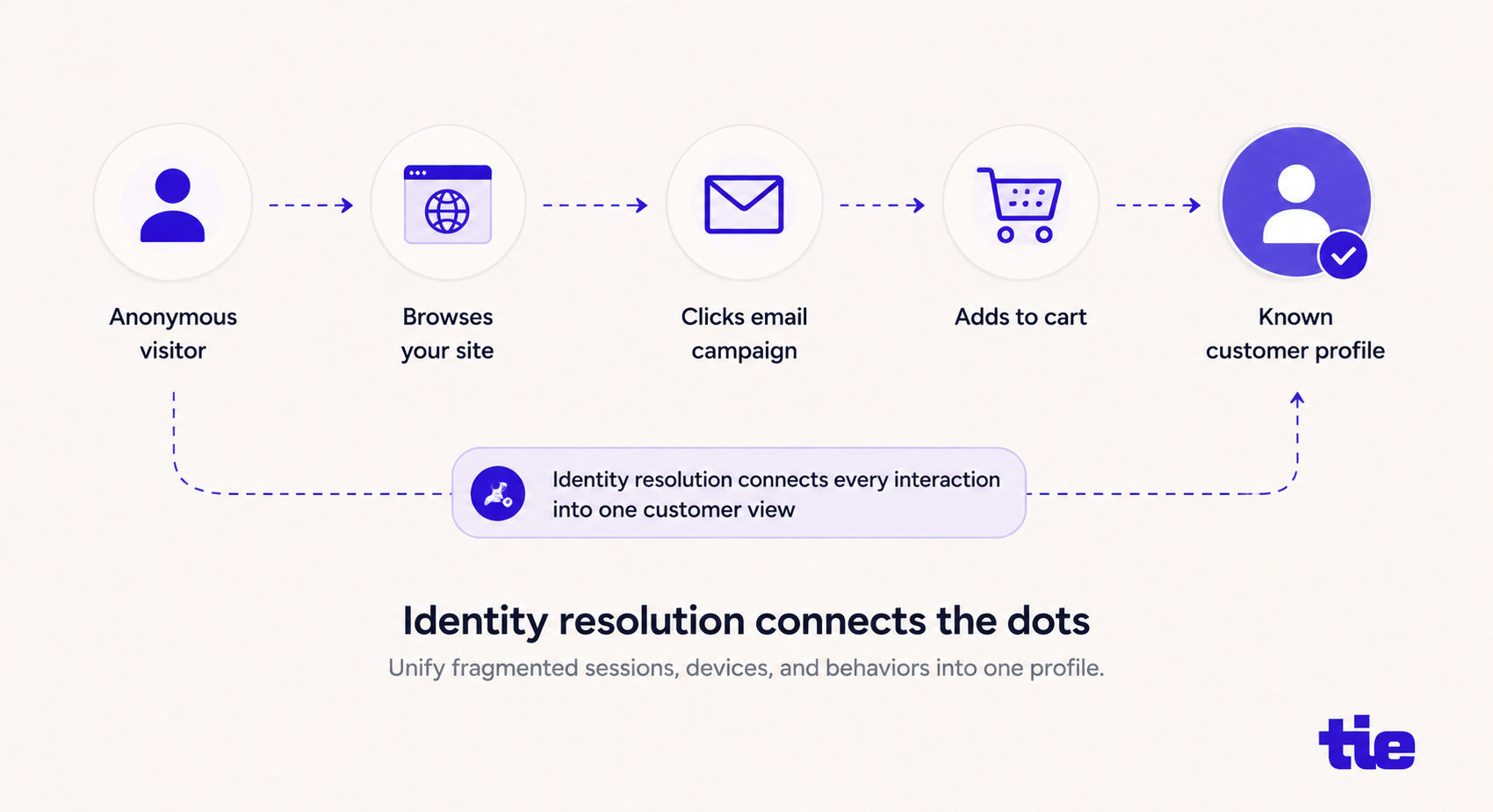
For ecommerce brands, identity resolution solutions play a major role here. A shopper may browse your website anonymously on mobile, return later from a laptop, click an email campaign three days later, and complete a purchase after seeing a retargeting ad.
Without identity resolution for customer targeting, those actions look like disconnected sessions. With identity resolution, your platform connects them into one customer journey tied to a single contact profile. That gives your team cleaner attribution, better lead scoring, and more accurate customer targeting.
Data appending and enhancement
Once the platform confirms a match, it expands the contact profile with additional attributes. This often includes:
- Verified phone numbers
- Demographic and psychographic data
- Product interests and shopping preferences
- Preferred marketing channels
- Intent data
- Device usage and location data
- Purchase behavior
- Engagement history
Most enrichment workflows also clean your CRM data during this process. For example, your sales team may store “Meta,” “Facebook Inc.,” and “Meta Platforms” as three separate company names across spreadsheets and CRM records. An enrichment platform standardizes those entries so your reporting, segmentation, and outreach workflows run correctly.
Strong enrichment workflows also validate fields before combining them. Some platforms cross-check phone numbers and contact information across multiple data providers before updating your CRM records.
Real-time vs. batch enrichment
The timing of enrichment directly affects how quickly you can act on customer intent.
Real-time enrichment updates contact profiles immediately after someone enters your workflow. For example, when a shopper signs up through a popup, abandons a cart, or downloads a resource, the enrichment platform can instantly append behavioral and demographic data before your automation flow triggers.
That allows you to:
- Route high-intent leads faster
- Personalize campaigns immediately
- Improve retargeting audiences
- Trigger more accurate lifecycle workflows
Batch enrichment serves a different purpose. Instead of updating records instantly, the platform processes large datasets through CSV uploads, scheduled syncs, or database refreshes.
Companies usually run batch enrichment to refresh outdated CRM data, improve ecommerce data capture, clean duplicate contact records, enrich historical datasets, and standardize formatting across systems.
Most companies use both approaches together. Real-time enrichment keeps new contacts actionable, while batch enrichment keeps your CRM accurate as your database grows.
Benefits and limitations of contact enrichment
Contact enrichment gives your team more context around the customers already in your CRM. That improves targeting, personalization, and campaign performance across your workflow.
At the same time, traditional enrichment tools depend heavily on existing contact data. As customer journeys become more fragmented across devices, browsers, and channels, those limitations become harder to ignore.
Let’s look at both sides in detail.
Benefits
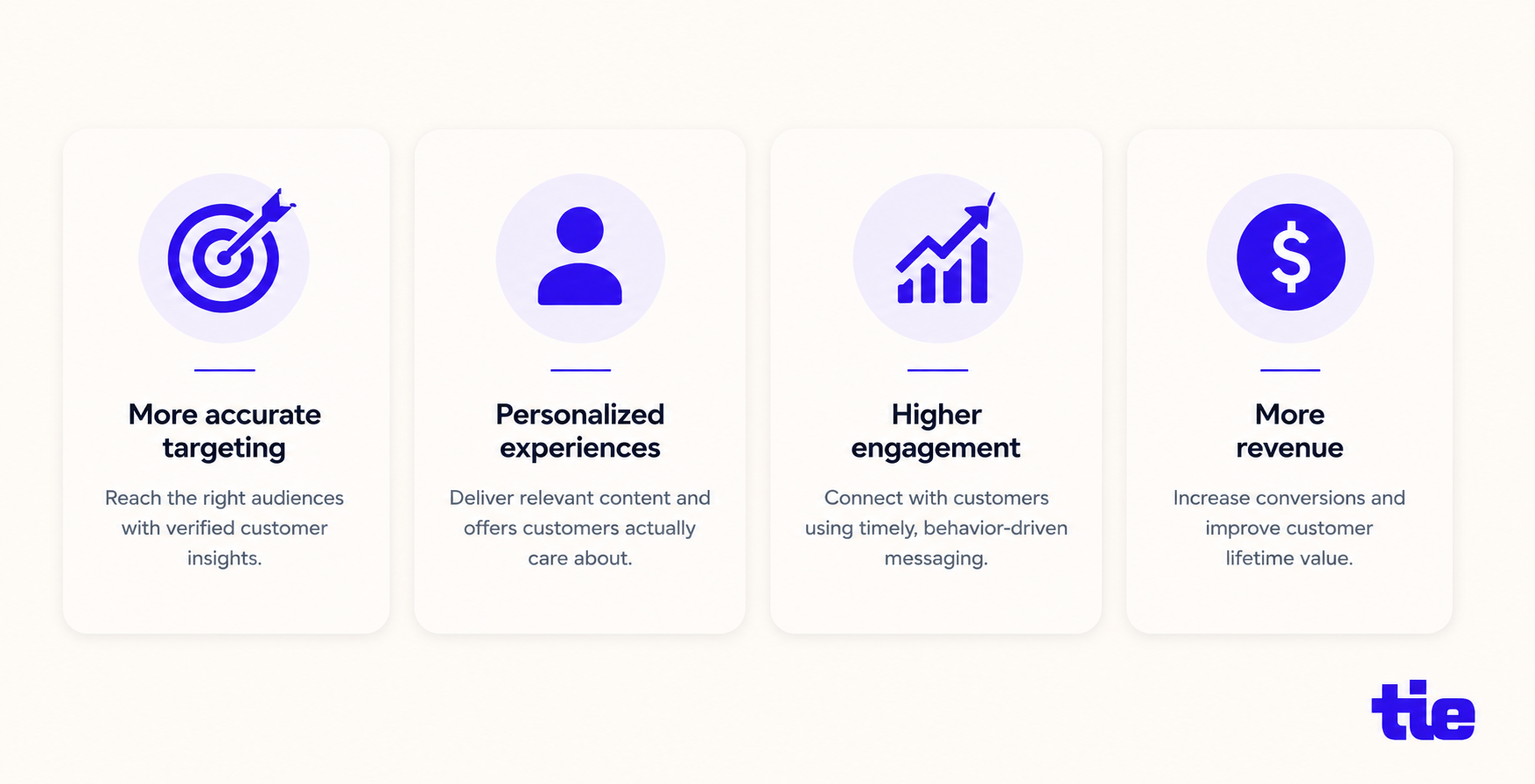
Here are some ways contact enrichment improves customer targeting, personalization, and CRM performance:
- Better personalization: Tailor emails, product recommendations, SMS campaigns, and outreach using behavioral data, purchase history, demographics, and engagement signals.
- More accurate targeting: Enriched contact profiles help you build tighter audience segments using firmographic data, intent data, company size, lifecycle stage, or browsing behavior.
- Higher conversion rates: Complete customer profiles help your team trigger campaigns while intent is still high, improving engagement and purchase likelihood.
- Cleaner CRM records: Enrichment workflows validate phone numbers, standardize company data, and reduce duplicate contact records across your tech stack.
- Stronger attribution: Identity resolution and enriched CRM data help you connect website visits, ad clicks, email engagement, and purchases back to the same customer journey.
For example, if a shopper repeatedly visits high-ticket product pages, engages with SMS campaigns, and purchases through mobile devices, your automation workflow can prioritize mobile-first promotions and cookieless retargeting strategies tied to that behavior.
Limitations
The benefits of contact enrichment are clear, but traditional enrichment workflows still struggle with several data quality, identity, and scalability challenges, including:
- Dependency on existing data: Most enrichment tools require strong identifiers like an email address, phone number, or LinkedIn URL before they can enrich a profile.
- Low B2C match rates: Ecommerce shoppers often browse anonymously across multiple devices and browsers, making identity matching harder and reducing enrichment coverage.
- Data decay: Customer data changes constantly. Job titles, phone numbers, purchase behavior, and engagement patterns become outdated quickly without continuous refreshes.
- Privacy and compliance pressure: GDPR, CCPA, and broader privacy shifts require stricter consent management, opt-out controls, and data handling practices.
- Fragmented customer journeys: Traditional enrichment workflows struggle when customer activity spreads across paid ads, email, SMS, mobile apps, and anonymous browsing sessions.
Contact enrichment vs. identity resolution
Contact enrichment and identity resolution solve two different problems inside your growth workflow.
Contact enrichment improves the customer data you already have. Identity resolution helps you identify the people you don’t know yet.
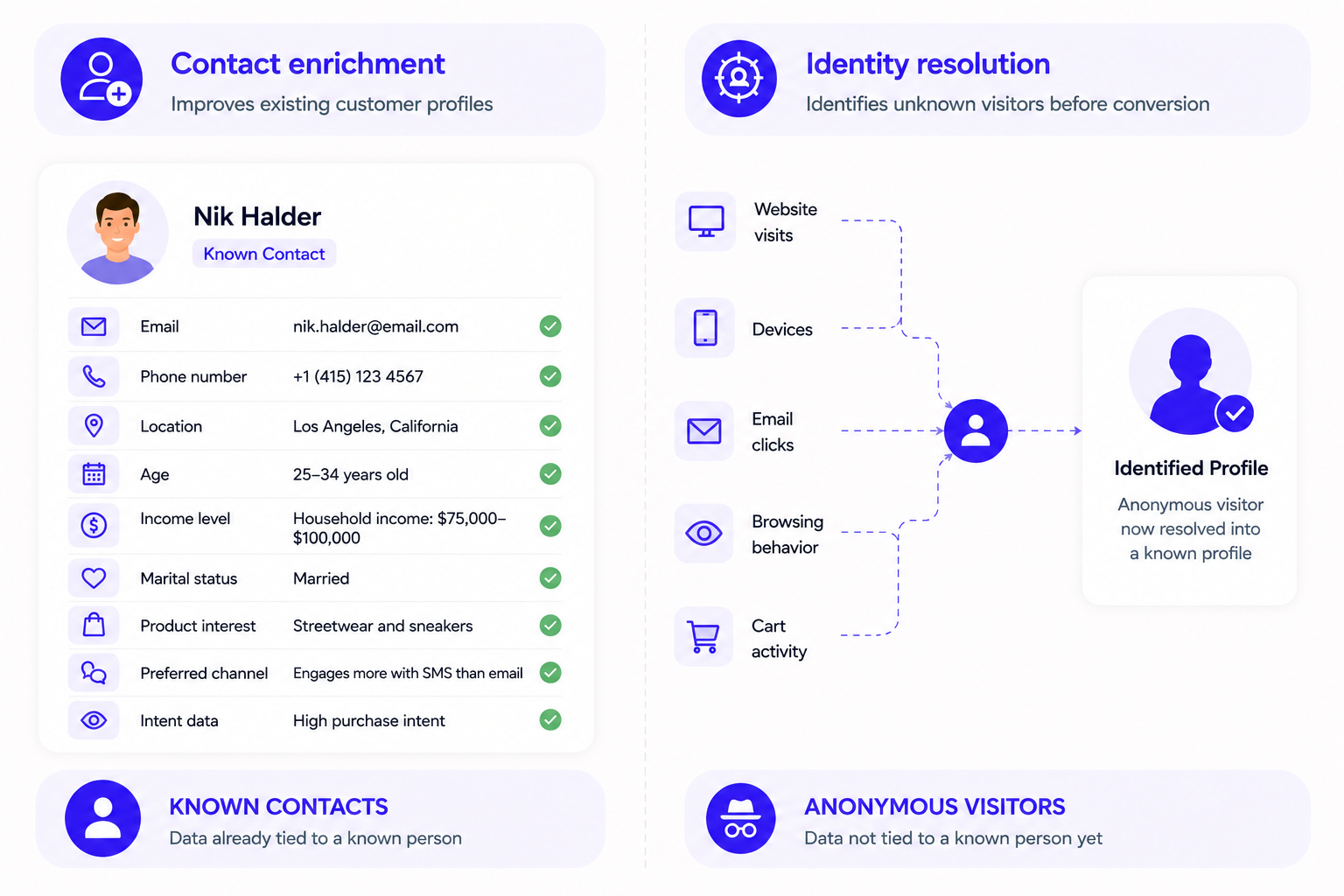
The table below explains the differences in more detail:
This shift has become increasingly important as customer journeys spread across multiple devices, browsers, apps, and channels.
A few years ago, most growth teams focused on improving existing CRM data. Now, a much larger challenge exists: identifying the massive percentage of traffic that never converts during the first visit.
That is why many ecommerce brands now combine contact enrichment with visitor identification systems and identity resolution to target customers. Instead of optimizing only the contacts already part of the CRM, brands can continuously expand the number of identifiable and reachable customers entering their growth workflow.
Best contact enrichment tool categories
The best contact enrichment tool depends on what you are trying to solve. Some platforms focus on identifying anonymous B2C website visitors, while others specialize in B2B sales prospecting, CRM enrichment, or workflow automation.
Here’s a quick comparison of the most common data enrichment tool categories:
B2C identity and enrichment platforms
These platforms focus on identifying anonymous website visitors and turning them into enriched, actionable customer profiles for email, paid media, and retention workflows.
- Tie: Tie combines identity resolution and contact enrichment to help ecommerce brands identify anonymous visitors and enrich profiles in real time.
- Customers.ai: Customers.ai focuses on identifying anonymous traffic and enriching profiles using behavioral and email-linked signals.
- Epsilon: Epsilon combines person-level identity resolution with consumer data enrichment to help brands build unified customer profiles across channels and devices.
B2B enrichment platforms
These tools work best for outbound sales, account-based marketing, and B2B lead generation workflows.
- Apollo: Apollo combines contact enrichment, prospecting, outreach, and sequencing into one platform.
- ZoomInfo: ZoomInfo provides large-scale B2B data enrichment for enterprise sales and RevOps teams.
- Clearbit: Clearbit focuses on real-time B2B contact and company enrichment. It now operates under HubSpot.
Data enrichment and workflow tools
These platforms focus more on orchestration, routing, and enrichment workflows across your broader data stack.
- Clay: Clay connects multiple enrichment tools, data providers, and automation workflows into one system.
- Segment: Segment helps companies collect, unify, and activate customer data across tools and channels.
- Hightouch: Hightouch syncs warehouse data into marketing, CRM, and advertising platforms.
Ecommerce brands often pair identity resolution platforms with CRM enrichment and workflow automation tools to improve customer targeting, attribution, and lifecycle activation across channels.
How to choose the right contact enrichment tool
The right contact enrichment tool depends on how your business acquires customers, manages data, and activates campaigns. A B2B sales team running outbound outreach needs very different capabilities than an ecommerce brand focused on identifying anonymous visitors and improving lifecycle marketing.
Here are the most important factors to evaluate before choosing a platform:
- Business model: B2B teams usually need firmographic data, job titles, technographic data, and account-level targeting. B2C brands typically need identity resolution, behavioral enrichment, and visitor identification.
- Match rates: Ask vendors how many profiles they can realistically identify and enrich for your audience. This matters heavily for anonymous ecommerce traffic and multi-device journeys.
- Real-time enrichment: Real-time workflows support cart recovery, lead routing, personalized campaigns, and retargeting while customer intent is still high.
- CRM and workflow integrations: Check integrations with tools like HubSpot, Salesforce, Klaviyo, Segment, Shopify, Meta, and Google Ads, so enriched profiles flow directly into activation workflows.
- Data quality and validation: Look for duplicate removal, validation workflows, refresh frequency, and confidence scoring to maintain accurate CRM records.
- Compliance and privacy: Your enrichment workflows should support GDPR, CCPA, consent management, opt-outs, and transparent data sourcing practices.
- Existing tech stack: Lightweight tools work well for smaller teams, while larger companies often need API-first platforms that connect with warehouses, CDPs, and broader automation workflows.
Contact enrichment use cases
Contact enrichment becomes valuable when it improves actual marketing performance, customer targeting, and lifecycle activation. The strongest use cases connect enriched profiles directly to campaigns, segmentation, and revenue workflows.
Here are some of the most common ways ecommerce and growth teams use contact enrichment:
- Recover abandoned visitors and carts: Identify high-intent visitors, enrich their profiles, and trigger cart recovery emails, SMS reminders, and retargeting campaigns.
- Grow high-quality email and SMS lists: Append missing contact data like location, product interests, and preferred channels to improve segmentation and deliverability.
- Personalize lifecycle campaigns: Use behavioral data, purchase history, and engagement signals to tailor welcome flows, product recommendations, and retention campaigns.
- Improve paid ad targeting: Sync enriched audiences into Meta and Google Ads to build stronger lookalike audiences, improve retargeting, and exclude existing customers from acquisition campaigns.
- Strengthen attribution across channels: Connect website visits, email engagement, ad clicks, and purchases into unified customer journeys for cleaner reporting and better conversion tracking.
- Support lead scoring and sales outreach: Enrich leads with job titles, company size, technographic data, and intent signals to help SDR and sales teams prioritize outreach.
- Improve CRM data quality: Remove duplicate contact records, validate phone numbers, and standardize CRM data across your workflow and tech stack.
- Power real-time automation workflows: Trigger segmentation, outreach, and personalization workflows immediately after a visitor signs up, browses products, or re-engages with your brand.
Best practices for contact enrichment
Contact enrichment is most effective when it’s treated as an ongoing system, not a one-time data update. The goal is to keep your data accurate, actionable, and directly connected to how your team runs marketing and sales.
Here are the key best practices to follow:
- Keep data quality high from the start: Regularly clean your CRM by removing duplicates, validating emails and phone numbers, and refreshing outdated records. Poor data quality compounds quickly and weakens segmentation and campaign performance.
- Use real-time enrichment wherever possible: Enrich profiles as customer behavior happens, not hours or days later. This allows you to trigger flows, retarget shoppers, and personalize messaging while intent is still high.
- Focus on actionable data, not just more data: Prioritize enrichment fields that directly impact campaigns (like purchase intent, behavior, and key demographics) rather than collecting data that doesn’t influence decisions.
- Integrate enrichment directly into your marketing stack: Ensure enriched profiles flow automatically into your CRM, email platform, and ad channels. This removes manual work and keeps segmentation and targeting consistent across channels.
- Align enrichment with your use case: Tailor your enrichment strategy to your goals. B2B teams should focus on firmographic and account-level data, while B2C brands should prioritize identity resolution, behavioral signals, and visitor recognition.
- Maintain compliance and transparency: Work with vendors that support GDPR, CCPA, and consent management. Make sure data sources are transparent, and users can opt out easily.
- Continuously monitor performance: Track how enrichment impacts key outcomes like match rates, campaign conversion, and revenue per user. Use this feedback to refine your data strategy over time.
- Avoid over-enrichment and list bloat: More data isn’t always better. Focus on identifying and enriching high-intent shoppers rather than expanding your database with low-quality or irrelevant contacts.
When done right, contact enrichment strengthens every part of your marketing system—from segmentation to personalization to attribution—by making your data complete, timely, and usable.
How platforms like Tie extend enrichment further
Traditional contact enrichment starts after someone enters your CRM. Platforms like Tie accelerate that process by combining B2C website visitor identification, identity resolution, and enrichment into a single workflow.
Instead of waiting for a form fill or account signup, these platforms identify anonymous website visitors using behavioral and consented identity signals. Once a visitor is identified, the platform enriches the profile with demographic, behavioral, and intent data that supports personalization, targeting, and attribution.
For ecommerce brands, this changes how customer acquisition and retention workflows operate. For example, a shopper may:
- Visit your website from a paid ad
- Browse several product pages
- Leave without purchasing
- Return later through email or organic search
A traditional enrichment workflow may never recognize that visitor until they submit a form or complete checkout. Identity resolution platforms connect those sessions into a unified profile much earlier, giving your team more time to personalize campaigns, trigger retargeting flows, and improve attribution.
Platforms like Tie also sync resolved identities directly into tools like Klaviyo, Meta, Google Ads, and CRM systems in real time. That speed matters because customer intent fades quickly when data sits inside disconnected dashboards instead of active workflows.
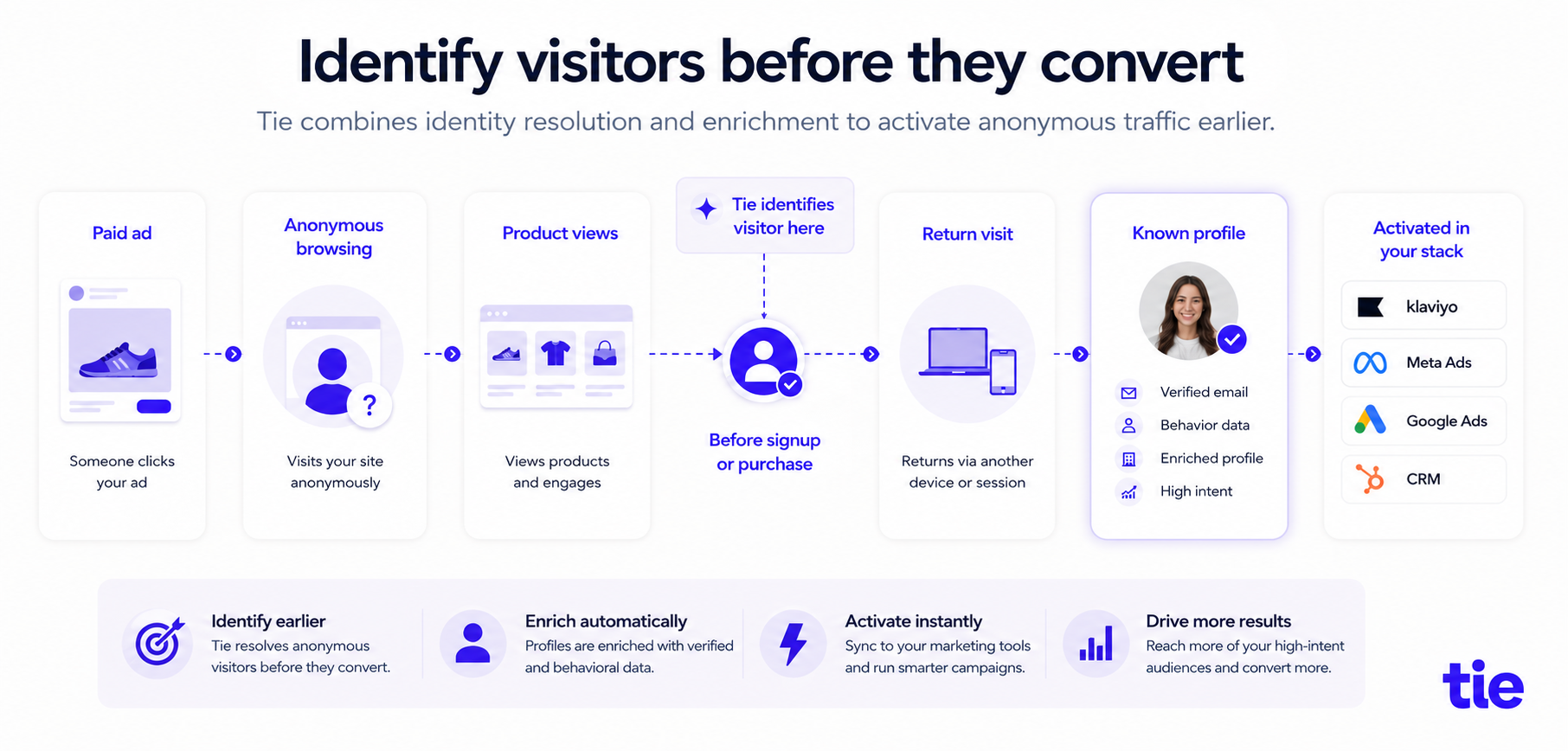
As privacy changes continue to reshape digital marketing, ecommerce brands now focus on expanding the number of identifiable visitors entering their funnel, not just enriching the contacts already inside their CRM.
Conclusion: The future of contact enrichment is identity-driven
Traditional contact enrichment helps brands improve the customer data already part of their CRM. But ecommerce growth has shifted far beyond cleaning spreadsheets and filling missing fields.
Your highest-intent visitors often browse anonymously long before they ever submit a form or complete a purchase.
They visit product pages, compare pricing, open emails across devices, and return through different channels. Traditional enrichment workflows miss most of that activity because no contact record exists yet.
Identity-driven enrichment changes that.
Instead of enriching only known contacts, platforms like Tie help you identify anonymous visitors earlier, connect fragmented customer journeys, and enrich profiles in real time using behavioral and intent signals. That gives your team more opportunities to personalize campaigns, improve targeting, strengthen attribution, and recover revenue from traffic already coming to your website.
If you want to see how identity-driven enrichment fits into your existing stack, book a demo with Tie.
Contact enrichment FAQs
What data can be enriched in a contact profile?
Contact enrichment expands a basic customer record into a complete profile. Most enrichment tools add:
- Contact details like phone numbers, location, and preferred channels
- Demographic data like age range, household income, or interests
- Behavioral signals like browsing activity, purchase history, and email engagement
- CRM data like loyalty status, product preferences, and past orders
- Intent data tied to buying behavior
For ecommerce brands, this creates richer contact profiles that support better segmentation, personalization, lead scoring, and automation workflows.
Is contact enrichment legal under GDPR and CCPA?
Yes, contact enrichment can comply with GDPR and CCPA when brands use consented data sources, provide opt-out options, and follow proper privacy and data retention practices.
How accurate is contact enrichment data?
Accuracy depends on the enrichment provider and data sources. Contact details and engagement data are usually reliable, while demographic and interest-based attributes often work as modeled estimates that improve with first-party behavioral data.
Can contact enrichment identify anonymous website visitors?
Traditional contact enrichment tools usually work with existing records already stored in your CRM, spreadsheets, or contact list.
Identity resolution platforms like Tie extend this process further by helping brands recognize anonymous website visitors and connect them to known customer profiles.
For example, a shopper may browse products on mobile without logging in. Tie can connect that browsing session to an existing profile using consented identifiers, cross-device signals, and identity resolution workflows.
That gives marketing teams more ways to personalize campaigns, improve conversion rates, and recover high-intent visitors through email, SMS, and paid media outreach.
What is an example of data enrichment?
A shopper signs up with only an email address. A contact enrichment workflow can append their name, location, device preference, product interests, and purchase behavior to support personalized campaigns and retargeting.
That enriched profile can then trigger personalized welcome emails, audience segmentation, product recommendations, and retargeting campaigns.