
Best Website Visitor Identification Software for Ecommerce


Most ecommerce visitors leave without converting or identifying themselves. For many DTC brands, that means 95%+ of website traffic disappears before it ever reaches your CRM, email platform, or retargeting workflows.
Website visitor identification software helps solve that problem by turning anonymous website visitors into contactable shopper profiles. Once identified, those visitors can flow directly into email, SMS, paid media, and lifecycle campaigns while purchase intent is still active.
The category has expanded quickly over the last few years, but the platforms themselves are very different. Some tools are adapted from B2B website visitor tracking software built around company-level lead generation.
Others focus almost entirely on email acquisition. A few operate as larger shopper intelligence or enterprise orchestration platforms with identity resolution built in.
This guide compares the five most relevant website visitor identification tools for ecommerce and DTC brands, including Tie, Opensend, Retention.com, Customers.ai, and Wunderkind.
What "website visitor identification" actually means for ecommerce
Website visitor identification helps ecommerce brands recognize anonymous shoppers visiting their site, turning that traffic into reachable customer profiles.
Instead of only tracking sessions or pageviews, identification platforms connect browsing activity to real people using consented identity data and behavioral signals. Once identified, those shoppers can be synced into tools like Klaviyo, Salesforce, HubSpot, or Google Ads for retargeting and lifecycle campaigns.
This gives brands a way to generate more revenue from existing traffic, especially from shoppers who leave without leaving their details or placing an order.
B2B vs B2C identification
B2B identification focuses on companies and buying teams. The goal is to identify which businesses are researching your product so that sales reps can do outreach.
B2C identification works at the shopper level. Ecommerce brands need to understand which products someone viewed, whether they abandoned their cart, how engaged they are, and when they’re likely to purchase.
That’s why ecommerce platforms focus on person-level identity resolution and lifecycle activation across email, SMS, ads, and retention flows.
How person-level identification works in ecommerce
When someone visits your site, identification platforms collect session-level signals like device type, IP address, browser activity, and on-site behavior.
Those signals are matched against consented identity graphs to connect anonymous sessions with known shopper profiles. If a match is found, the platform can enrich the profile with email address, phone number, demographic data, and buying intent signals.
That data then syncs into your CRM or marketing tools so you can:
- Trigger browse abandonment flows
- Build SMS retargeting audiences
- Personalize follow-up campaigns
- Suppress low-intent visitors
- Prioritize high-intent shoppers for lifecycle campaigns
Platforms like Tie enrich profiles with behavioral and demographic data, apply intent scoring, and help brands filter which identified shoppers should actually enter their CRM. That matters because list quality directly affects email deliverability, segmentation accuracy, retargeting efficiency, customer attribution clarity, and revenue per send.
Factors to evaluate when picking an identification tool for your ecommerce brand
Choosing the right website visitor identification platform affects far more than list growth. The quality of your identification layer directly shapes your retargeting efficiency, deliverability, segmentation accuracy, attribution visibility, and lifecycle revenue.
That’s why ecommerce teams should evaluate identification tools based on how well they fit their growth model, retention marketing strategy, and existing marketing stack. Here are the key factors to evaluate before choosing a platform.
Match rate on real ecommerce traffic
Most identification platforms advertise high match rates, but the number only matters if it holds up against real ecommerce traffic. Look for:
- Public case studies
- Revenue attribution examples
- Match rates across actual Shopify stores
- Proof that identified traffic converts into revenue
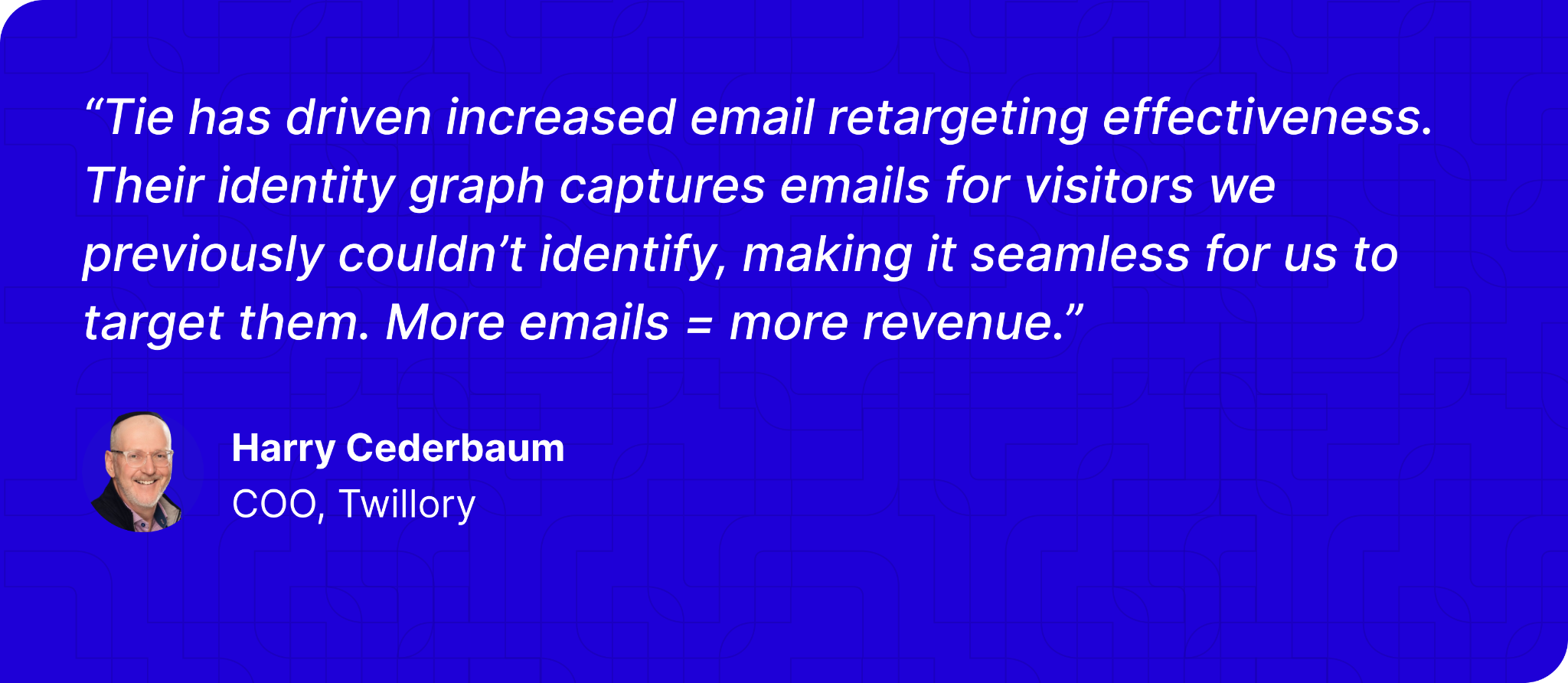
The strongest platforms improve match quality over time using behavioral modeling and machine learning, especially as cookie-based tracking becomes less reliable. Tie, for example, helped Twillory improve email open rates by 39% through deliverability optimization.
Data depth and enrichment quality
The value of an identification platform depends heavily on how much usable customer intelligence it gives your team after a match happens.
Some platforms stop at basic email capture. Others build richer shopper profiles using demographic data, browsing behavior, device signals, purchase intent, and session-level activity. That additional context helps you create tighter audience segments, trigger more relevant lifecycle marketing flows, improve suppression logic, and personalize campaigns across channels.
For ecommerce brands, deeper data enrichment also improves attribution clarity because your team can connect more touchpoints across the customer journey instead of relying on isolated sessions or last-click activity.
Native integrations with your marketing stack
Identity data only becomes valuable when it flows into the tools your team already uses. Look for integrations with native tools like Klaviyo, Shopify, Meta CAPI, Google Ads, email service providers (ESPs), and customer data platforms (CDPs).
Without direct integrations, sales teams often end up relying on delayed CSV exports or manual workflows that slow execution. The right integrations support real-time audience syncing, faster campaign activation, better attribution visibility, cleaner retargeting audiences, and cross-channel personalization.
Compliance model and consent architecture
Compliance architecture matters because identity resolution depends on customer data handling, consent collection, and opt-out management. Evaluate:
- Compliance with state and country data privacy laws
- Consent management support
- Opt-out workflows
- Data sourcing transparency
- Identity verification processes
Platforms built around consented identity graphs and explicit opt-ins create lower compliance risk and cleaner long-term data infrastructure.
For example, Tie operates on a consent-based identity framework built for regulatory compliance. The platform uses verified opt-in data with full traceability across its identity graph, helping ecommerce brands enrich and activate customer data while maintaining cleaner compliance and data governance standards.
Top 5 website visitor identification tools for ecommerce compared
Most ecommerce brands evaluating visitor identification software are trying to answer the same question: Which platform will actually help us convert more of our existing traffic into measurable revenue?
The answer usually comes down to a few operational differences: match quality, identity depth, attribution accuracy, deliverability protection, and how effectively the platform helps your team activate shopper data across lifecycle marketing workflows.
That last part matters more than ever. Along with identified contacts, ecommerce teams need better signals around who’s actually ready to engage, purchase, or re-enter the funnel. As predictive scoring and AI-powered segmentation become more common, the quality of the underlying identity and shopper-intelligence layer becomes a major differentiator between platforms.
Below, we break down the top website visitor identification tools ecommerce brands are using right now and where each platform fits best.
Tie: Best for brands that want to activate high-intent shoppers across their entire stack
Ideal for: Ecommerce and DTC brands with meaningful U.S. traffic volume that want stronger identity resolution, cleaner lifecycle audiences, and better deliverability control.
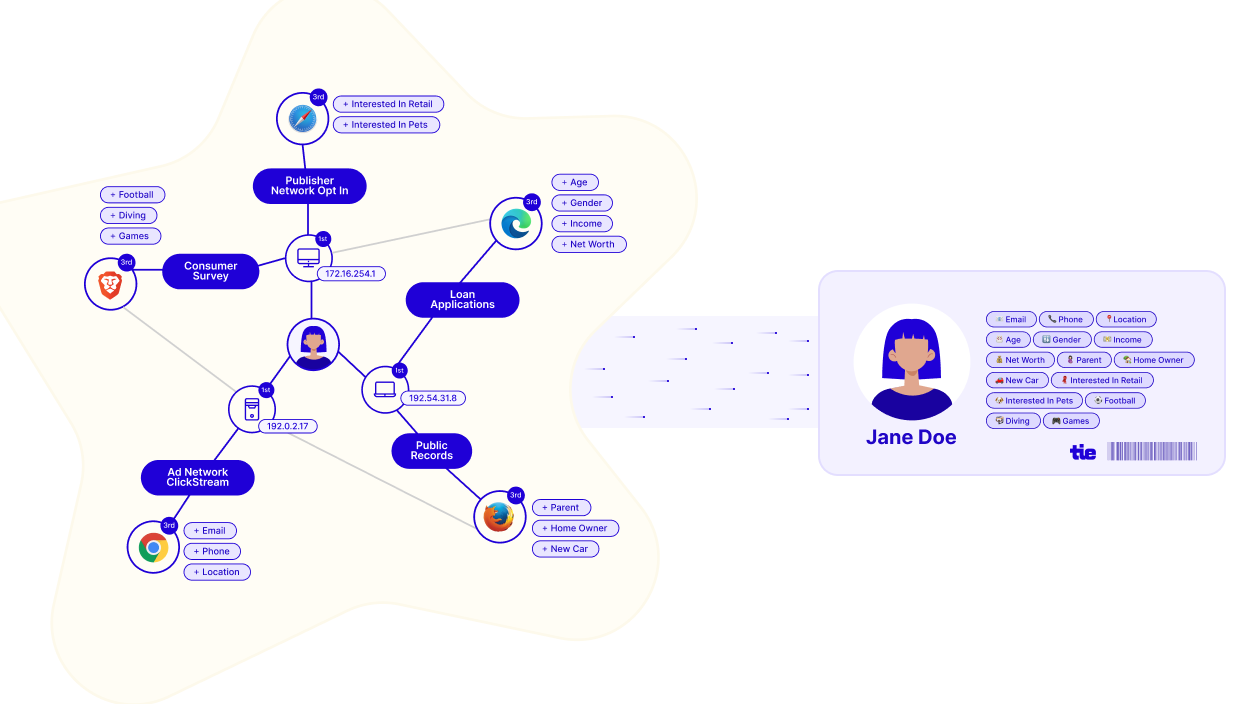
Tie is a shopper intelligence platform built specifically for ecommerce identity resolution. Instead of identifying companies or work emails, it connects anonymous browsing activity to real shopper profiles using a large consent-based identity graph and behavioral signals across devices and sessions.
That identity layer feeds directly into lifecycle marketing systems, helping brands retarget visitors, personalize campaigns, improve segmentation, and measure attribution more accurately.
Tie also focuses heavily on audience quality. Brands can filter identified visitors based on behavior, engagement signals, demographics, and match-quality thresholds before syncing that contact data into marketing platforms like Klaviyo, Shopify, Meta, Google Ads, and Postscript.
Pricing: Tie uses a credit-based pricing model built around identified shoppers and profile enrichment. Plans start at 300K annual credits, with higher tiers scaling based on traffic volume, enrichment usage, and activation needs. One credit covers a unique identified visitor for the full month, even if that shopper returns multiple times across devices or sessions.
How Tie works
Tie combines real-time identity resolution with demographic enrichment and AI segmentation.
When a shopper lands on your site, Tie analyzes signals like browsing activity, device context, session behavior, and engagement patterns. Those signals are then matched against Tie’s identity graph of 280M+ opted-in U.S. consumers and billions of behavioral data points.
Once a match is confirmed, Tie enriches the profile with email and phone data, demographic attributes, device and geo signals, purchase intent indicators, and behavioral history.
Tie Predict then layers AI-powered shopper scoring on top of that identity data. Using 55+ behavioral, demographic, and engagement signals, Predict scores shoppers based on their real-time likelihood to open, click, or purchase, including shoppers your existing Klaviyo segments may overlook entirely.
Those scores sync directly into your lifecycle workflows as profile properties, helping retention teams prioritize high-intent shoppers, improve segmentation, and activate campaigns based on forward-looking buying intent instead of backward-looking engagement rules.
Strengths
- High ecommerce-focused match rates, with reported identification rates reaching up to 90% on qualified U.S. traffic.
- Strong deliverability infrastructure, including domain warming and audience-quality controls.
- The dashboard surfaces real-time shopper identification, predictive scoring, and campaign attribution in one place.
- Deep shopper enrichment with demographic, behavioral, and intent-based attributes.
- Predictive scoring through Tie Predict to identify shoppers most likely to engage or purchase.
- Native integrations with Shopify, Klaviyo, Meta, Google Ads, Postscript, and major CRMs.
- Transparent order-level attribution with timestamps and identity tracking.
- Configurable audience filtering to prioritize higher-intent shoppers.
- Built around a regulatory-compliant consent architecture.
- Dedicated CSM support to help retention teams optimize segmentation, deliverability, lifecycle workflows, and overall campaign performance over time.
For example, TUSHY used Tie’s identity-based remarketing to improve the efficiency of its email and SMS programs. After implementing Tie, the brand saw $110K+ in incremental revenue generated from identity-based remarketing and 6x return on investment from campaigns targeting newly identified shoppers.
Where it falls short
Tie performs best for brands with larger U.S.-based ecommerce audiences. Brands typically see the strongest results with 100K+ monthly U.S. website visitors, 200K+ CRM profiles, and active lifecycle marketing programs.
For smaller stores, the platform can feel heavier than necessary relative to traffic volume and operational needs.
Tie is built around United States consumer identity data, so brands with limited U.S. traffic may see lower overall value compared to ecommerce companies targeting primarily American shoppers.
Average user rating: 4.9 stars on G2
Opensend: Best for fast email-list growth with minimal setup
Ideal for: Small-to-mid-sized ecommerce brands that want faster email list growth from existing website traffic without adding a heavy operational layer.

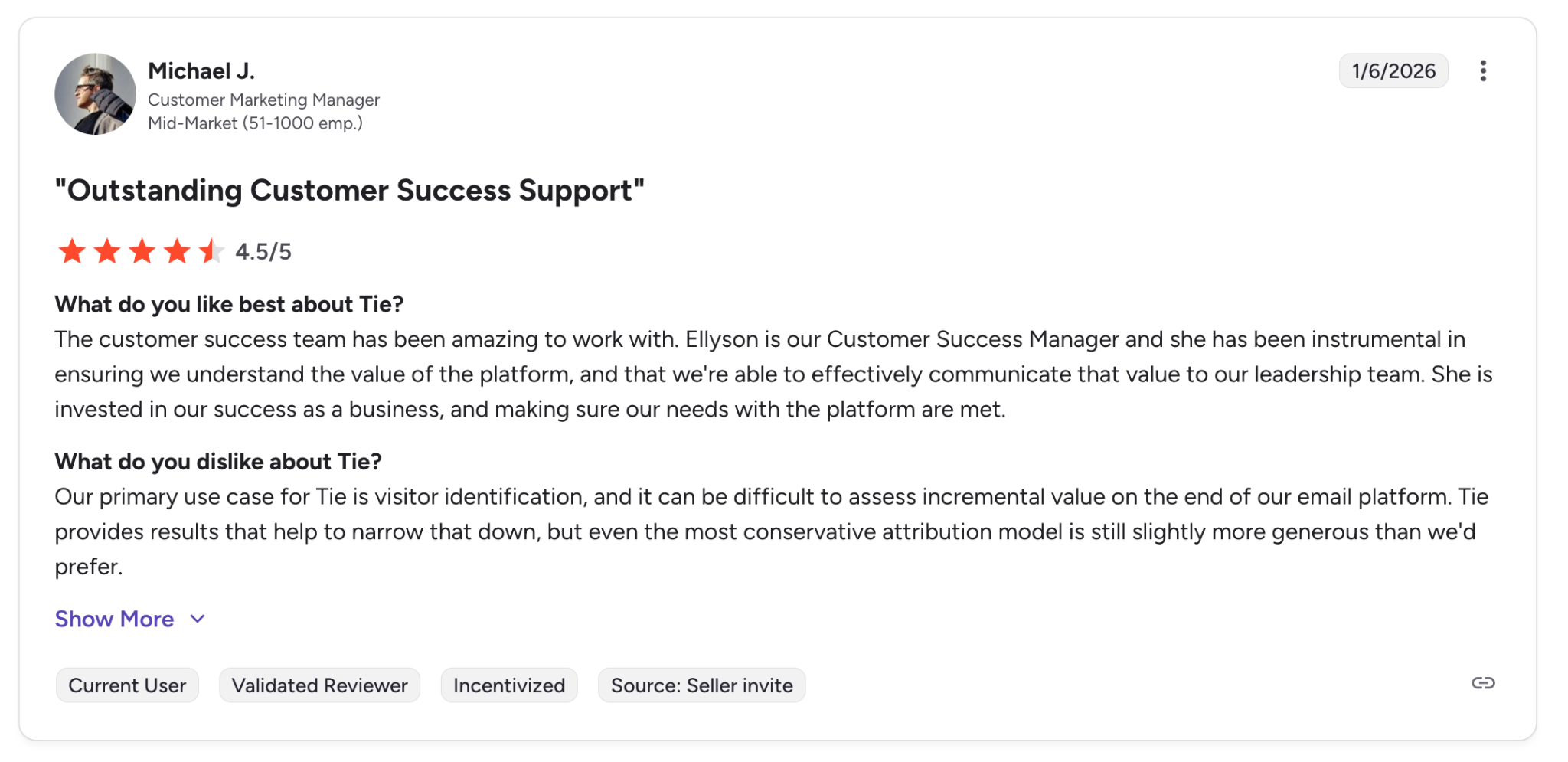
Opensend focuses on helping ecommerce brands identify anonymous website visitors and quickly push those contacts into email workflows. The platform is designed for fast deployment, simple onboarding, and immediate list growth without requiring complex implementation or large retention teams.
For brands primarily focused on growing owned audiences for email follow-up campaigns, Opensend offers a relatively straightforward setup and activation process.
See how Tie compares with Opensend.
Pricing: Paid plans start at $400/month for 2,000+ identified visitors on sites with roughly 10K–50K monthly visitors. Higher tiers scale based on traffic and identities delivered, with enterprise plans available for larger ecommerce brands.
Strengths
- Fast setup with minimal technical implementation.
- Strong fit for ecommerce teams prioritizing email list growth.
- Integrates with platforms like Shopify.
- Simple workflows for browse abandonment and follow-up campaigns.
- Useful for recovering high-value from existing website traffic.
- Clean UI and lightweight operational overhead for lean marketing teams.
- Works well for brands focused on a quick, short-term uplift from their website visitor tracking tool.
Where it falls short
- Narrower data enrichment compared to platforms like Tie, with a stronger focus on email identification than deeper shopper intelligence.
- Limited demographic enrichment, advertising IDs, and behavioral data depth.
- Single match-rate approach without configurable controls for balancing volume and quality.
- Faster list expansion can create deliverability pressure and violate ESP terms of service if audience filtering and suppression workflows are not tightly managed.
- More limited functionality outside email activation, especially for SMS attribution, direct mail orchestration, and paid media enrichment.
- Attribution visibility is lighter compared to platforms offering order-level tracking and deeper CRM integrations.
- No AI-powered shopper scoring or predictive segmentation layer comparable to Tie Predict for identifying who is most likely to engage or purchase next.
- Does not currently have an approved native app listing in the Klaviyo app marketplace, which may matter for ecommerce teams prioritizing tighter platform validation and ecosystem support.
Average user rating: 4.7 stars on G2
Retention.com: Best for brands prioritizing list size over list quality
Ideal for: Small-to-mid-sized ecommerce brands focused on rapid email list growth and basic retargeting from anonymous website traffic.

Retention.com is a website visitor identification platform built to help ecommerce brands identify anonymous website visitors and sync those contacts into tools like Klaviyo, Meta, and Google Ads for follow-up campaigns.
The platform is primarily focused on email acquisition and retargeting. Once installed, it identifies visitors and pushes those contacts into downstream marketing workflows to support cart recovery, browse abandonment, and audience growth initiatives.
Pricing: Starts at $79/month for up to 1,000 identified emails, with larger ecommerce plans scaling based on identified-contact volume.
Strengths
- Fast setup for ecommerce brands looking to grow owned audiences
- Useful for cart abandonment and browse abandonment workflows
- Integrates with platforms like Shopify, Klaviyo, Meta, and Google Ads
- Predictable entry-level pricing for lower-volume brands
- Helps recover value from anonymous traffic and website visits
- Straightforward functionality for email-driven retargeting campaigns
- Useful for brands building larger contact databases quickly
Where it falls short
- Attribution visibility can become difficult to validate as volume scales, especially for teams measuring incrementality and lifecycle impact.
- Several ecommerce operators have raised concerns around attribution confidence and contact quality in public reviews, DTC communities, and migration case studies.
- Primarily focused on email identification, with lighter demographic enrichment and fewer advertising or device-level signals compared to broader shopper intelligence platforms.
- Uses a single match methodology without configurable controls for balancing list quality versus match volume.
- Faster list expansion can create deliverability pressure and violate ESP terms of service if audience filtering and suppression workflows are not tightly managed.
- Pricing scales aggressively as identified-contact volume increases, which can compress margins for lower-AOV ecommerce brands.
- Limited shopper intelligence outside email activation, with weaker support for SMS attribution, direct mail workflows, predictive lead scoring, and deeper segmentation.
- No AI-powered shopper segmentation or predictive scoring layer comparable to Tie Predict for identifying which shoppers are most likely to engage or purchase next.
Average user rating: 4.5 stars on G2
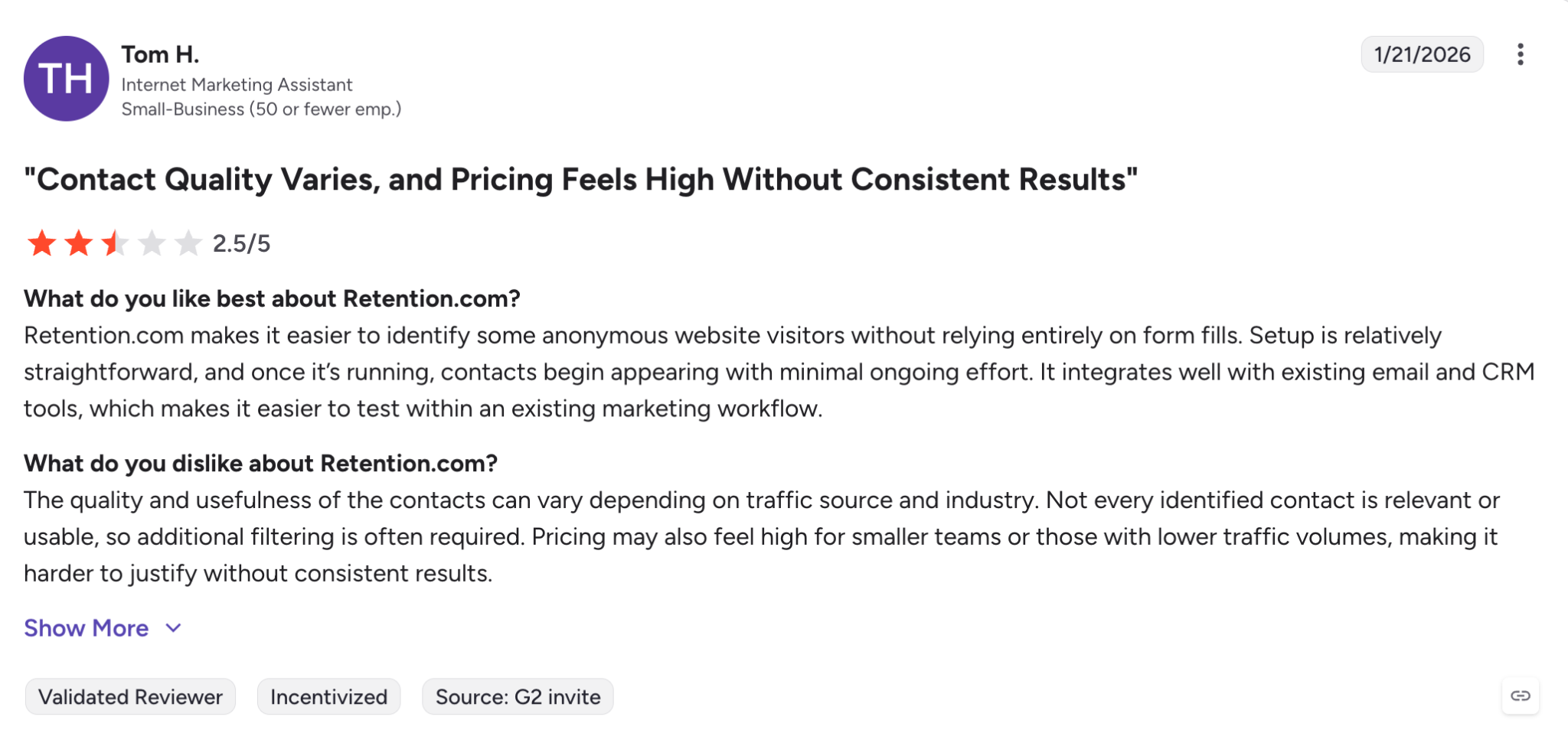
Customers.ai: Best for hybrid B2B and B2C teams in one tool
Ideal for: Mid-sized brands and marketing teams running both B2B lead generation and B2C ecommerce workflows from a shared CRM and automation stack.

Customers.ai combines website visitor identification, retargeting, automation, and outreach tools inside a broader marketing platform. The product supports both company-level B2B identification and person-level ecommerce visitor resolution, making it appealing for teams managing multiple acquisition motions in one system.
Alongside ecommerce visitor identification, Customers.ai also includes key features tied to social media, like LinkedIn outreach and Facebook Messenger automation, lead generation workflows, and CRM integrations with platforms like HubSpot and Salesforce.
Pricing: Starts at $600/month for 3,000 monthly resolutions, with higher tiers scaling based on identification volume.
Strengths
- Supports both B2B website visitor tracking and B2C ecommerce use cases.
- Includes automation and outreach workflows across multiple channels.
- Integrates with HubSpot, Salesforce, Shopify, and major CRMs.
- Useful for marketing teams managing both lead generation and ecommerce acquisition.
- Includes retargeting, visitor data enrichment, and follow-up functionality in one platform.
- Can support account-based marketing and company-level identification workflows.
- Offers integrations across email, ads, Messenger, and CRM systems.
Where it falls short
- Product focus is split across B2B and B2C use cases, which makes some ecommerce-specific workflows feel less mature than purpose-built ecommerce platforms.
- Shopify-native attribution, cart abandonment routing, and lifecycle orchestration are less developed compared to ecommerce-first tools like Tie.
- Match-rate transparency and attribution reporting are less detailed than platforms offering order-level visibility.
- Setup overhead can feel heavier for ecommerce teams that primarily want real-time resolved profiles synced directly into Klaviyo.
- Visitor enrichment depth is more generalized across industries instead of optimized specifically for ecommerce retention and segmentation.
- Some workflows require additional configuration across CRM integrations, automation layers, and notifications before activation becomes fully operational.
Average user rating: 4.8 stars on G2
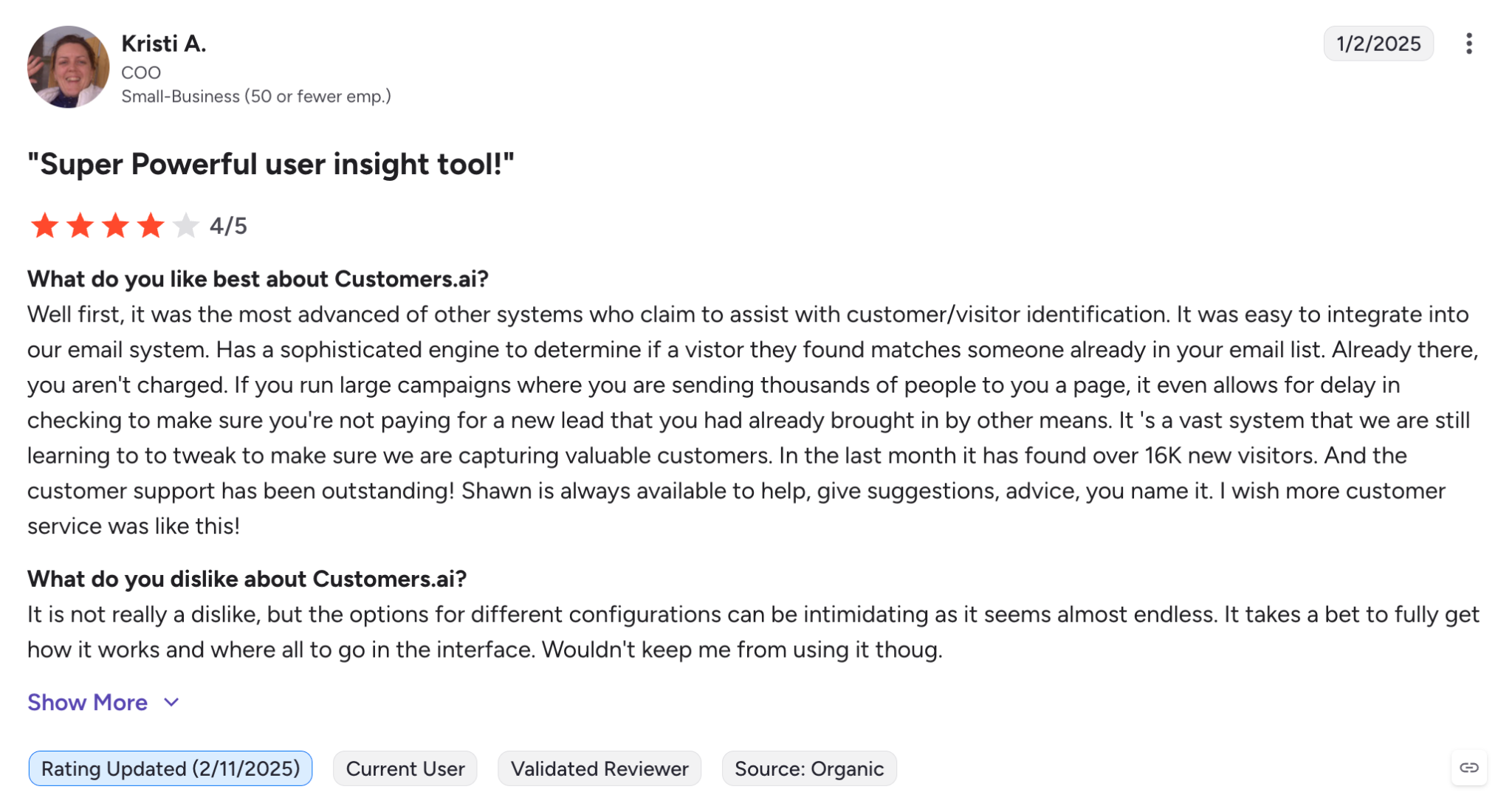
Wunderkind: Best for enterprise retailers wanting a managed-service platform
Ideal for: Enterprise ecommerce and retail brands with large retention teams and high traffic volume who want to outsource their retention marketing to a managed service program.
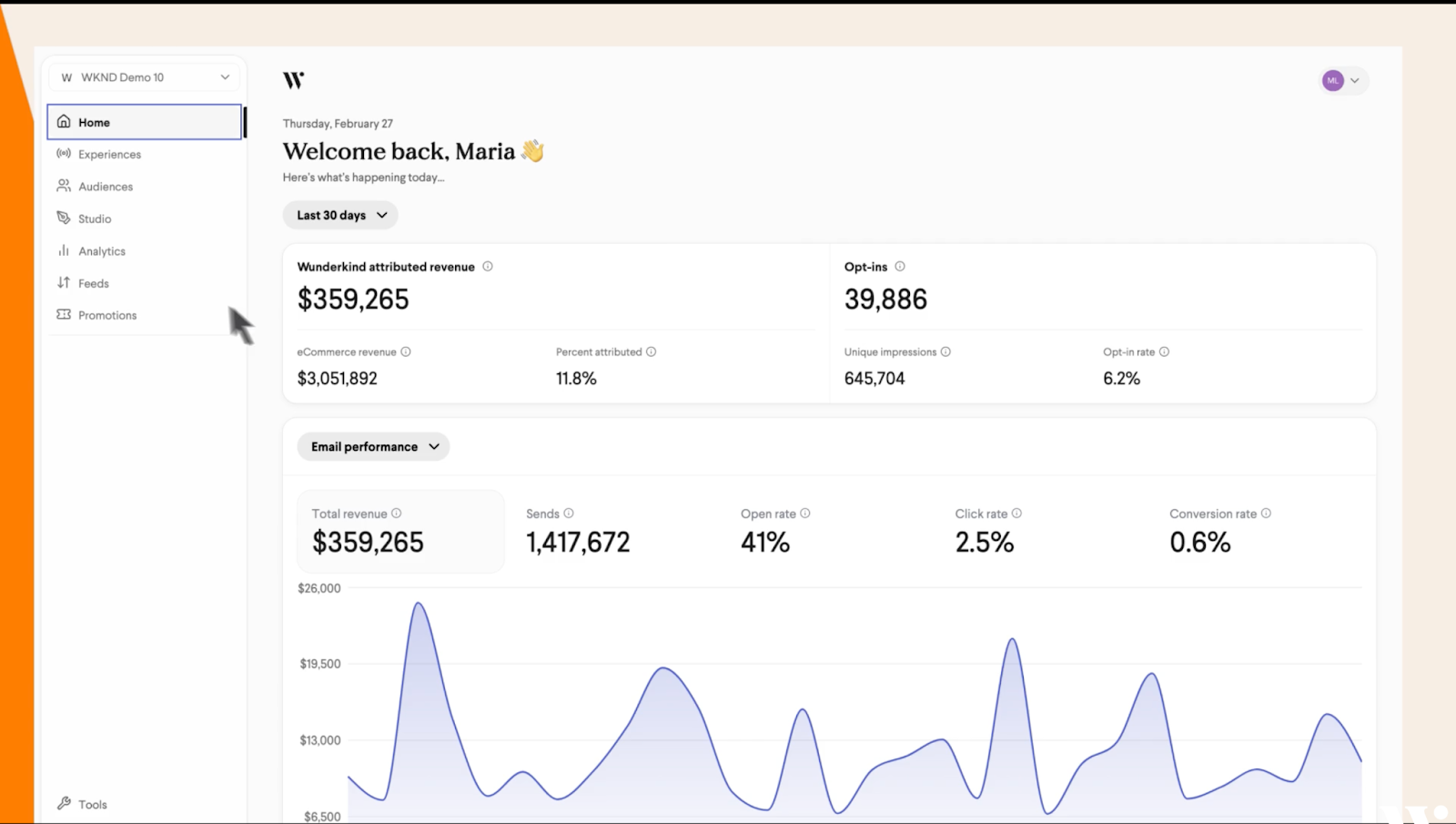
Wunderkind combines website visitor identification, identity resolution, behavioral enrichment, and triggered messaging inside a managed-service marketing platform. The system helps retailers recognize shoppers across devices and sessions, then activate personalized messaging across email, SMS, onsite experiences, and paid media.
The platform is heavily geared toward enterprise orchestration and hands-on account management. Instead of operating as lightweight website visitor identification software, Wunderkind functions more like a fully managed retention and lifecycle marketing suite.
See how Tie compares with Wunderkind.
Pricing: Custom enterprise pricing based on traffic, attribution scope, and revenue agreements.
Strengths
- Strong identity resolution and cross-device recognition capabilities.
- Built for high-volume enterprise website traffic and large customer databases.
- Supports real-time triggered messaging across email, SMS, web, and paid media.
- Deep integrations with enterprise CRMs, ESPs, and ecommerce platforms.
- Useful for large-scale lifecycle orchestration and personalization.
- Hands-on managed-service support and strategic account teams.
- Privacy-first identity infrastructure built around GDPR and CCPA requirements.
Where it falls short
- Enterprise pricing structure and longer-term contracts make it unrealistic for many brands below roughly $50M ARR.
- Identification functionality is bundled into a larger managed-service platform, which increases operational and platform costs.
- Brands already running mature Klaviyo or Attentive workflows may end up paying for overlapping triggered messaging capabilities.
- Slower implementation timelines compared to lighter-weight platforms like Tie, Opensend, or Retention.com.
- Managed-service structure creates more operational dependency on Wunderkind’s internal teams for campaign changes, workflow updates, and testing.
- Less flexibility for lean ecommerce marketing teams that prefer self-serve workflows and faster experimentation cycles.
- Less direct visibility into day-to-day optimization decisions, attribution logic, and audience controls compared to self-serve ecommerce platforms.
- No predictive shopper scoring or AI-powered segmentation layer comparable to Tie Predict for prioritizing who is most likely to engage or purchase next.
Average user rating: 4.4 stars on G2
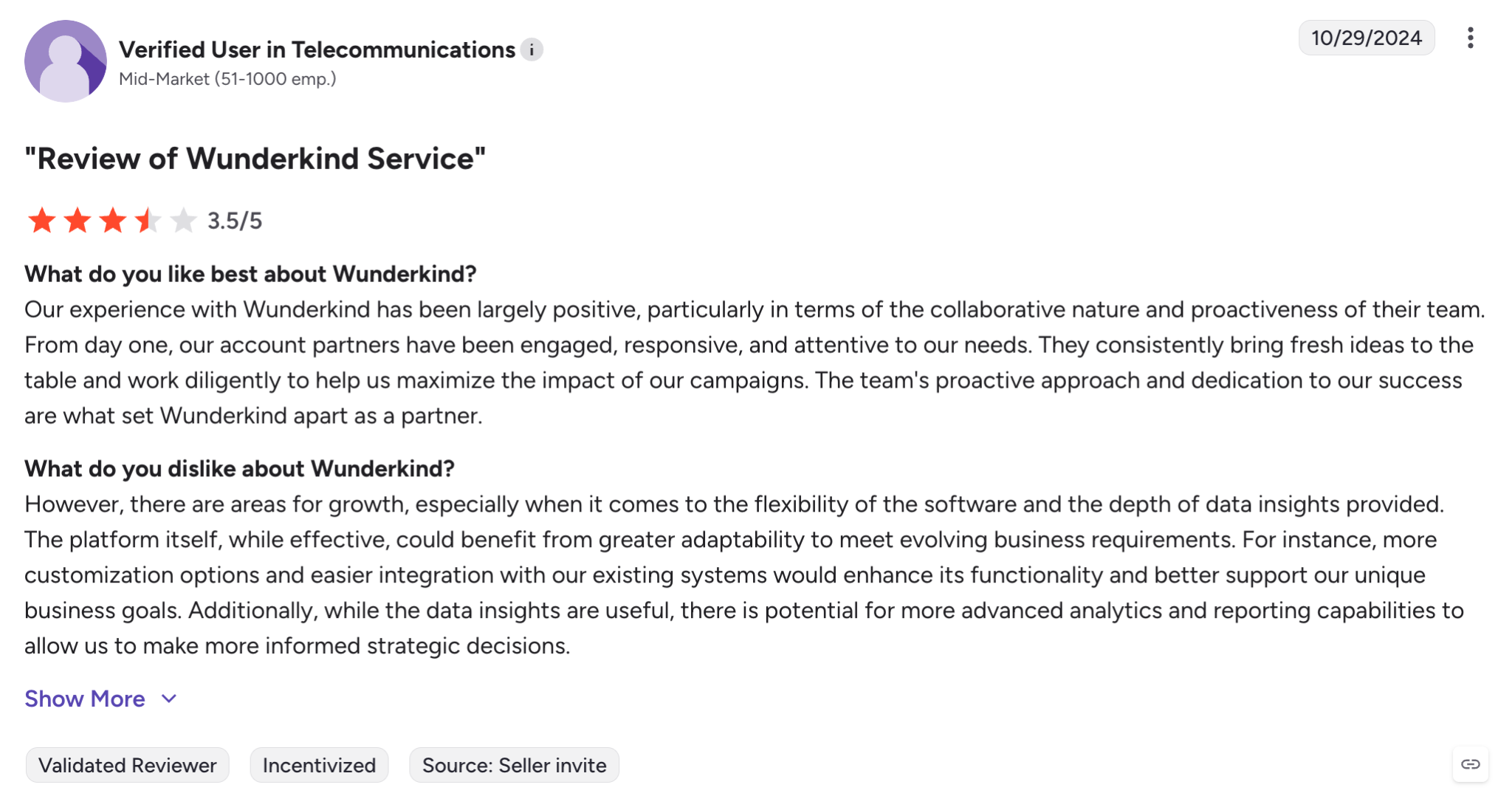
Side-by-side comparison table
The biggest differences between website visitor identification tools usually show up after implementation, when brands start evaluating list quality, data accuracy, deliverability impact, and downstream revenue performance.
Here’s how the leading platforms compare across the areas ecommerce teams care about most.
Want to turn more anonymous traffic into revenue?
The right website visitor identification software depends on what your team wants to improve: faster list growth, stronger deliverability, cleaner attribution, or better lifecycle performance.
Some tools focus mainly on identifying more emails. Others help ecommerce brands understand which shoppers are actually worth activating across email, SMS, retargeting, and paid media workflows.
That’s where Tie stands out.
Tie combines real-time website visitor identification with a shopper intelligence layer built specifically for ecommerce brands. Alongside identity resolution and shopper enrichment, Tie Predict uses AI-powered scoring to identify which shoppers are most likely to open, click, or purchase next based on behavioral, demographic, and cross-session signals your existing stack can’t see on its own.
Those predictive scores sync directly into platforms like Klaviyo, helping retention teams move beyond backward-looking engagement segments and build campaigns around real-time buying intent.
The platform also includes configurable match controls, transparent order-level attribution, deliverability safeguards, and direct integrations with Shopify, Klaviyo, Meta, Google Ads, and major CRM systems. This helps brands scale lifecycle revenue without hurting list quality.
Want to see how much incremental revenue your existing website traffic could generate? Book a demo with Tie.


